
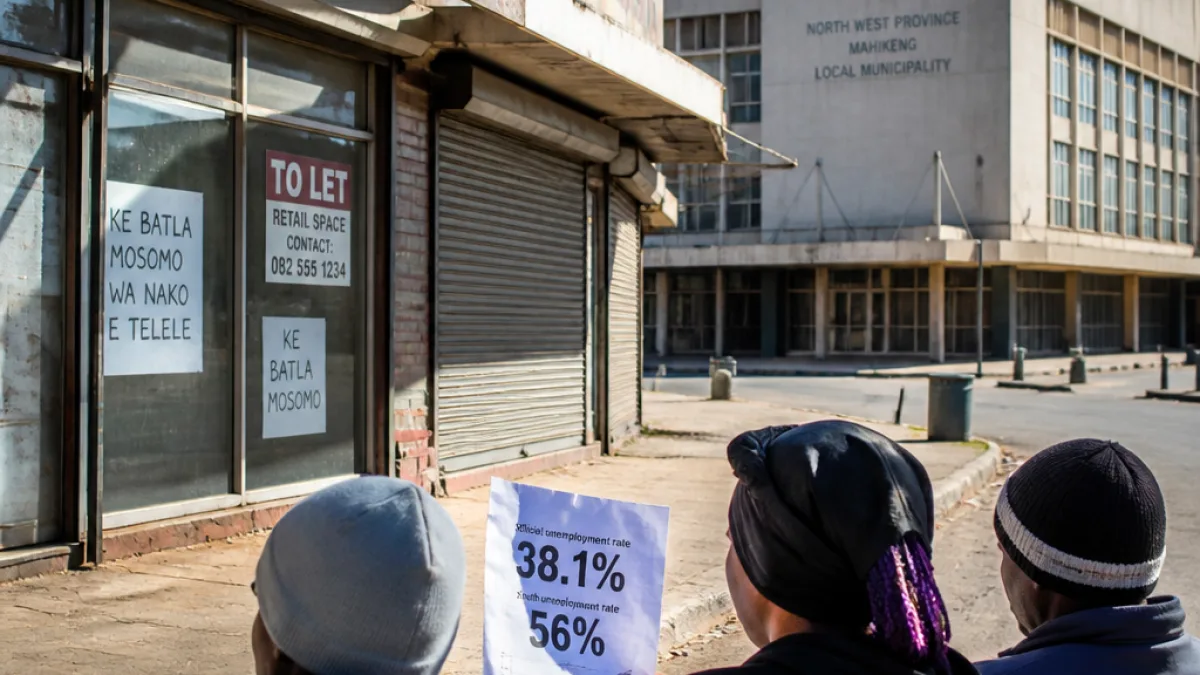
The North West recorded a sharp deterioration in labour-market conditions in the second quarter of 2026, according to figures highlighted in a statement published on Polity by the Democratic Alliance (DA). The province’s official unemployment rate rose to 38.1%, up from 35.3% in the previous quarter — a rise of 2.8 percentage points among the largest quarterly increases nationally.
What the numbers show
Alongside the headline unemployment figure, the statement drew attention to a broader measure of exclusion from the labour market: a combined unemployment and potential labour force rate of 56.0%. That measure includes people who want work but are no longer actively searching or are otherwise classified as part of the potential labour force. The DA said the 56% figure demonstrates that more than half of the province’s potential workforce is effectively locked out of meaningful economic participation.
| Measure | Q1 2026 | Q2 2026 | Change |
|---|---|---|---|
| Official unemployment rate | 35.3% | 38.1% | +2.8 pp |
| Combined unemployment & potential labour force | — | 56.0% | — |
| Jobs lost (quarter) | — | 15,000 | — |
Local impact and immediate concerns
These statistics mark a considerable setback for a province that relies heavily on mining, agriculture and transport links to Gauteng. The DA’s statement warned that the loss of 15,000 jobs in one quarter will translate quickly into reduced household incomes, greater pressure on municipal services and rising demand for social grants.
Observers and residents in towns across the province are likely to feel the effects in multiple ways: fewer customers for local retailers, increased arrears for municipal accounts, and higher levels of food and transport insecurity among working-age households. Municipalities already under financial strain will face extra demand for basic services while their revenue bases shrink.
- Households: reduced income and rising reliance on social grants.
- Municipalities: tighter budgets and higher service delivery pressure.
- Businesses: weaker consumer demand and possible closures.
Political response and accountability
The DA used the labour-force figures to criticise the ruling African National Congress (ANC) in the province, accusing the provincial government of failing to convert the region’s economic potential into sustained jobs. The statement said North West has the natural and economic assets — mining, agriculture, tourism and manufacturing, and proximity to Gauteng — but lacks effective government to unlock opportunity.
"We want a North West where municipalities work, infrastructure supports economic activity, businesses can operate without unnecessary political and bureaucratic obstacles,"
The DA called on provincial authorities to prioritise workable interventions rather than summits and task teams. The party urged measures that would stabilise municipalities, address infrastructure decay and reduce red tape for businesses.
What this means for workers and policy
For workers and those seeking work, the immediate policy priorities are practical and well established: preserving existing jobs, creating routes to employment in labour-absorbing sectors, and maintaining basic services that enable economic activity. In the medium term, government and business will need to align on investment, skills development and infrastructure maintenance to reverse recent losses.
Given the size of the shock in one quarter, provincial and local leaders face pressure to present credible short-term relief plans for households and businesses and medium-term strategies that tackle structural barriers to employment. For unions, civil-society groups and municipal administrations, the numbers will be a call to step up support for affected communities while pressing for clearer accountability from provincial government.
Until concrete plans and measurable results are produced, the figures released for Q2 2026 suggest North West will struggle to regain lost ground — and households across the province will face an increasingly uncertain economic outlook.













