
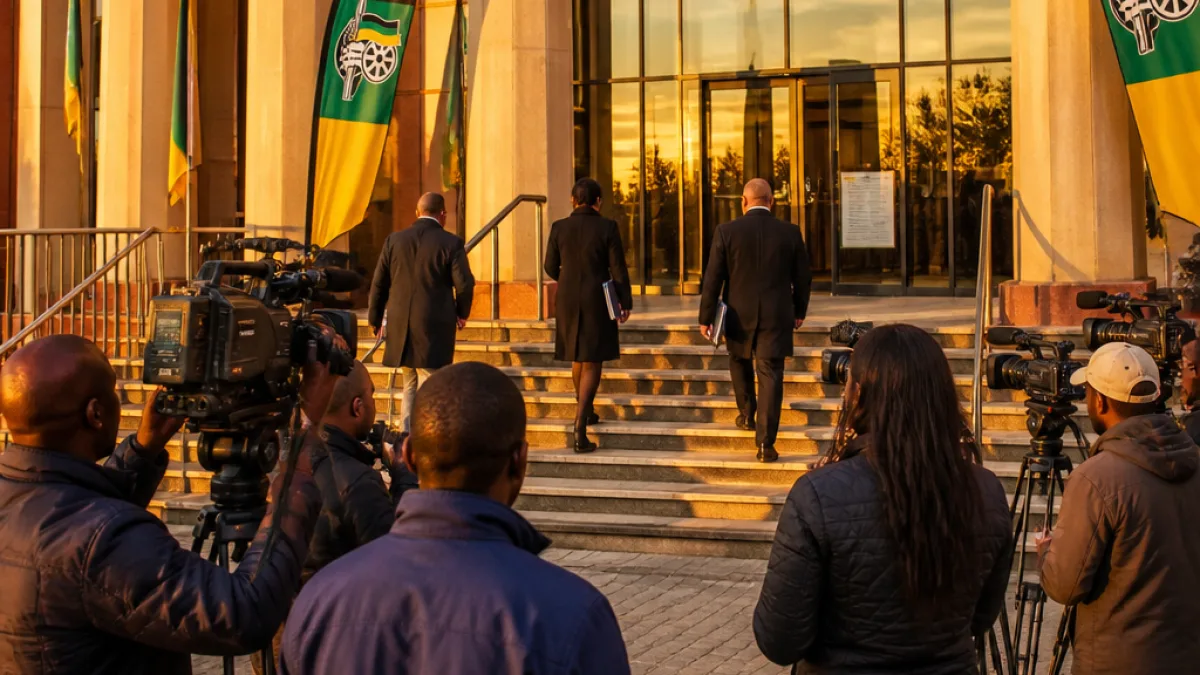
Premier Lazarus Mokgosi announced a reshuffle of the North West provincial executive that moves key members of his cabinet and the provincial legislature into new roles. The ANC in the province says the changes are intended to boost government capacity, but opposition parties have accused the party of settling internal scores.
What changed
The most notable moves include Viola Motsumi being removed as MEC for Education and appointed Speaker of the North West Legislature. Dr Desbo Mohono, the former speaker, takes over the Education portfolio. Wessels Morweng leaves Community Safety and Transport Management to head up Arts, Culture, Sports and Recreation, while Virginia Tlhapi becomes the new MEC for Community Safety and Transport Management.
| Previous role | New role | Office‑holder |
|---|---|---|
| MEC for Education | Speaker, North West Legislature | Viola Motsumi |
| Speaker, North West Legislature | MEC for Education | Dr Desbo Mohono |
| MEC for Community Safety and Transport Management | MEC for Arts, Culture, Sports and Recreation | Wessels Morweng |
| MEC for Community Safety and Transport Management | Virginia Tlhapi |
Premier frames reshuffle as capacity strengthening
Premier Mokgosi told his quarterly address that performance alone was not the only factor that could prompt changes in the executive. He emphasised that decisions were at his discretion and might follow discussion with affected MECs.
“Anybody who is at the behest of the premier, that’s what we should also understand. Now if the premier decides tomorrow that, based on the following, discussed with the respective MEC and agreed upon, I’ve decided to make a change not based on performance. So performance cannot be a determining factor of changing MECs,”
The ANC’s provincial spokesperson Tumelo Maruping framed the moves as a measure to strengthen both the legislature and the provincial executive so they can better serve residents of the North West.
Opposition accuses ANC of factionalism
Opposition parties responded sharply. The Economic Freedom Fighters’ provincial spokesperson Fanon Moema said the reshuffle resembled internal political manoeuvring rather than a plan to tackle service‑delivery failures.
Other opposition critics argued that swapping MECs across portfolios does little to address persistent service delivery problems and may worsen continuity in departments that require specialised leadership.
Background to the controversy
The changes follow months after a video clip that circulated widely on social media during the state of the province address. The footage reportedly captured a private exchange in which Viola Motsumi expressed hostility towards Premier Mokgosi during a conversation with deputy speaker Collen Maine. Motsumi later confirmed to the Guardian newspaper that she had written a letter of apology to ANC provincial secretary Louis Diremelo, the ANC and the public.
While the premier rejected suggestions that the reshuffle was a response to poor performance, the timing and the personnel choices have fuelled debate about whether the moves aim to restore functionality or settle factional disputes within the provincial ANC.
Practical implications for departments and residents
Education, community safety and transport are high‑impact portfolios whose leadership changes are likely to affect policy direction and delivery projects in the short term. Observers and stakeholders will watch whether the new Education MEC, Dr Desbo Mohono, maintains or alters existing plans on school infrastructure, learner transport and matric support programmes.
- Education leadership now held by Dr Desbo Mohono; continuity of major projects will be tested.
- Community Safety and Transport Management moves to Virginia Tlhapi amid ongoing road safety and policing coordination challenges.
- Arts, Culture, Sports and Recreation under Wessels Morweng will inherit programmes often linked to youth development and community cohesion.
What to watch next
The reshuffle places pressure on the ANC provincial leadership to demonstrate improved delivery and to show that the changes were made for governance reasons rather than factional advantage. Stakeholders in education, law enforcement and transport will be monitoring budget allocations, appointments of senior departmental officials, and the pace at which policy decisions are taken.
Political analysts and civil society organisations are likely to probe whether the reshuffle stabilises the provincial government or deepens factional tensions ahead of future party processes. For residents, the measure of success will be tangible improvements in basic services, schools and community safety rather than political realignment.
As the province adjusts to the new line‑up, municipal leaders, unions and community groups will be important interlocutors for the incoming MECs. The administration’s next reports and the premier’s follow‑up statements will be critical in shaping public perception of the reshuffle’s purpose and effect.













