
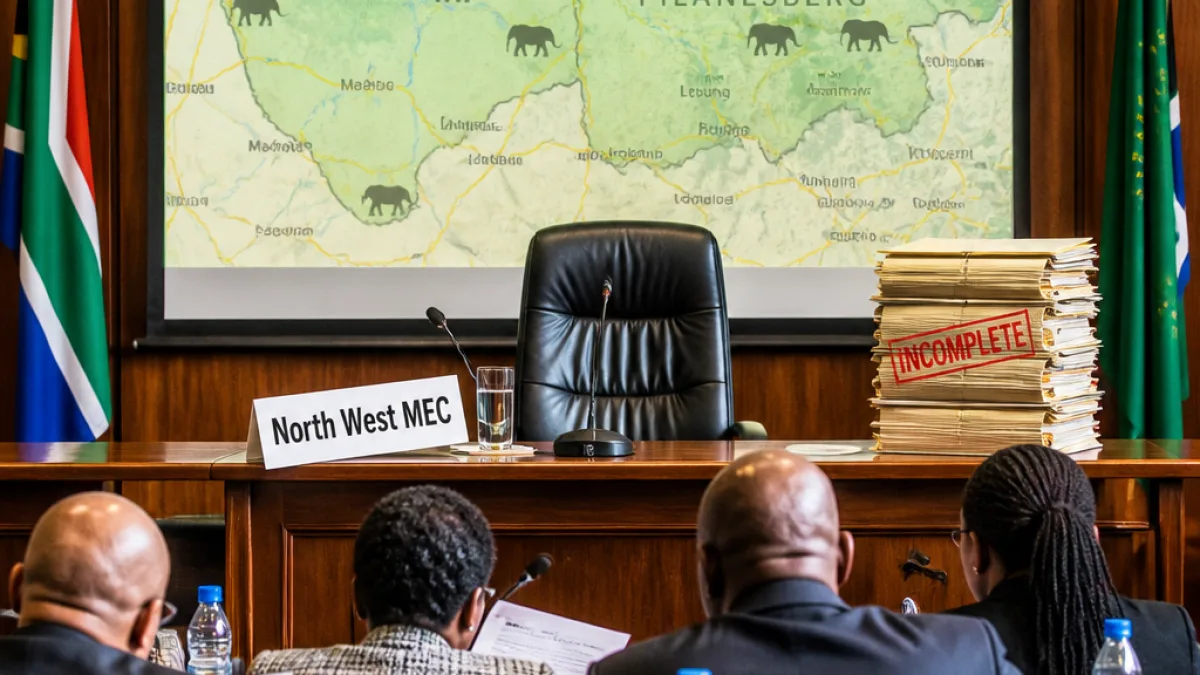
The North West provincial government again failed to provide full parliamentary oversight of its controversial elephant management proposals when MEC Bitsa Lenkopane did not appear before Parliament’s committee on forestry, fisheries and the environment on 11 August.
Officials from the North West department and representatives from North West Parks presented to MPs, but committee members complained the province had submitted incomplete documentation and withheld key reports, hampering effective scrutiny.
Parliamentary oversight undermined, MPs say
Committee chairperson Nqabisa Gantsho said several undertakings from a prior meeting had not been honoured. He criticised the absence of written responses and requested documents, including details on concession agreements, land claims, employee ownership and transformation statistics, and the final Provincial Elephant Task Team (PETT) report.
“Most of these reports from the department have still not been submitted to Parliament, which cripples and undermines the work of Parliament.”
The absence of the MEC was not new. Democratic Alliance MP Andrew de Blocq reminded the committee that Lenkopane had missed a previous meeting on the issue and said the repeated no-shows had delayed parliamentary scrutiny.
“It’s the second week in a row that we’ve been pushed out by the MEC,”
With the MEC absent, MPs received a presentation based on a provincial task team report they had not been provided. The committee was not given costs or firm timelines for the proposals.
Scope of the plan and remaining questions
The options outlined by provincial officials for managing elephant numbers in Madikwe and Pilanesberg include translocation, contraception, hunting, and lethal removal. A scenario presented to MPs suggested that nearly 1,000 elephants could be removed from Madikwe over a five-year period under the provincial plan.
Parliamentarians and observers have warned that the scale of the proposed interventions makes full disclosure and independent oversight essential. Yet the PETT report, which apparently underpins the strategy, had not been circulated to the committee and the report’s conclusions were not provided during the presentation.
Impacts and unanswered issues for communities and conservation
The lack of clarity on costs, timeframes and the legal basis for some interventions raises questions for affected communities, conservation bodies and workers engaged in park operations. MPs had asked for information on concession agreements and land claims—areas that can directly affect local livelihoods and empowerment arrangements such as employee ownership and transformation.
Without the requested documentation, the committee cannot properly scrutinise how the province plans to balance animal welfare, ecological considerations, community rights and economic interests. Animal welfare organisations and conservationists have previously signalled concern about any approach that involves lethal removal at scale.
What is known: options on the table
- Translocation: Moving elephants to other areas, with logistical and financial costs.
- Contraception: Population control through reproductive management.
- Hunting: Retained as a potential intervention, though controversial.
- Lethal removal: Includes culling to reduce numbers; the plan suggests this could be applied at scale.
| Option | Implications |
|---|---|
| Translocation | High transport/logistics cost; requires receptor sites |
| Contraception | Long-term management; requires veterinary capacity |
| Hunting | Controversial; raises ethical and regulatory questions |
| Lethal removal | Immediate reduction in numbers; high welfare and reputational risks |
These broad implications were discussed at the parliamentary meeting, but without the PETT report and accompanying financial and legal detail, MPs said they lacked the material needed to test the province’s claims and to propose safeguards for communities and conservation workers.
Calls for transparency and next steps
Parliamentary members have demanded the outstanding documents and urged that the MEC make herself available to answer questions in person. The committee will need those materials to set costs, timelines and measurable conditions should it assess the provincial plan further.
For communities and those working in the parks, the immediate need is clarity: what interventions will be used, who will pay, and what mechanisms will protect jobs, transformation commitments and community rights where concessions or land claims exist. The failure so far to provide that information has deepened mistrust between Parliament and the provincial department.
As the debate continues, stakeholders and the public will be watching to see whether the North West will submit the requested reports and engage fully with parliamentary oversight—or whether decisions about the future of Madikwe and Pilanesberg elephants will proceed without the transparency many say is required.
Photo credit: NSPCA (image circulated with provincial discussions).













