
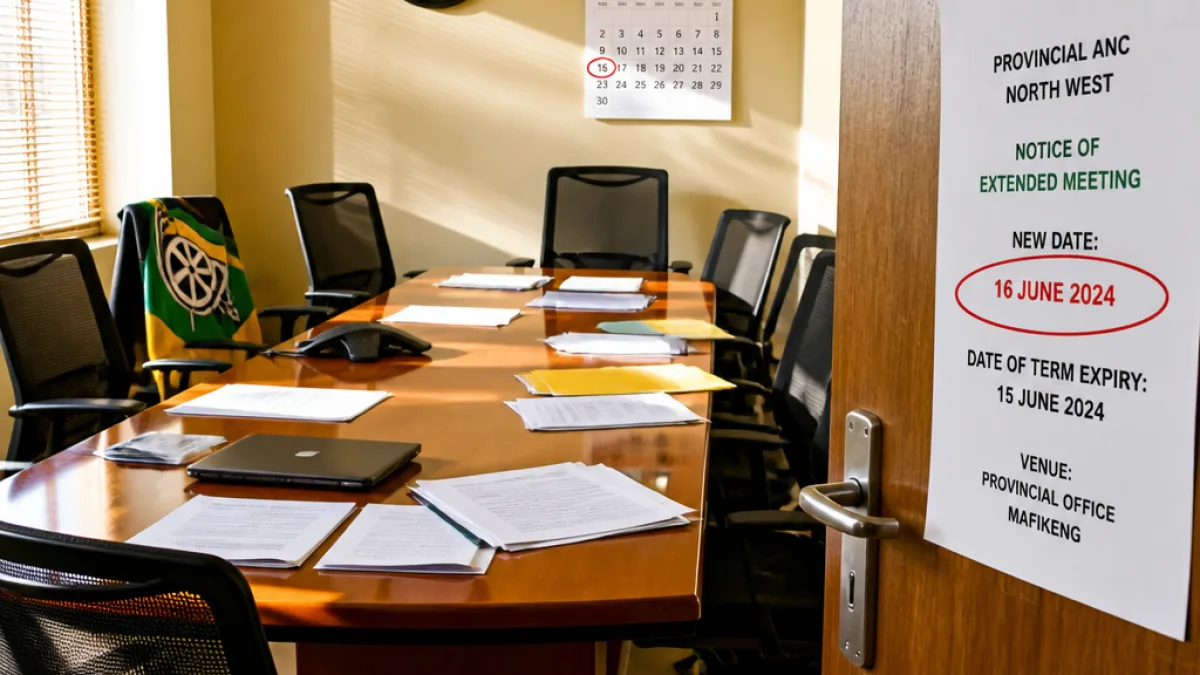
The North West African National Congress (ANC) has plunged into a fraught constitutional moment after its provincial executive committee (PEC) set, then postponed, an "extended" meeting to a date that falls a day after the PEC's four‑year term of office officially expires.
Timing raises legal and political questions
Photographs and a listing of the PEC published with reporting identify the provincial leadership as Nono Maloyi (chairperson), Lazzy Mokgosi (deputy chairperson), Louis Diremelo (secretary), Viola Motsumi (deputy secretary) and Sello Lehari (treasurer). The PEC initially called an extended meeting that would occur after the end of its four‑year term, but later postponed it.
The move has sparked immediate debate within the province about whether any decisions taken at a meeting held after the PEC’s term would be valid under the ANC's rules and South Africa's broader constitutional and governance frameworks. If a provincial structure acts beyond its mandate, questions arise about the legal force of its resolutions and the possible need for intervention by the ANC’s national leadership.
What this means locally
For communities and branch members in the North West, the dispute is more than procedural. Provincial leadership controls deployment decisions, candidate slates for local government and provincial elections, and influences service delivery priorities. Uncertainty at the PEC level can stall decisions on appointments, funding allocations and mobilisation efforts ahead of crucial electoral timelines.
Mineworkers, municipal employees and public servants who rely on predictable governance in the province may see the fallout if the stalemate persists. Political contestation at provincial level often filters down into service delivery and municipal administration, particularly in a province where local governance challenges are already acute.
Possible next steps and options
There are a number of paths that national party structures or provincial actors might pursue, depending on internal contestation and legal advice:
- National executive intervention: the ANC's national leadership could be asked to clarify the status of the PEC and, if necessary, appoint an interim structure to manage provincial affairs.
- Internal dispute mechanisms: party disciplinary and electoral committees may be engaged to determine whether the postponed meeting violates party rules.
- Legal challenge: stakeholders could seek a court declaration on the validity of any decisions taken after the expiry of the PEC's term.
At this stage there is no publicly reported confirmation of which — if any — of these courses will be taken.
PEC membership
| Position | Name |
|---|---|
| Chairperson | Nono Maloyi |
| Deputy Chairperson | Lazzy Mokgosi |
| Secretary | Louis Diremelo |
| Deputy Secretary | Viola Motsumi |
| Treasurer | Sello Lehari |
Why procedural timing matters
Political parties function on mandates and mandates define authority. When a leadership’s term lapses, its capacity to make binding decisions is weakened unless the party constitution or subsequent resolutions provide for continuity. That legal ambiguity can become acute when a leadership appears to schedule meetings that would extend their own mandate, even if the meeting is later postponed.
Outside observers and party members will be watching whether the postponement resolves the issue or merely delays a confrontation over legitimacy. The matter could affect candidate selection processes and coalition manoeuvring ahead of the 2026 local government elections cycle planning.
What residents should watch for
Locally, residents and political stakeholders should follow developments on three fronts:
- Whether the North West PEC reconvenes within its mandate or re‑schedules in a manner compliant with party rules.
- Any formal pronouncements from the ANC's national leadership on the PEC's status.
- Legal steps by members or rival factions seeking clarity from the courts or internal party bodies.
"The timing of the scheduled meeting — and its postponement — has opened questions about the continued authority of the provincial executive committee," the reporting said.
The coming days are likely to determine whether this develops into a short internal dispute resolved within the party, or a longer constitutional controversy that draws in national structures and, potentially, the courts.
Reporting identified the PEC figures above and noted the initial plan and subsequent postponement; no further official statements from the provincial or national ANC were reported at the time of publication.
(Kagiso Seopa is the North West correspondent.)













