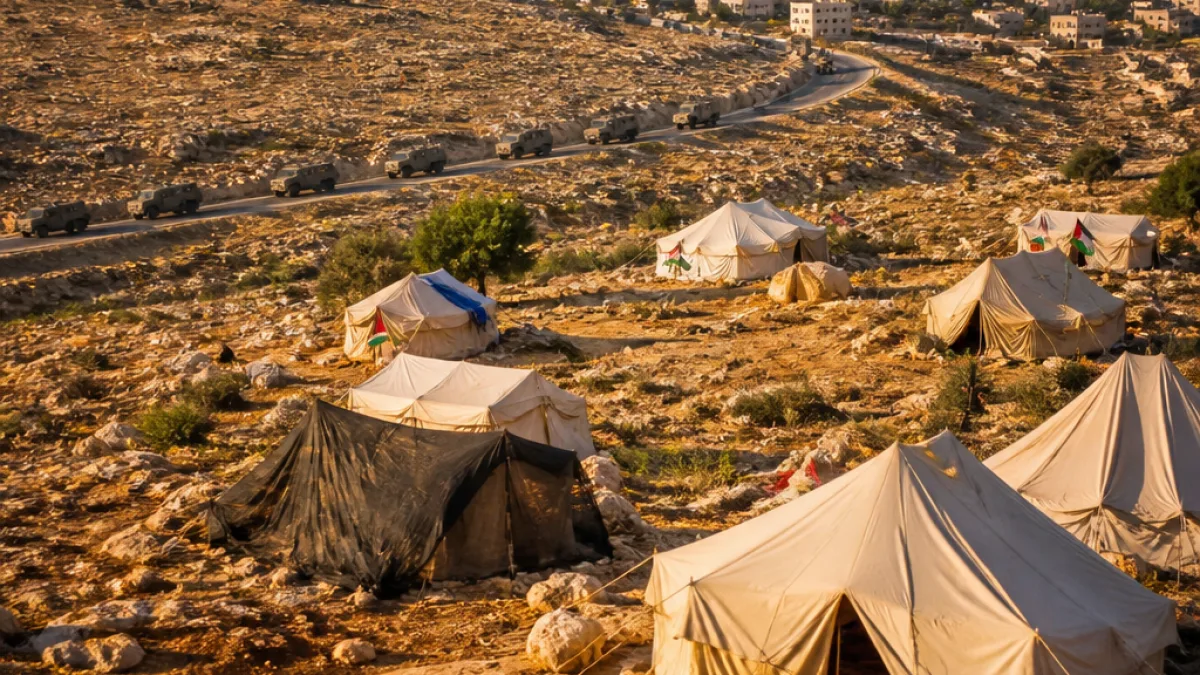
Settler tents pitched near Umm Safa as tensions across West Bank escalate
Illegal Israeli settlers have established tents to create a new outpost in the Wadi Zeytun area south of Umm Safa, north-west of Ramallah, Palestinian authorities reported. If the encampment becomes permanent it will be the sixth outpost encircling the village.
The move comes amid a sustained campaign of settlement expansion and military operations across the occupied West Bank. Palestinian institutions say settlers have founded roughly 200 outposts in the 1,000 days since Israel began its military campaign in Gaza in October 2023.
According to the Palestinian Colonisation and Wall Resistance Commission, about 750,000 Israeli settlers now live in the West Bank and occupied East Jerusalem in 156 settlements and 360 illegal outposts. The United Nations regards settlements in the occupied territories as illegal under international law.
Local officials also described related incidents across the Ramallah and Nablus districts, where military raids and settler actions have increased in recent days. Authorities reported that another outpost was set up in the village of Burqa, near Ramallah.
In the Nablus area, authorities said an eight-day siege is under way on three families in Qusra, south of the city. Qusra Mayor Abdul Azim Wadi said the Israeli military had converted a residential building on Ras al‑Ain mountain into a temporary barracks, creating persistent security risks and repeated harassment alongside settler attacks.
Elsewhere in Ramallah district, reports detail a sequence of military actions: troops raided Al‑Mughayyir, firing what were described as toxic tear gas into homes and prompting cases of suffocation; checkpoints were erected; and troops entered Beit Liqya to deliver stop‑work and demolition orders to several homeowners.
In the south of the West Bank, Israeli forces and settlers reportedly raided Wadi Ajheish, detaining five Palestinians — including four members of one family — and confiscating a vehicle and work tools. In Masafer Yatta authorities issued demolition notices for residential caves in Khallet al‑Dabaa, while settler movements in Wadi al‑Rakhim allegedly drove livestock into inhabited areas and forced farmers off their land.
“Settler groups set up tents in the Wadi Zeytun area south of Umm Safa village to seize Palestinian land,” reported the Palestinian official news agency Wafa.
Medical personnel were also affected. The Jerusalem Governorate said an assault by Israeli forces left a Palestinian doctor injured east of Bethlehem. Authorities named the doctor as Majid Aliyan Dweikat, saying he was attacked by settlers and Israeli forces.
- New outpost: tents erected south of Umm Safa, Wadi Zeytun area.
- Regional trend: 200 outposts established since October 2023, according to Palestinian authorities.
- Settler population: some 750,000 in 156 settlements and 360 outposts across West Bank and East Jerusalem.
| Item | Figure |
|---|---|
| New outposts since Oct 2023 | 200 |
| Days since Oct 2023 | 1,000 |
| Settler population (approx.) | 750,000 |
| Settlements | 156 |
| Illegal outposts | 360 |
The developments form part of a pattern of land appropriation and heightened military presence that Palestinian officials link to broader pressures on communities across the territory. The reported combination of new outposts, raids, detentions and demolition notices has renewed concerns about safety, access to farmland and freedom of movement for residents.
International bodies consider Israeli settlement activity in occupied territory unlawful; the figures cited by Palestinian bodies underline the scale of population dispersal and infrastructure expansion in the West Bank and occupied East Jerusalem since October 2023.
For communities such as Umm Safa and Burqa, the immediate consequences are practical and tangible: loss of access to land, increased checkpoints and the threat of further encroachment. Municipal authorities and human rights organisations monitoring the area have been documenting the changes and their effects on civilians.
As tensions continue to mount, residents and local leaders say they face daily disruptions to livelihoods, schooling and medical access. The reported incidents across Ramallah, Nablus, Hebron and Bethlehem districts illustrate a wider pattern of pressure on Palestinian villages that local officials describe as systematic.
International and regional responses were not detailed in the reports, and no statements from Israeli authorities were included in the accounts referenced by Palestinian sources.