
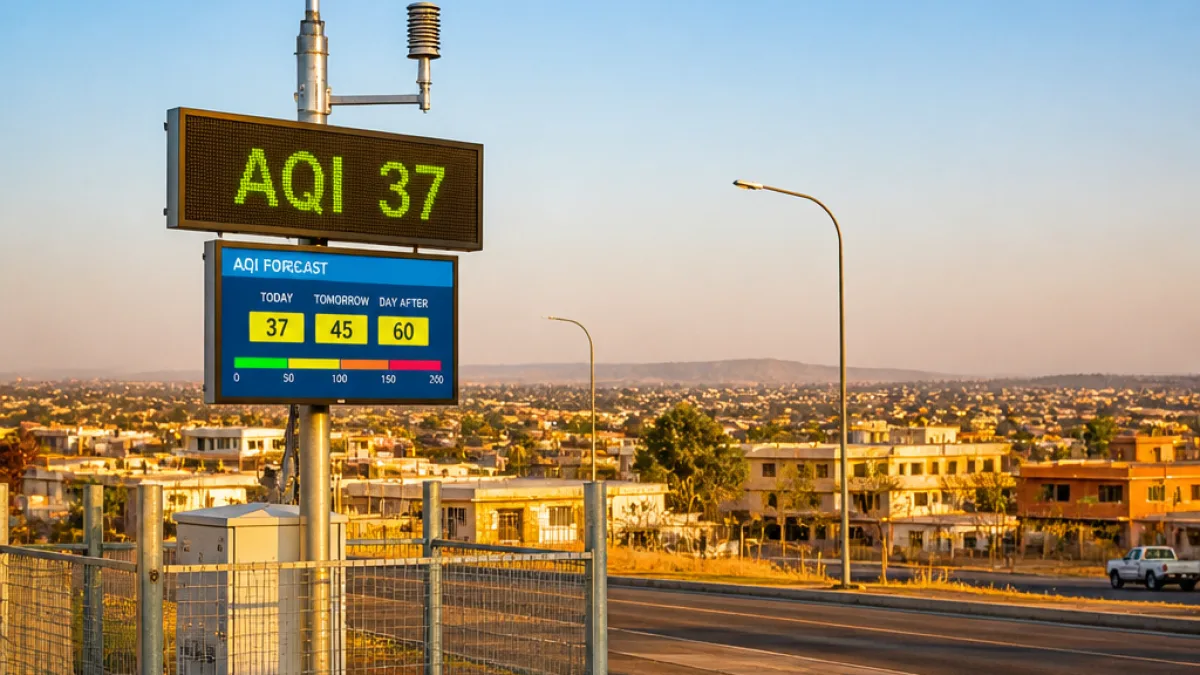
Musina’s current air quality and short-term outlook
Real-time air-pollution monitoring by IQAir places Musina at an AQI (Air Quality Index) of 37, a level classified as good, according to the platform’s latest report. The site also notes that fine particulate matter (PM2.5) concentration in Musina is 1.3 times the World Health Organization annual PM2.5 guideline value, a detail that carries importance for residents with long-term exposure risks.
What the coming days look like
Hourly and daily forecasts published by IQAir show a short-term deterioration in air quality over the next two days. Weather parameters issued alongside the AQI indicate changes in temperature, wind speed and humidity that can influence pollutant dispersion.
| Day | AQI | Temperature (max°/min°) | Wind (km/h) | Humidity |
|---|---|---|---|---|
| Today | 37 | 25° / 18° | 34 | 61% |
| Monday | 60 | 27° / 17° | 31 | 57% |
| Tuesday | 55 | 30° / 18° | 22 | 45% |
How to interpret the numbers
IQAir’s AQI categorisation places values below 50 in the good band, indicating little or no risk to the general population from short-term exposure. However, the site also highlights PM2.5’s relation to long-term health guidance. As IQAir reported,
"PM2.5 concentration is currently 1.3 times the World Health Organization annual PM2.5 guideline value."
This means that although hourly AQI is presently low, annual-average PM2.5 exposure may be above the WHO recommended limit. Long-term exposure to elevated PM2.5 is linked internationally to increased risks of respiratory and cardiovascular disease, particularly among the elderly, young children, and people with chronic conditions. IQAir’s data therefore suggests residents should be mindful of cumulative exposure.
Local context and what residents should do
Musina is part of a wider Limpopo monitoring picture in which nearby towns show varied air quality. IQAir’s South Africa city ranking placed Polokwane at an AQI of 60 and Thabazimbi at 39 at the time of the report. Local meteorology — including wind speed and direction — plays a strong role in whether pollutants disperse or concentrate.
- People with asthma, chronic lung disease, heart disease, older people and children should consider limiting prolonged outdoor exertion when AQI reaches the moderate range (around 50–100).
- On days when AQI is forecast to rise (IQAir shows Monday and Tuesday at higher levels), reduce outdoor exercise intensity and avoid high-traffic routes where possible.
- Keep windows closed during early morning and evening when particle concentrations can be higher, and use indoor air circulation or filtration if available.
Local employers with outdoor workers should consider adjusting schedules on days when IQAir forecasts moderate AQI. Municipal and health authorities can use the forecast window to inform outreach to clinics and community centres.
Monitoring and staying informed
IQAir’s platform provides hourly updates and historic graphs for Musina; the report noted a historic reading of AQI 37 as recently as 23:00–00:00 on 19 September. Residents can consult the IQAir website for live readings and short-term forecasts, and should follow local health advisories issued by Limpopo health authorities for guidance tailored to local conditions.
While Musina’s current air quality is favourable for most people, the combination of a PM2.5 measure above the WHO annual guideline and forecasts of higher AQI on coming days suggests prudence for sensitive groups and those who work outdoors. Continued monitoring and simple protective actions can reduce health risks while local stakeholders consider longer-term air-quality management strategies.