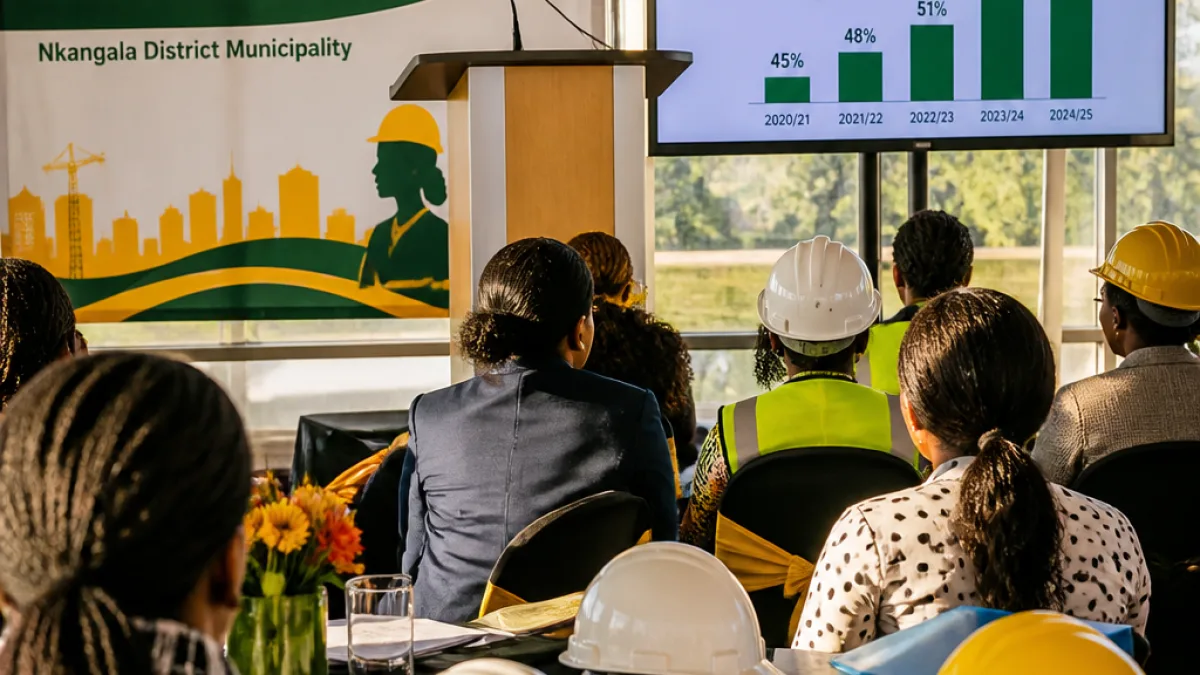
MPUMALANGA — The provincial Department of Public Works, Roads and Transport has reported a notable rise in the proportion of contracts awarded to women-owned enterprises, the department’s political head said on Friday at a Women in Construction Dialogue held in the Nkangala District Municipality.
Progress measured but participation still low
Mpumalanga MEC for Public Works, Roads and Transport, Thulasizwe Simon Thomo, said the department increased the share of contracts going to businesses owned by women to 57% during the first quarter of the 2026/27 financial year, up from 45% in 2025/26. He described the change as measurable progress while stressing that overall female participation in the construction industry remains disproportionally low.
“Construction is one of the largest contributors to economic development. It creates employment, stimulates local economies, develops productive assets and unlocks opportunities across the entire value chain,”
Thomo said the province had to look beyond policy statements, pointing to persistent structural obstacles that prevent many women from fully participating in the sector.
Barriers identified
According to the MEC, the main constraints hampering women-owned firms include limited access to finance, restricted procurement opportunities, gaps in technical skills, and weak professional networks and leadership representation within the built environment. He warned that legislation and procurement reforms alone are insufficient to deliver transformation.
- Limited access to finance and development funding;
- Insufficient technical and professional skills development for women in construction trades;
- Barriers in procurement systems and limited inclusion in networks and leadership roles.
Thomo urged coordinated and sustained institutional responses that bring government, industry, development finance institutions and women-owned businesses together to design measurable interventions and to monitor implementation.
Institutionalising a provincial platform
The MEC commended the Office of the Premier for institutionalising the Women in Construction Dialogue as an annual provincial forum for policy engagement, accountability and implementation. He said the dialogue shifts the focus of infrastructure delivery beyond kilometres of road or numbers of facilities, to whether government spending actually changes ownership patterns and builds sustainable enterprises.
That framing is important in a province where public infrastructure projects are a significant portion of construction activity and where local procurement can support township and rural small businesses. By tying procurement outcomes to transformation objectives, the province seeks to broaden economic participation among historically disadvantaged groups.
Practical implications for contractors and communities
For women-led bidders in Mpumalanga, the provincial commitments suggest an increased emphasis on improving access to procurement pipelines and on programmes that build the capacity required to deliver on public contracts. For municipal officials and project managers, the MEC’s remarks signal closer scrutiny of procurement decisions and their downstream impact on ownership and job creation.
Thomo described the approach as requiring both political will and technical interventions: aligning procurement targets with skills development, facilitating access to finance and incentivising larger contractors to form meaningful partnerships with women-owned enterprises.
Data snapshot
| Financial year | Share of contracts to women-owned firms |
|---|---|
| 2025/26 | 45% |
| Q1 2026/27 | 57% |
While the numbers presented indicate an improvement in the department’s procurement outcomes, the MEC acknowledged that further work is needed to ensure those contracts translate into sustained business growth and employment for women across the construction value chain.
What to watch
Key indicators to monitor in the coming months will include whether the increased contract share is sustained across the full financial year, whether value and scope of contracts awarded to women-owned firms rise, and whether complementary measures — such as skills training, access to bridging finance and mentorship — are rolled out as part of procurement packages.
Thomo’s address underlined the provincial government’s intention to treat infrastructure delivery as an instrument of economic transformation, not only an operational activity. Realising that ambition will depend on continued policy oversight, institutional collaboration and targeted programmes that address the structural barriers he outlined.
Reporting on the Women in Construction Dialogue suggests the provincial commitment to gender-responsive procurement will remain a focal point for government, industry stakeholders and communities dependent on public contracts for local economic development.