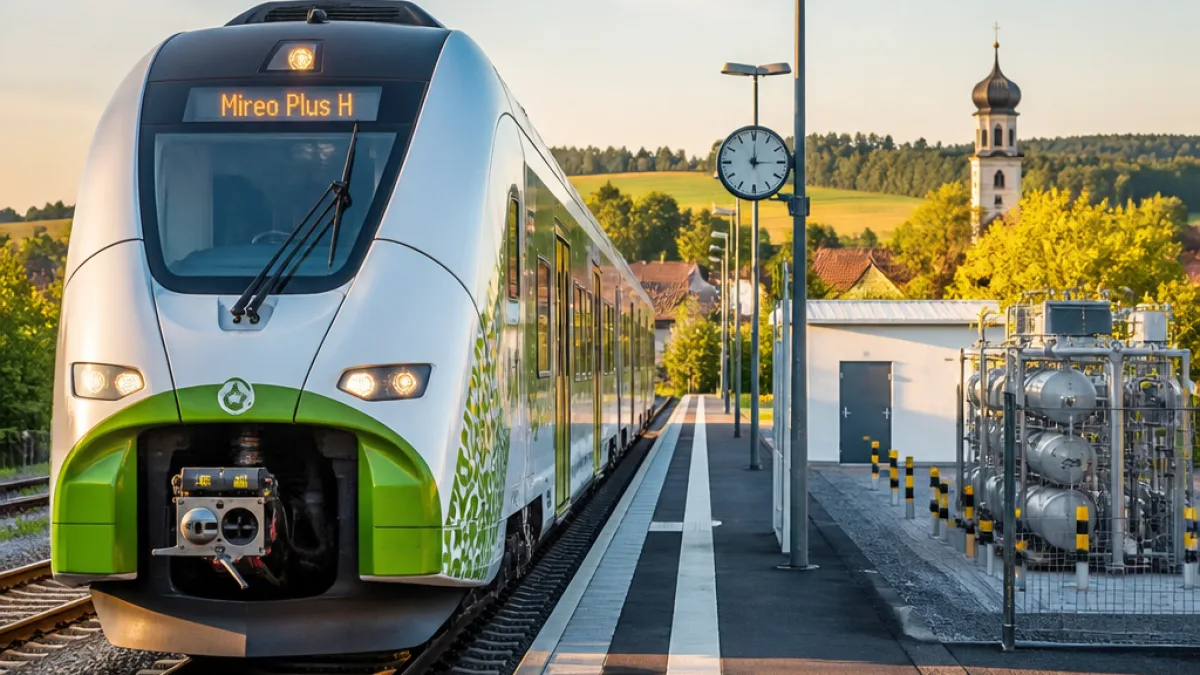
Mühldorf, Bavaria — Siemens Mobility and regional operator Südostbayernbahn (SOB) presented the first hydrogen-powered Mireo Plus H units for regular passenger service in Bavaria, the companies reported on 8 October 2026. Test and training runs are under way and the three barrier-free trains are due to enter scheduled service on the Mühldorf–Burghausen route from December 2026.
What is being put into service
The trains are the Siemens Mireo Plus H model, fuelled by hydrogen and equipped with fuel cells that produce electricity on board. Siemens Mobility is supplying three vehicles to SOB under the "Mühldorf 2025+ Line Star" transport contract, the Bavarian Railway Company (BEG) having mandated their use as part of regional passenger services planned, financed and overseen on behalf of the Free State of Bavaria.
Funding and infrastructure
The Federal Ministry of Transport is providing targeted support for the project. According to federal authorities, the ministry is contributing €8.2 million to cover the procurement of vehicles, refuelling infrastructure and an electrolyser to produce hydrogen for the trains. The funding follows earlier pilot projects intended to move hydrogen traction from demonstration to everyday operations.
“With the first hydrogen train in regular service, we are demonstrating how the phase-out of diesel on the railways can succeed,” said Christoph Kraller, Deutsche Bahn's representative for the Free State of Bavaria, according to the reporting. “These trains not only save CO2, they are also quieter than conventional diesel trains.”
Ulrich Lange, Parliamentary State Secretary at the Federal Ministry of Transport, described the deployment as an example of transferring innovation into regular operation and said the ministry had supported the operator as part of efforts to accelerate climate-friendly mobility.
Expected benefits and local impacts
Project backers emphasise three practical advantages of hydrogen traction for regional lines that are not electrified:
- Lower local emissions: fuel-cell trains emit only water vapour at the point of use, reducing local air pollution compared with diesel traction.
- Noise reduction: hydrogen trains are reported to be quieter than conventional diesel units, offering immediate benefits for passengers and residents close to rail corridors.
- Operational option for non-electrified lines: hydrogen traction provides a decarbonisation pathway where installing overhead electrification may be costly or logistically complex.
What remains to be seen
While the vehicles are now in training and acceptance runs, routine service performance will determine whether hydrogen traction is competitive and reliable in everyday regional operations. The project includes on-site refuelling infrastructure and an electrolyser; the clean credentials of hydrogen depend on how the hydrogen is produced and the entire chain of supply and maintenance.
| Stakeholder | Role |
|---|---|
| Siemens Mobility | Manufacturer and supplier of Mireo Plus H trains |
| Südostbayernbahn (SOB) | Operator; will run trains on Mühldorf–Burghausen route |
| Bavarian Railway Company (BEG) | Planner, financier and overseer of regional rail on behalf of Bavaria |
| Federal Ministry of Transport | Provided targeted funding (electrolyser, vehicles, refuelling infrastructure) |
Context and wider relevance
The Mireo Plus H roll-out follows pilot and demonstration projects elsewhere in Europe that tested hydrogen traction as an alternative to diesel on unelectrified routes. Proponents argue hydrogen trains can help achieve rail decarbonisation without the time and cost of installing overhead wiring on less busy lines. Critics and analysts point out that the environmental benefit depends heavily on the method of hydrogen production and the availability of reliable, cost-effective refuelling logistics.
For passengers on the Mühldorf–Burghausen line the immediate changes will be quieter travel and the appearance of modern, barrier-free rolling stock carrying hydrogen fuel cells rather than diesel engines. For local authorities and residents, the project brings investment in refuelling infrastructure and an early example of a zero-emission option for regional transport.
Operational timetables and further technical details of the trains’ performance will be published as the vehicles move from testing into regular service in December 2026, the companies reported.
Reporting note: this article is based on the presentation and reporting by Siemens Mobility, Südostbayernbahn and federal and state representatives, as cited in the project's public statements.