Gauteng’s water crisis has moved beyond service-delivery frustration and into the territory of a broad human rights concern, according to the South African Human Rights Commission (SAHRC). The warning came as residents in parts of Johannesburg continued to endure lengthy dry taps and Rand Water announced further disruptions affecting municipalities across the province.
The commission released its long-awaited report on the province’s water and sanitation problems on 2 November, following hearings held from 19 to 21 May. The inquiry included eight water services authorities and examined whether households and communities were receiving safe and reliable access to one of life’s most basic necessities.
“Water is the lifeblood of human existence. Where there’s no water, there is no life,” said SAHRC commissioner Henk Boshoff.
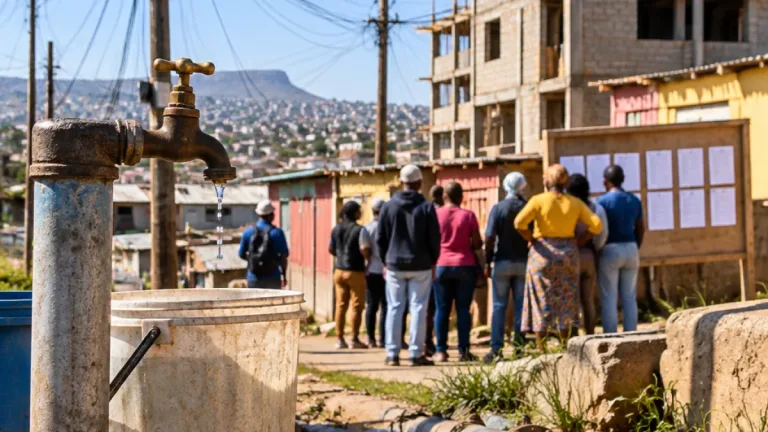
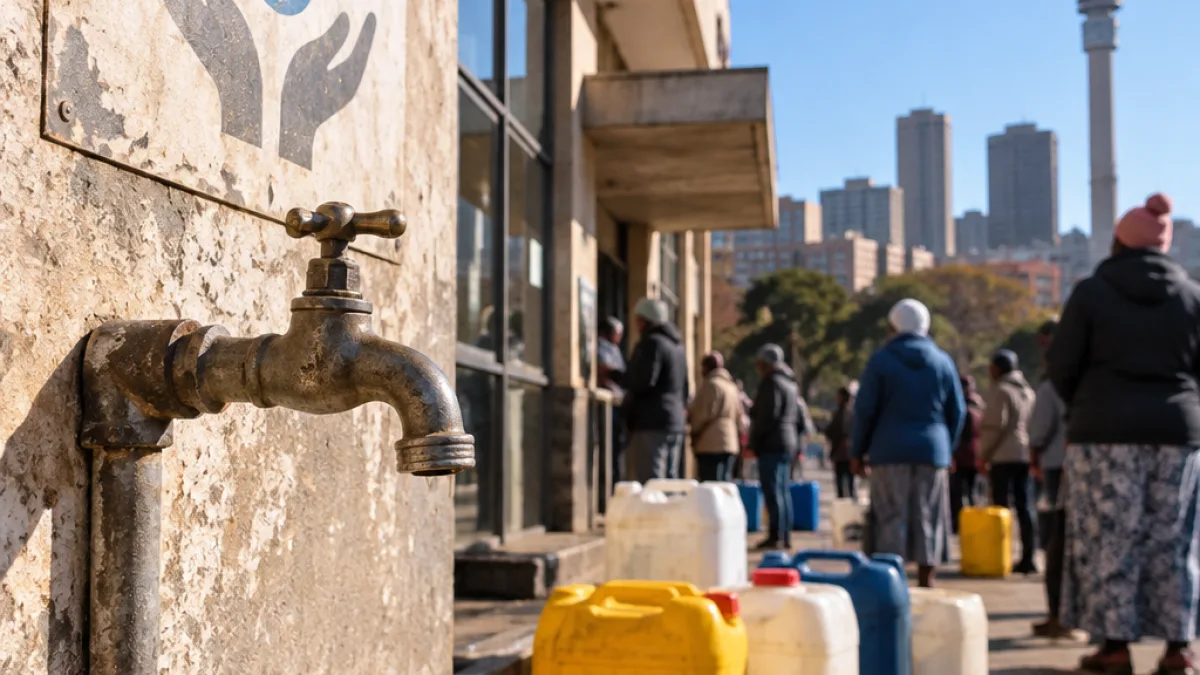
The report’s publication coincided with a protest at Johannesburg Water’s Newtown offices. Residents from Parktown West and surrounding areas gathered to raise their anger over water outages that had lasted for as long as 12 weeks in some households.
For people living through extended interruptions, the crisis is not an abstract policy dispute. It affects household routines, sanitation and the ability to rely on municipal infrastructure for a service that should be available every day. The timing of the protest, on the same day the commission’s findings were made public, underlined the distance between official assurances and the experience of residents at the tap.
New disruption hits three Gauteng municipalities
Less than a day after the report was released, Rand Water announced widespread supply problems in Ekurhuleni, Tshwane and Lesedi. The interruptions were linked to a power failure in the East Rand that affected the bulk water utility’s Mapleton Pumping Station.
Rand Water spokesperson Makenosi Maroo said the failure to repair a breaker and deal with the outage as an emergency had put water supplies at risk. The warning also extended beyond Gauteng to the Mpumalanga municipalities of Govan Mbeki, Victor Khanye and Thembisile Hani, bringing the number of affected municipalities to six.
| Area | Reported issue |
|---|---|
| Johannesburg | Residents in Parktown West and nearby areas reported outages lasting up to 12 weeks. |
| Ekurhuleni, Tshwane and Lesedi | Rand Water warned of supply disruptions after a power outage affected Mapleton Pumping Station. |
| Govan Mbeki, Victor Khanye and Thembisile Hani | Residents were also warned to expect shortages. |
Supply may exist, but access remains unreliable
The SAHRC report highlights a central problem in Gauteng’s water system: assurances that there is enough water at source have not translated into dependable access for people in homes and at communal taps. The Department of Water and Sanitation told the commission that supplies were adequate, but the inquiry found that this did not resolve the failure to provide safe and consistent services.
The commission’s concerns include both municipal authorities responsible for water services and the bulk suppliers that form part of the wider system. That means the crisis cannot be reduced to a single broken pipe or one isolated municipal failure. The fresh Mapleton interruption also showed how closely water delivery is tied to electricity infrastructure and the speed at which faults are repaired.
Boshoff said the situation had deteriorated despite the expectation that municipalities would improve their performance ahead of the local government elections. His assessment was blunt: residents were still without water and conditions had worsened rather than stabilised.
“As we speak, people don’t have access to water. I thought municipalities would beef up their performance in the days before the local government elections. Instead, the opposite happened. Rather than improving, things just went haywire,” Boshoff said.
The latest warnings leave residents in several municipalities facing uncertainty over the reliability of their next supply. In Johannesburg, some communities have already been dealing with prolonged outages. In the East Rand and other affected areas, the immediate pressure is connected to an electrical fault at a key pumping station, while the commission’s report points to a deeper and more persistent failure in the delivery chain.
What the SAHRC inquiry covered
- Hearings were held from 19 to 21 May.
- Eight water services authorities were included in the inquiry.
- The investigation examined Gauteng’s water and sanitation crisis.
- The commission raised concerns about systemic human rights violations and unreliable access to water.
For ordinary residents, the practical measure of the system remains whether water comes out of the tap, whether communal points can be used safely and whether interruptions are resolved within a reasonable period. The commission’s findings suggest that those basic expectations are not being met consistently across Gauteng.
The immediate responsibility now falls on the affected municipalities and bulk water suppliers to address the interruptions identified in the report and in Rand Water’s latest warning. Until the infrastructure and operational failures are resolved, households will continue carrying the cost of a crisis that the SAHRC says has become a province-wide rights issue.