
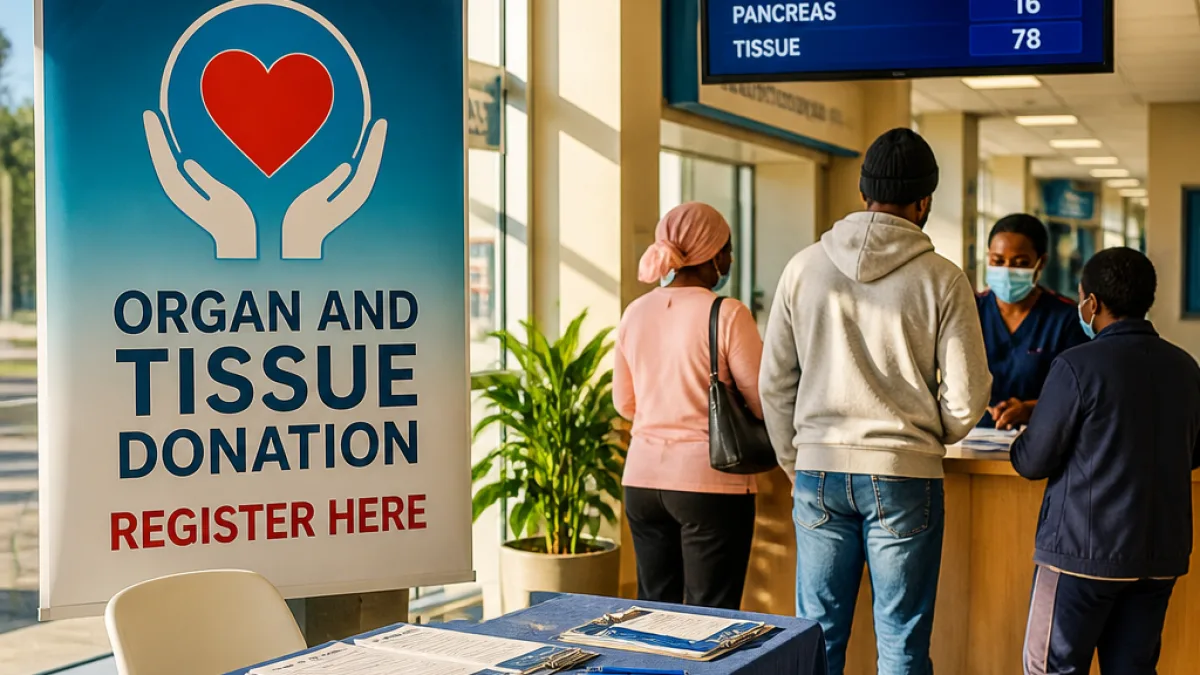
The Gauteng Department of Health (GDoH) has renewed an appeal for communities to register as organ and tissue donors and to speak openly with family members about their wishes, saying greater registration could offer a lifeline to thousands of patients on transplant waiting lists.
High demand, limited supply
Across South Africa, an estimated 6 500 people are waiting for organ and tissue transplants, including children, the department said. In Gauteng alone about 1 100 patients are either waiting for a kidney transplant or are being assessed for placement on a transplant waiting list.
Medical advances have improved transplant outcomes, but the GDoH acknowledged that the supply of donor organs remains well below demand. South Africa performed approximately 317 solid organ transplants in 2024 across public and private sectors. As a consequence, many patients endure lengthy waits for a suitable match and some deteriorate to the point where transplantation is no longer possible.
What can be donated?
The department outlined the range of organs and tissues that can be donated. Organs include the heart, lungs, liver, kidneys and pancreas. Tissue donations can encompass corneas, skin, heart valves, bone, blood vessels and connective tissue. These donations can restore sight, improve mobility and substantially enhance quality of life for recipients.
Importantly, organ donation is not restricted to deceased donors. Living donors may safely donate one kidney or portions of the liver and go on to lead healthy lives. The GDoH said living donation has become a safer option for many patients in need of a transplant.
Human impact
For those on the lists, organ donation is more than a clinical procedure: it is a chance for ordinary life. A transplant may allow a child to grow up with fewer medical restrictions, give a parent more time at home with family, or free a patient from regular dialysis sessions.
The department also noted how sensitive the subject is. Choosing to become an organ or tissue donor is a deeply personal decision and discussing it can be difficult for families. The GDoH therefore emphasised the importance of conversations within households so that loved ones understand a donor’s wishes.
Data snapshot
| Measure | Figure |
|---|---|
| People waiting for organ/tissue transplants in South Africa | 6 500 |
| Patients in Gauteng awaiting or being assessed for kidney transplant | 1 100 |
| Solid organ transplants performed in South Africa (2024) | 317 |
Practical considerations and next steps
The GDoH’s appeal is aimed at boosting registrations and family discussions rather than changing clinical criteria. The department also highlighted living donation as a viable route for many patients requiring kidneys or partial liver transplants.
- Registering as a donor and informing family members of your decision are key steps the department is encouraging.
- Living donation options exist for kidneys and portions of the liver; medical assessments are required to confirm suitability.
- Despite improved transplant outcomes, organ availability remains the main constraint; increased registrations could reduce waiting times.
Healthcare workers and patient groups have long called for greater public awareness about organ and tissue donation. The GDoH’s renewed push seeks to translate awareness into registration and family conversations so that more donors become available when clinical matches arise.
Officials said discussions around organ donation are sensitive and urged community leaders, clinicians and civil society to support conversations that help families prepare. The department did not provide a step-by-step registration link or contact details in its statement; residents wanting to register or learn more should contact their nearest public health facility or the GDoH for guidance.
As Gauteng’s transplant waiting lists persist, the department’s message is straightforward: increased donor registration and clearer family conversations could turn the possibility of a second chance into reality for many patients.











