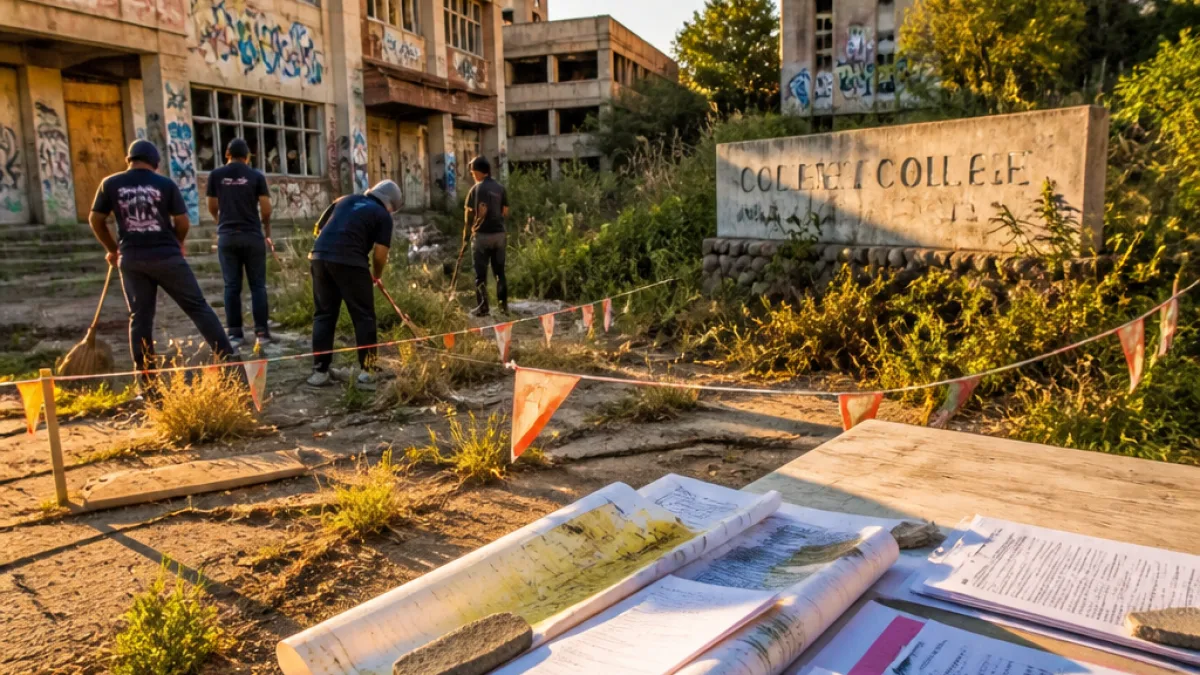
The long-running effort to convert the vandalised Elijah Mango College of Higher Education in KaBokweni into a Fourth Industrial Revolution (4IR) technology hub has made procedural headway, but contradictory accounts from provincial departments expose bureaucratic friction that could stall the project.
History and local concern
Once a teacher-training college and a notable educational institution in the former KaNgwane homeland, the facility was closed in the late 1990s. In the decades since, the campus has suffered severe structural decay, stripping of infrastructure and repeated vandalism. Residents and civic actors, including the KaBokweni Community Movement, have undertaken basic clean-ups while pressing for the site to be put to productive use.
Conflicting departmental timelines
Sources provided to this publication show a mismatch between statements issued by the Department of Public Works, Roads and Transport (DPWRT) and the Office of the Mpumalanga Surveyor-General (SG).
On 22 July, DPWRT spokesperson Bongani Dhlamini said the department was actively redesigning and amending the official cadastral (survey) plan so the college could be created as a distinct land parcel and then registered with the Deeds Office, enabling legal ownership to be granted.
Yet the SG’s office — through the deputy director of communication services at the Department of Land Reform and Rural Development, Zithini Dlamini — has recorded that the diagram amendment had already been completed. The SG’s office updated affected spatial datasets and notified the DPWRT by email on 22 June, a month before DPWRT’s July statement.
"The target for completion of the whole process in terms of the operational plan is 21 working days,"
Dlamini said the formal request for amendment was lodged via email on 18 May and that the request letter was dated 3 November 2025. Dlamini broke down the operational plan into 13 working days for endorsement and rescanning and eight working days for updating the spatial dataset.
| Date | Event |
|---|---|
| 3 November 2025 | Request letter dated for diagram amendment (per SG records) |
| 18 May 2026 | Formal amendment request lodged via email (per SG records) |
| 22 June 2026 | SG notified DPWRT that diagram amendment and dataset updates were completed |
| 22 July 2026 | DPWRT stated it was amending and redesigning the cadastral plan |
Why the cadastral diagram matters
Creating a distinct cadastral parcel is a legal and administrative prerequisite for transferring property, for qualifying a site for specific development funding and for registering ownership with the Deeds Office. Until the land is correctly diagrammed and recorded, the site cannot be formally transferred or declared for a new use without risking legal hurdles or protracted challenges from other claimants.
- Community impact: Residents want the site secured against further vandalism and repurposed to create training and jobs.
- Heritage value: The campus holds historical significance in the former KaNgwane homeland.
- Economic potential: A 4IR hub could support local skills development, small businesses and tourism spillover.
Local reaction and next steps
Community activists have carried out clean-ups and lobbied successive administrations to stop the rot and move the site into productive use. Their efforts reflect wider frustrations about neglected state infrastructure in smaller towns across the province.
Officials indicated two distinct administrative tracks: the technical amendment of the cadastral diagram by the SG’s office, and DPWRT’s internal processes to redesign and register the site once the diagram is in place. The inconsistency in public statements suggests a need for improved interdepartmental coordination and clear communication to the community.
For residents and potential partners watching the project, the key milestone to monitor is formal registration at the Deeds Office. Once that occurs, procurement, refurbishment and partnerships to establish the 4IR hub can proceed with legal certainty.
The transformation of Elijah Mango College holds potential for learning, innovation and local economic stimulus — but only if the departments involved reconcile their timelines and move quickly to secure the site from further decay. I will continue to follow developments in KaBokweni and report on confirmed progress toward registration and redevelopment.
Nomsa Mahlangu
Mpumalanga correspondent (Mbombela)