
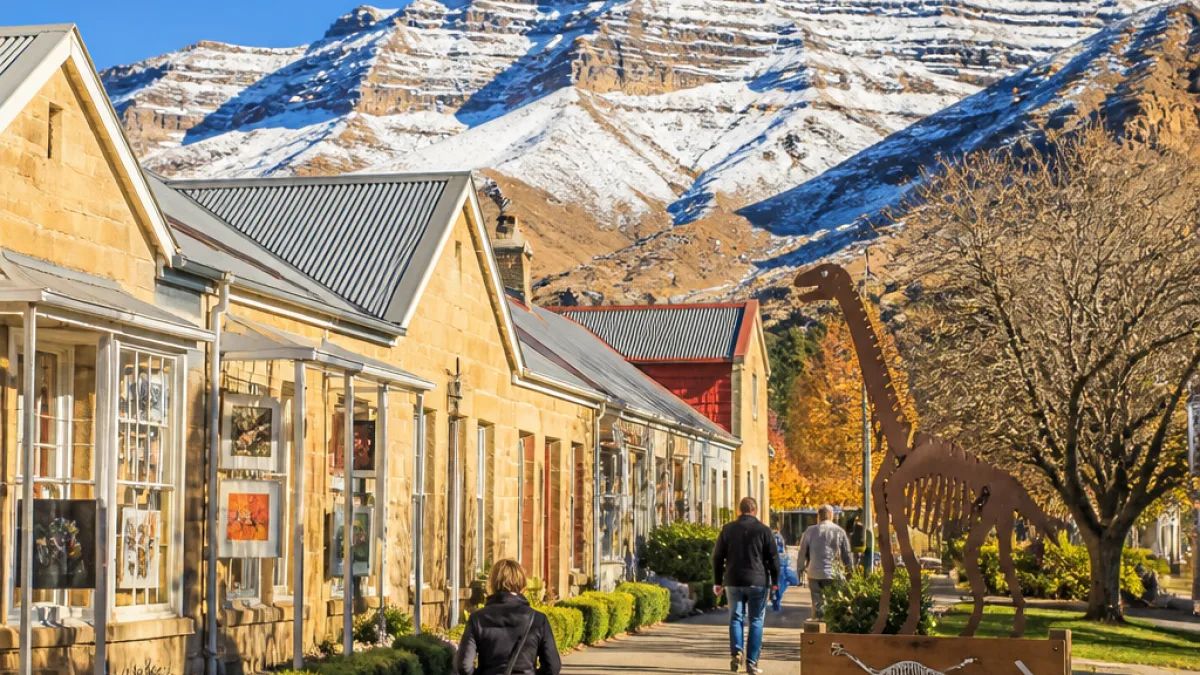
Clarens, a small town on the eastern edge of the Free State near the Lesotho border, has quietly built a reputation as one of South Africa’s cultural and outdoor destinations. Nestled under the Maluti mountains, the town of roughly 6,500 residents markets itself on a combination of gallery culture, sandstone architecture and proximity to significant palaeontological sites.
Art economy outstrips local schooling
Visitors and local entrepreneurs have transformed Clarens into what many now call an arts hub. The town hosts more than 20 permanent art exhibitions, giving it one of the highest numbers of galleries per capita in the country. By one estimate, there are about three galleries for every 1,000 residents, and galleries outnumber schools in the broader Clarens area.
The local education footprint remains modest: authorities and community sources place the number of schools in Clarens and its surroundings at about 13. Tourism, built around arts, outdoor activities and heritage, dominates the local economy.
Heritage, sandstone and the Kruger connection
Clarens’s architectural character is notable for buildings fashioned from carved sandstone quarried nearby, giving the town a distinctive, historic look that attracts photographers and architects. The town was named after a Swiss locality associated with Paul Kruger, the former president of the South African Republic, who sought refuge there during the Anglo-Boer War. That historical connection remains part of Clarens’s identity.
Fossils, high altitude and winter snow
The area around Clarens is also significant for palaeontology. Fossils discovered locally include bones, teeth and claws from species such as Massospondylus, a long-necked dinosaur from more than 200 million years ago. Researchers have also recovered some of the oldest fossilised dinosaur eggs in the region.
At an elevation around 1,940 metres above sea level, Clarens is among South Africa’s higher settlements. That height means the town experiences colder winters and occasional snowfall, a rarity for many parts of the country and a draw for visitors seeking mountain scenery.
Outdoor activities and visitor appeal
Outdoor enthusiasts are attracted to Clarens for its hiking and rock-climbing opportunities. The sandstone cliffs and nearby Maluti ridges provide routes for both day visitors and more experienced climbers. The town’s relative isolation from large urban centres contributes to its appeal as a nature and arts escape; it is roughly a three-hour drive from Johannesburg, depending on traffic and route.
- Culture: Over 20 art galleries and several permanent exhibitions.
- Heritage: Sandstone architecture and links to the Anglo-Boer War era.
- Nature: Hiking, rock climbing and fossil sites near the Maluti range.
- Climate: High altitude (c.1,940m) with occasional winter snowfall.
Local economy and practical information
Tourism is the primary economic engine for Clarens. Visitors contribute to hospitality, galleries, outdoor guiding and retail. For those planning a trip: the town is accessible by road from major Free State and Gauteng centres, and its compact layout makes most galleries and cafes walkable from central accommodation spots.
Local stakeholders have promoted Clarens both as an arts destination and as a base for exploring surrounding natural and archaeological sites. While the gallery density is a selling point, sustained visitor numbers are important to maintain the viability of both creative enterprises and essential services such as schools.
| Statistic | Figure |
|---|---|
| Estimated population | 6,500 |
| Permanent galleries | 20+ |
| Local schools (Clarens & surrounding) | 13 |
| Elevation | 1,940 m |
| Drive time from Johannesburg | About 3 hours |
Clarens’s combination of arts, heritage and outdoors opportunities has made it a noteworthy destination within the Free State. As the town balances tourism growth with the needs of residents, local galleries and hospitality operators will remain central to its economy and identity.












