
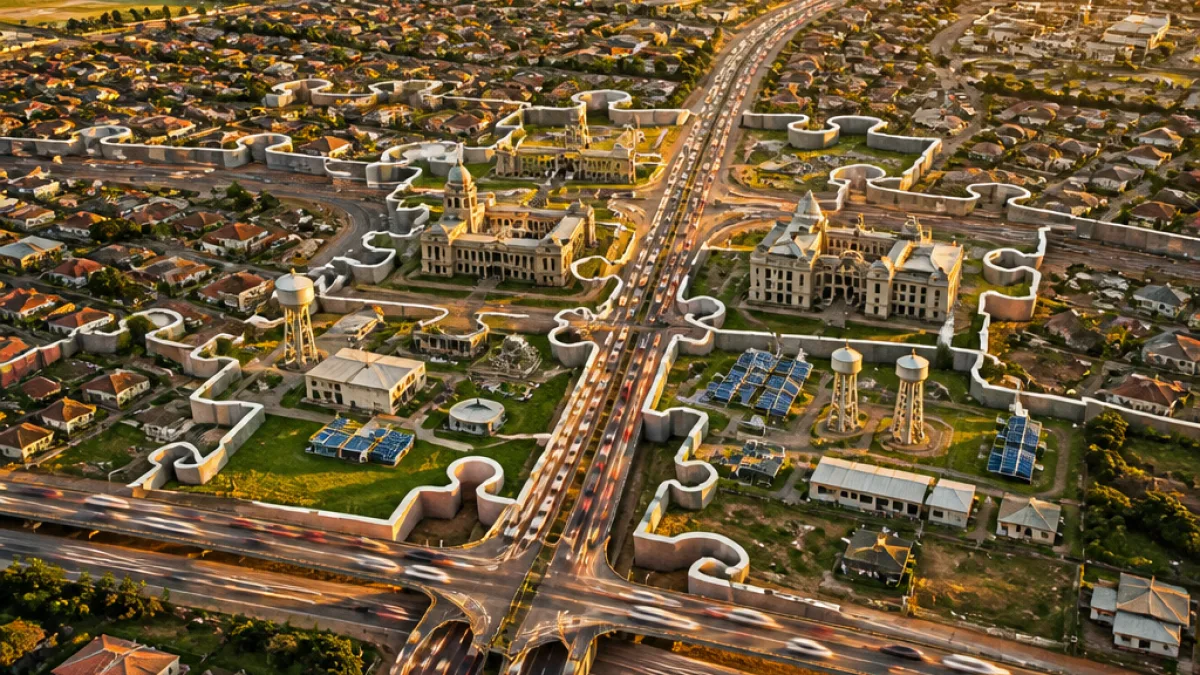
The African National Congress (ANC) has reopened discussion about a major overhaul of local government in Gauteng that could see Johannesburg, Tshwane and Ekurhuleni combined into a single administrative “city region” or megatropolis.
Why the idea is back on the table
ANC first deputy secretary-general Nomvula Mokonyane said the party is re-examining whether current municipal boundaries and structures still make sense as Gauteng’s urban areas expand and become ever more interconnected. Speaking to TimesLIVE, Mokonyane argued that the provincial landscape is now largely seamless.
“In Gauteng, at [one] point, there was acceptance across the board that, in fact, you need a city region here, because the boundaries [within] Gauteng are imaginary,” Mokonyane said.
She pointed to everyday signs of that integration: areas such as Midrand and Centurion straddle what were once clear municipal boundaries, while economic activity, transport networks and residential patterns increasingly cross those lines.
Economic rationale and research support
Research by the Gauteng City-Region Observatory (GCRO) is frequently cited in the debate. The GCRO describes Johannesburg, Ekurhuleni and Tshwane as part of a single, interconnected city-region. According to the GCRO, that region is home to about 16.1 million people and generates roughly a third of South Africa’s GDP.
| Indicator | Figure |
|---|---|
| Population (Gauteng City-Region, GCRO) | 16.1 million |
| Share of national GDP | ~33% |
Proponents argue that aligning governance with the economic geography of the region could improve co‑ordination on transport, housing, infrastructure and industrial policy — areas where municipal boundaries can complicate planning and delivery.
Questions about governance and delivery
Despite the economic logic, the proposal raises immediate questions about political accountability, service delivery and local representation. Merging three metros would involve complex legal and institutional changes and could provoke resistance from municipal leaders and residents who fear losing direct access to local councillors and services.
- Who would be the political authority in a merged city-region?
- How would services such as water, electricity and waste be managed across formerly separate metros?
- What would happen to existing debt, staff structures and municipal bylaws?
Those practical challenges are not addressed in detail in the public remarks, and the ANC’s comment suggests the proposal is at the discussion stage rather than an imminent policy move.
Historical context and precedent
The idea of a Gauteng city-region is not new. Urban planners and researchers have long mapped economic and transport linkages across the province that blur municipal borders. The GCRO and other bodies have studied integrated approaches to land use, public transport and economic planning that cross local government lines.
But turning analytical boundaries into an administrative reality would be a major political and legal undertaking — one that would require consultation with provincial and local stakeholders and likely national approval for any statutory changes.
What residents need to know
For ordinary residents, the discussion could affect daily life if it leads to consolidated services or new funding arrangements. At this stage, however, there are no formal proposals to change municipal boundaries or dissolve existing metros. The debate is in its early stages and framed by the ANC as a review of whether current structures match Gauteng’s evolving urban footprint.
Any process to alter municipal arrangements would involve public consultation and legal processes. Until detailed proposals are published, current responsibilities remain with the City of Johannesburg, Tshwane and Ekurhuleni metros.
As the conversation continues, key stakeholders to watch include provincial government, the three metropolitan councils, organised business, labour and civil society groups focused on service delivery and urban planning.
The idea of a unified Gauteng city-region raises fundamental questions about how to govern a densely populated, economically vital province. The ANC’s intervention moves the debate from academic research to party politics — and ensures the issue will be tempered by electoral and administrative considerations as it develops.












