
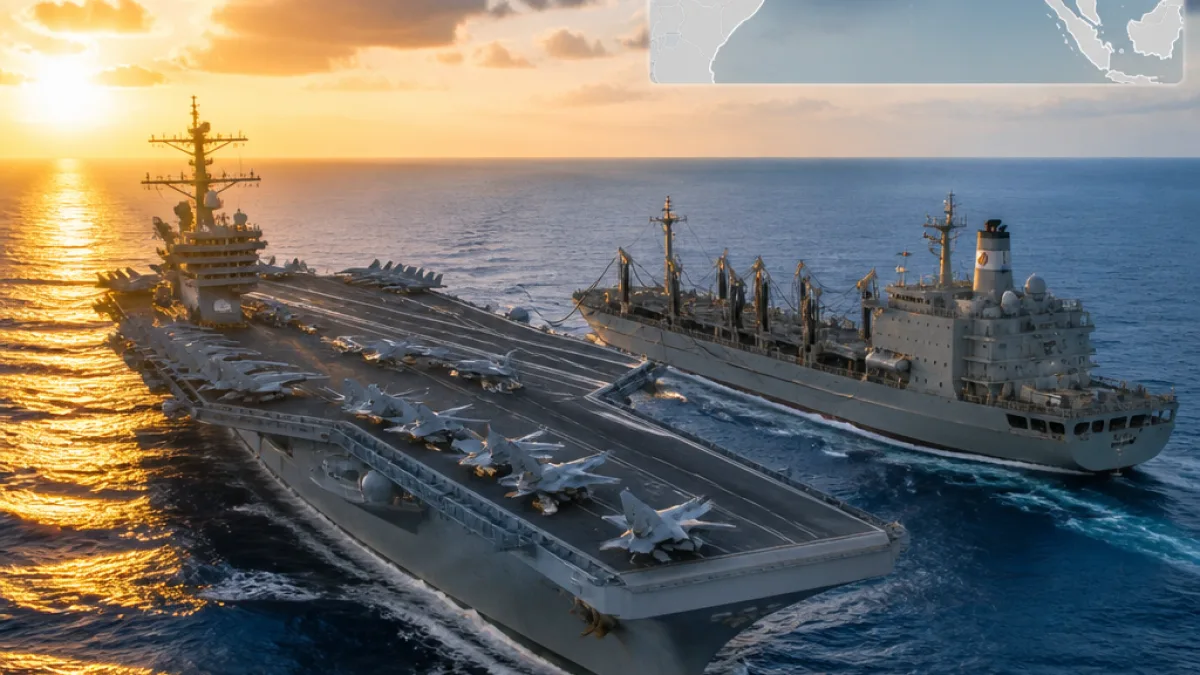
The U.S. Navy this week repositioned a large-deck aircraft carrier to the Middle East following public scrutiny of conditions aboard another carrier deployed to the region. USS George Washington arrived in the Arabian Sea on Wednesday, U.S. Central Command said, as part of what the command described as a routine movement.
What the Navy says
CENTCOM confirmed the arrival Thursday and described the deployment as scheduled. Officials emphasized the carrier’s movement was planned rather than an ad hoc response to media accounts describing hardships on board a sister ship that had been operating in the same theater.
“part of a scheduled deployment”
The announcement comes after sustained reporting about the condition of the USS Lincoln, which set a U.S. naval record for the longest deployment without a port visit. That deployment began after the carrier left San Diego in November and included a stint off Venezuela before being rerouted to the Middle East following the outbreak of hostilities between the U.S. and Israel and Iran on Feb. 28.
Concerns raised about conditions and planning
Accounts from families of sailors and Marines aboard the Lincoln described shortages of food and hygiene supplies, maintenance challenges and mental health strains during the prolonged deployment. News reports said the ship’s complement — roughly 5,000 sailors and Marines — endured significant hardships, and some family members recounted instances of service members seeking to leave the ship in desperate circumstances.
Those accounts have prompted calls from Democratic lawmakers for investigations into the handling of the deployment and broader questions about U.S. naval readiness and operational planning amid a protracted and expanding regional conflict.
Strategic implications
The rotation of the George Washington to the Arabian Sea leaves the United States without an aircraft carrier in the Western Pacific, a region Washington has designated a strategic priority. The Navy announced last week that the Lincoln would be rotated back to the United States. The move highlights the competing deployment demands placed on carrier strike groups as the U.S. addresses multiple global security challenges simultaneously.
| Carrier | Recent note |
|---|---|
| USS George Washington | Arrived in the Arabian Sea this week as part of a scheduled deployment |
| USS Lincoln | Set record for longest deployment without a port visit; being rotated back to U.S. |
Local and operational impacts
Though both carriers are elements of national force posture, the redeployment has implications for pacing and presence missions in both the Middle East and Indo-Pacific regions. The absence of a carrier in the Western Pacific reduces U.S. forward naval options there at a time of enduring strategic competition.
- Families of personnel aboard the Lincoln reported shortages and mental health strains.
- Lawmakers have requested probes into whether the extended deployment was properly planned and supported.
- The shift temporarily removes a carrier from the Western Pacific theater.
Context of the wider conflict
The movements take place against the backdrop of the broader U.S.-Iran tensions tied to conflict involving Israel and Iran. Even as direct combat has paused at times, Tehran has asserted influence over maritime approaches such as the Strait of Hormuz, and U.S. authorities have emphasized efforts to keep commercial traffic moving through the vital waterway.
Officials have said the United States will continue to adjust deployments to meet evolving security demands. The latest carrier rotation underscores the strain on a finite number of capital ships when extended deployments, operational diversions and political pressure converge.
As Congress and military officials review the circumstances that produced prolonged time at sea and reported shortfalls in supplies and support, questions remain about how the Navy will balance near-term wartime requirements with long-term presence commitments across multiple regions.
Reporting from CENTCOM and subsequent public accounts have focused attention on the human and logistical price of sustained deployments, setting up potential oversight hearings and policy debates in the months ahead.


















