
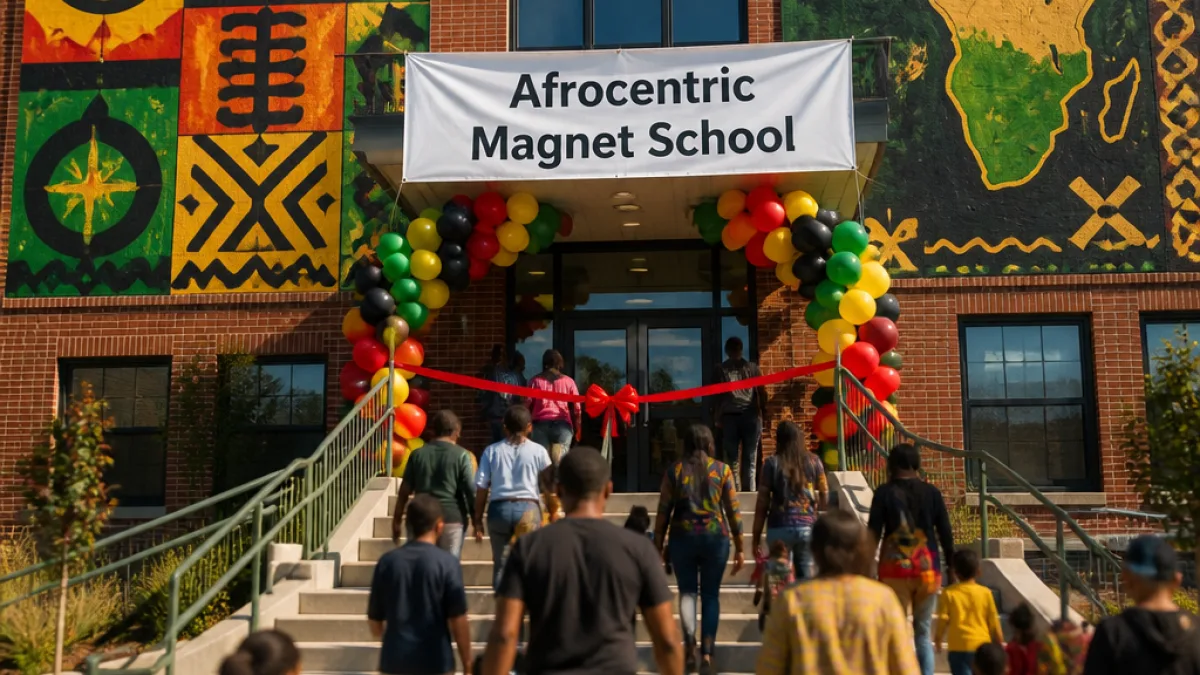
Rondo site returns focus on Black history, community in elementary curriculum
St. Paul Public Schools this month opened the Benjamin E. Mays Afrocentric Magnet School in the city’s historic Rondo neighborhood, a new pre-kindergarten through fifth-grade campus intended to center the experiences of people of African descent in classroom instruction. School officials said the magnet launched with more than 300 students enrolled, roughly 70% of whom identify as African American.
The school responds to long-standing calls from members of St. Paul’s Black community for an educational model that reflects students’ cultural backgrounds and histories. District leaders and parents have described the opening as the outcome of decades of advocacy.
“They haven't been a part of history in the sense of education,” Principal Danielle Hughes said, adding that the new curriculum will "highlight all, but we also do it with the African diaspora at the center of it."
Curriculum and neighborhood context
District officials say the Benjamin E. Mays program integrates subjects such as literature, music, science, math and art to explore the experiences of people of African descent. The school’s placement in Rondo — once a thriving center of Black life in St. Paul and the site of community upheaval after construction of Interstate 94 in the 1960s — was explicitly chosen to anchor the program in local history.
School leaders frame the magnet as both academic and identity-forming. Principal Hughes told reporters the school aims to provide representation in materials and staff that many students have not seen in their education, a factor she said she wished she had experienced as a child.
Enrollment and demographics
The district reported initial enrollment figures for the new school as follows:
| Grade span | Enrollment | Approx. share identifying as African American |
|---|---|---|
| Pre-K through 5 | More than 300 | About 70% |
The magnet’s opening comes at the start of the school year, with staff and students already engaged in lessons that district officials say blend academic standards with Afrocentric perspectives. A third-grade classroom was cited as an early example, where a lesson on empathy was paired with Black history content, reflecting the school’s dual focus.
Local reactions and longer history
Community advocates have pushed for similar programs in St. Paul for more than five decades, arguing that traditional schools have too often left out or marginalized the histories and contributions of people of African descent. The Benjamin E. Mays name — honoring the educator and civil rights leader — was chosen to reflect both a national legacy and a local aspiration for culturally sustaining education.
Supporters emphasize that the magnet is voluntary and open to students across the district, while proponents see the school as a corrective to curricular gaps and underrepresentation. Principal Hughes described the school as meeting a sustained need for representation in both classroom materials and among educators.
- New school serves pre-K through 5th grade with more than 300 students enrolled.
- Approximately 70% of the student body identifies as African American.
- The magnet emphasizes Afrocentric perspectives across core subjects.
What comes next
As the school year progresses, district officials and community members will likely monitor academic outcomes, family satisfaction and enrollment patterns. The school’s success may influence future magnet or themed-school proposals within St. Paul Public Schools and affect broader conversations about representation and curriculum in the district.
For now, the Benjamin E. Mays Afrocentric Magnet School represents a notable local milestone: a district-backed, community-requested effort to place the African diaspora at the center of young students’ early education in a neighborhood long associated with Black culture and resilience.















