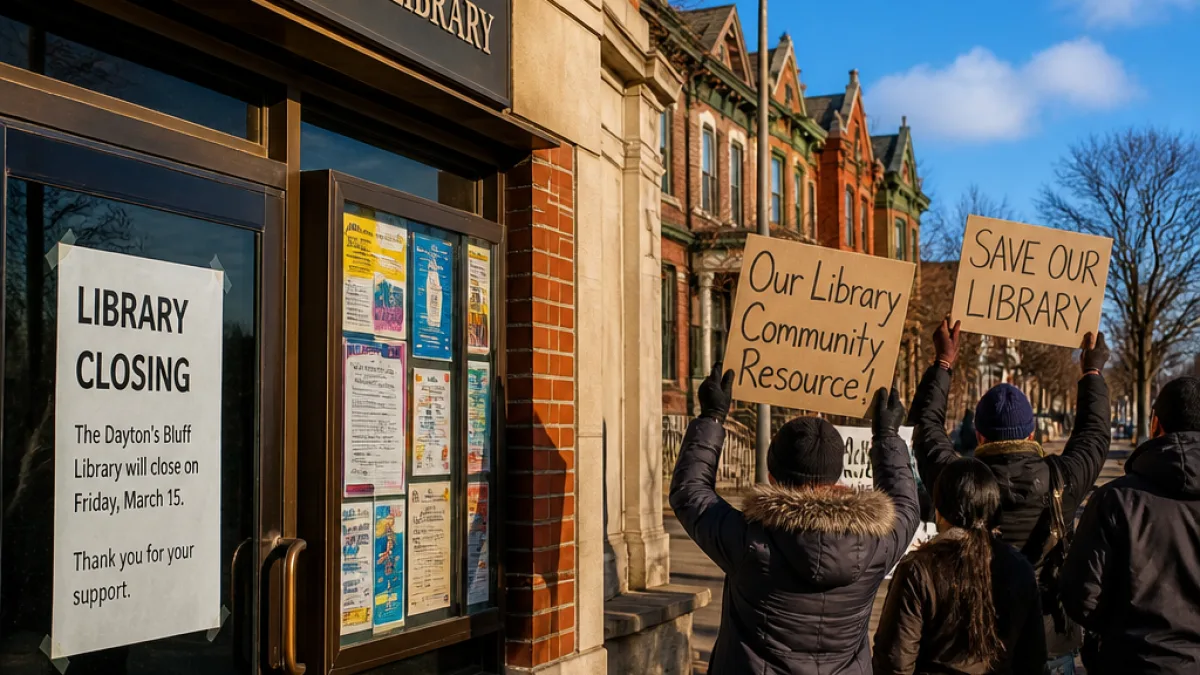
ST. PAUL — Mayor Kaohly Her’s initial budget proposal includes the planned closure of the Dayton’s Bluff branch of the St. Paul Public Library, a move city officials say trims costs but that has prompted concern from East Side residents and at least one council member who represents the neighborhood.
Budget trade-offs meant to soften tax hike
Her’s proposal calls for a 6.8% levy increase citywide — which the administration estimates would add about $58 a year in city taxes for the owner of a median-valued $290,000 home. To keep the overall tax increase from climbing further, the mayor’s budget includes several targeted reductions, among them ending the lease for the Dayton’s Bluff library space, which the city rents from Metro State University.
City figures in the proposal show that terminating the lease would save the city $131,700 in 2027. Additional reductions tied to the branch include about $40,000 from cuts to library materials and technology for that location and roughly $98,500 from removing a vacant staff position. Taken together, those actions are projected to shave more than $270,000 from the city’s budget.
| Savings item | Estimated 2027 savings |
|---|---|
| End lease for Dayton's Bluff space | $131,700 |
| Library materials and technology cuts | $40,000 |
| Remove vacant position | $98,500 |
| Total (approx.) | More than $270,000 |
East Side leaders decry impact on a neighborhood already feeling overlooked
Council Member Cheniqua Johnson, who chairs the City Council’s budget committee and represents Ward 7 including Dayton’s Bluff, has pushed back on the plan. She is organizing residents to lobby colleagues to oppose the closure and has questioned whether the usage data the city relied on fully captured demand at the branch.
"The neighborhood is facing too many budget cuts,"
Johnson has pointed to factors that could have lowered visits over the past year, including extensive road construction and a heightened law-enforcement presence during an operation last winter that she said depressed foot traffic at neighborhood institutions.
The Dayton’s Bluff branch recorded the lowest foot traffic of any city library over the past year, according to city data included with the budget proposal. Library officials said the proposal would not include layoffs for current staff at the branch; employees assigned to Dayton’s Bluff would be transferred to other branches if the location closes.
Local context and consequences
Residents and community leaders on the East Side have long raised concerns that their neighborhoods receive fewer municipal resources than other parts of the city. For people who rely on neighborhood libraries for internet access, children’s programming, study space or other services, the planned closure adds to those worries.
- Advocates say closures can deepen inequity by removing free services where they are most needed.
- City leaders counter that constrained finances require difficult trade-offs to limit tax impacts.
- Council debate and community lobbying are now likely to determine whether the branch remains open.
The budget proposal is the starting point for review and amendment by the City Council. Council members, as well as residents and neighborhood groups, can press for restorations or identify other savings before the levy and spending plan are finalized.
For Dayton’s Bluff residents, the closure would be a tangible and immediate change to neighborhood services. For city policymakers, it is one example of how Her’s first budget balances a politically sensitive tax increase against line-item reductions intended to keep that increase from growing larger.
Public hearings and committee meetings on the budget are expected to follow the mayor’s presentation; council deliberations will shape whether the Dayton’s Bluff branch remains part of St. Paul’s library system in 2027.