
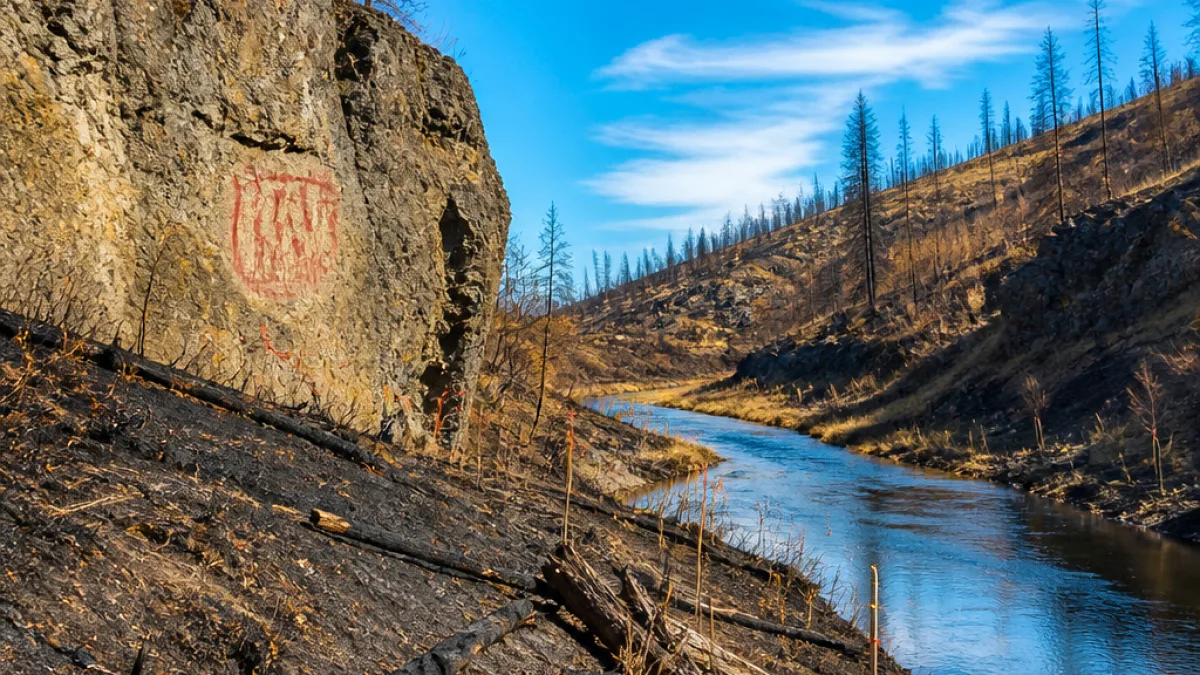
Historic pictographs remain visible despite heavy burn in Little Spokane River Valley
The area around the Little Spokane River that for generations has drawn paddlers, birders and hikers now bears deep scars from the Autumn Lane fire, one of three blazes that make up the Spokane Complex. Fire activity blackened roughly 9,000 acres and changed the look and ecology of the valley, Riverside State Park officials said, but the centuries-old rock paintings known as the Indian Painted Rocks survived and remain visible.
Riverside State Park spokesman Rex Schultz said much of the park’s northern end along the Little Spokane burned and that the scale of damage in some places is greater than past fires. A drive along Rutter Parkway now shows vast swaths of scorched ground with little to no vegetation, while historic farms and residences tucked among cottonwoods and wetland reeds to the east and south remain standing.
“I was a little nervous about it because there was some brush close to it,”
Schultz said of the Indian Painted Rocks, which volunteers and firefighters reported as still visible while crews worked to suppress hot spots in the area.
What the fire left behind
Observers found the pictographs largely intact even as ash accumulated several inches deep around the site and trees nearby bore burn scars. The rock paintings are thought to be more than 250 years old and are comprised of imagery applied with crushed red rock mixed with animal fats. The pictographs are arranged in two groups within a roughly 6-foot-square area on a 25-foot-tall rock, according to local historian and Spokane Tribal member Warren Seyler.
While the cultural touchstone survives, park officials and residents face a lengthy period of ecological recovery. Schultz said the northern park landscape had been characterized predominantly by grass and brush—vegetation that burns readily and often leads to extensive surface exposure after a fire. That exposure increases the risk of erosion and alters habitat for birds, amphibians and other species that rely on riparian wetlands.
- Damage footprint: The Spokane Complex has blackened about 9,000 acres.
- Cultural resource: Indian Painted Rocks — pictographs made with crushed red rock and animal fats — remain visible on a 25-foot rock face.
- Recovery timeline: Park officials say it will be years before the valley resembles its prefire condition.
Local and cultural implications
The Little Spokane River Valley has long been a place of both natural and cultural importance to the region. Early settlers established farms and residences along its fertile banks, and before them Indigenous peoples, including members of the Spokane Tribe, fished its waters and left markings such as the pictographs now standing through the blaze.
Preservation of the painted rocks is significant not only to historians and tribal members but also to the broader public that uses the Little Spokane River Natural Area. Seyler noted that relatively little is known about the creator or creators of the images, underscoring their importance as an archaeological and cultural record.
Even where cultural sites survived, the broader landscape will face changes: loss of ground cover increases runoff and erosion potential, alters plant succession and can shift wildlife patterns. The wetland and river systems that support amphibians, fish and waterfowl are particularly vulnerable in the immediate postfire years.
Next steps and public access
Park officials and emergency crews continue to monitor hotspots and assess hazards. Given the extent of ash and burn scars, officials caution that recovery of vegetation, stabilization of soils and restoration of wildlife habitat will require considerable time, and public access to some areas may remain restricted while assessments proceed.
For Spokane residents who frequent Riverside State Park, the visible survival of the Indian Painted Rocks offers a rare positive amid widespread damage. Still, the community faces years of restoration and careful stewardship to help the Little Spokane River Valley heal and protect the cultural resources within it.


















