A new feasibility study commissioned by Travis County and prepared by HNTB proposes a dedicated, high-speed passenger rail between Austin and San Antonio that could cut travel time to about an hour and establish a new regional transportation corridor with significant implications for downtown San Antonio.
Route, terminals and travel time
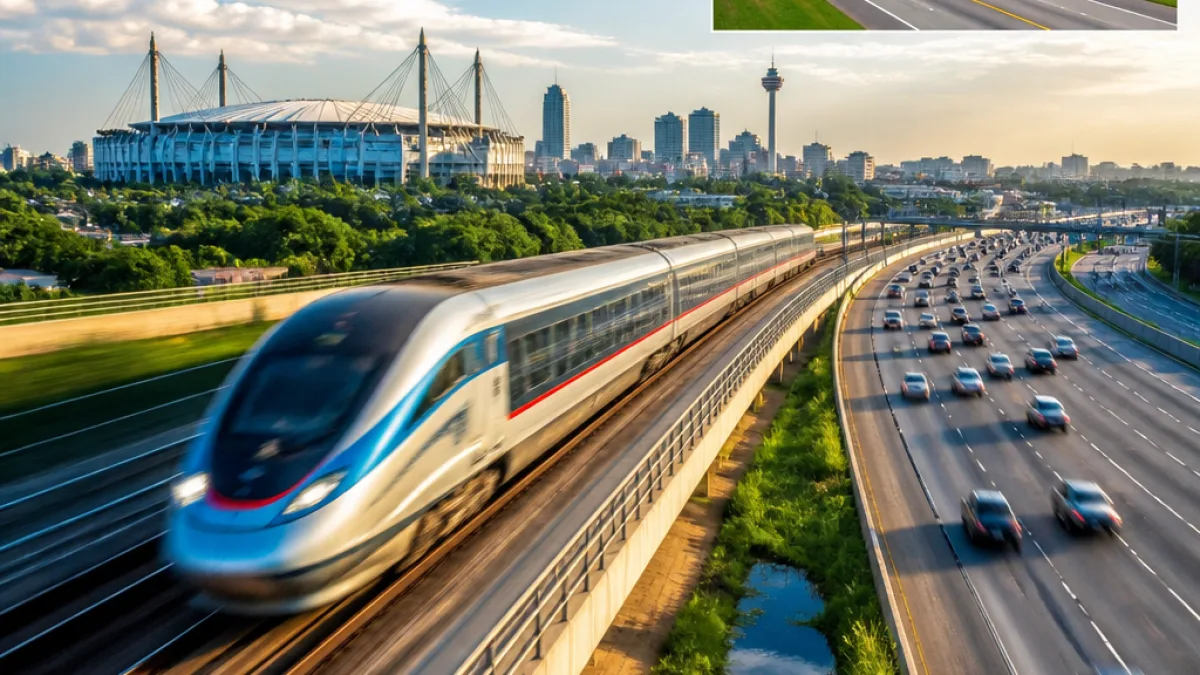
The HNTB analysis recommends a line largely following Interstate 10 and State Highway 130, with potential terminals at Austin-Bergstrom International Airport and downtown San Antonio’s Alamodome. Under the study’s operating scenario, commuter-style trains capable of 125 mph would complete end-to-end runs in roughly
"55 to 65 minutes"
That would be a substantial reduction from the only existing daily passenger option — Amtrak service over freight tracks — which clocks in at more than 2½ hours on its published schedule and has reliability challenges: Amtrak reported it runs on time about 56% of the time on that host railroad in 2024.
Estimated costs and facilities
HNTB’s top-line capital estimate for a dedicated corridor is $13.5 billion. The study breaks out several major components and near-term needs:
- Trainsets: Six trainsets estimated at $360 million (included in the $13.5 billion total)
- Operations and maintenance facilities: About $300 million
- Annual operating and maintenance: Projected between $140 million and $190 million (in 2026 dollars)
| Item | Estimated Cost |
|---|---|
| Total capital | $13.5 billion |
| Trainsets (six) | $360 million |
| O&M facilities | $300 million |
| Annual O&M | $140–$190 million |
Next steps and local implications
To advance the project, the study recommends several immediate actions: reach agreements with the Texas Department of Transportation and other agencies to secure use of the proposed highway corridors, start environmental reviews, conduct a market analysis to better estimate ridership and revenues, and explore funding paths that could include federal grants, local contributions and public-private partnerships.
For San Antonio, the proposed terminal at the Alamodome would tie the corridor directly into the downtown core and could affect local traffic patterns, parking, land use and economic development near the site. A dedicated corridor built along highway right-of-way could limit some impacts compared with entirely new alignments, but construction and station development still would shape neighborhoods and commercial areas served by the line.
Operational questions and community considerations
Key operational questions remain unanswered in the study and will shape whether the line becomes feasible and how it serves San Antonio residents. Those include projected daily ridership, fare structures, integration with local transit providers and how initial capital costs would be financed. Annual operating costs in the study suggest the line would require ongoing subsidies or robust farebox and ancillary revenue to sustain service without large deficits.
Local leaders and transit advocates will need to weigh potential benefits — faster intercity mobility, reduced highway congestion, economic development near stations — against costs and trade-offs such as public funding commitments and construction impacts. The prospect of a one-hour rail link between San Antonio and Austin also raises equity and land-use questions about who benefits from improved connectivity and how related growth is managed.
The HNTB report sets a framework but not a timetable. Any move toward construction would depend on negotiated corridor use, completed environmental clearances, funding commitments and coordinated planning among multiple jurisdictions. For San Antonio, the study represents a significant planning milestone: an assessment that places the city within a possible high-speed regional network and positions the Alamodome as a focal point for intercity rail access.