The Rhode Island Department of Health on Thursday confirmed that a man in his 70s from Newport County has tested positive for Powassan virus, a rare but potentially severe tick-borne illness. The man began experiencing symptoms in late July, the department said.
Statewide context and recent trends
This is the state’s second confirmed Powassan case of 2026 and the tenth recorded in Rhode Island since health officials first identified the disease in the state in 2016. Health department data cited in the announcement note that Powassan is found primarily in the Northeast, the Great Lakes region and parts of eastern Canada.
Although cases are still uncommon, health officials say they have increased in recent years. Nationwide, more than 397 cases were reported over the past decade, and 2025 set a record with 76 cases, including 27 across New England.
Symptoms and severity
Early signs of Powassan virus infection are often nonspecific and include fever, headache, vomiting and general weakness. In many patients the illness progresses to meningoencephalitis, which can present with altered mental status, seizures, difficulty speaking or understanding, muscle weakness or paralysis, and movement disorders. Severe cases frequently require hospitalization.
“We all need to be thinking about tick prevention measures when outdoors,” said Rhode Island Director of Health Dr. Jerry Larkin. “Repel and reduce your exposure to ticks, check your body for ticks, and be sure to remove ticks if you find one on yourself, a family member, or a pet. Ticks are tiny. You may not be able to feel them or spot them right away.”
No vaccine or specific treatment
Health officials emphasized there is currently no vaccine or targeted antiviral treatment for Powassan virus. As a result, prevention and early detection of tick bites remain the primary public-health tools to limit infections.
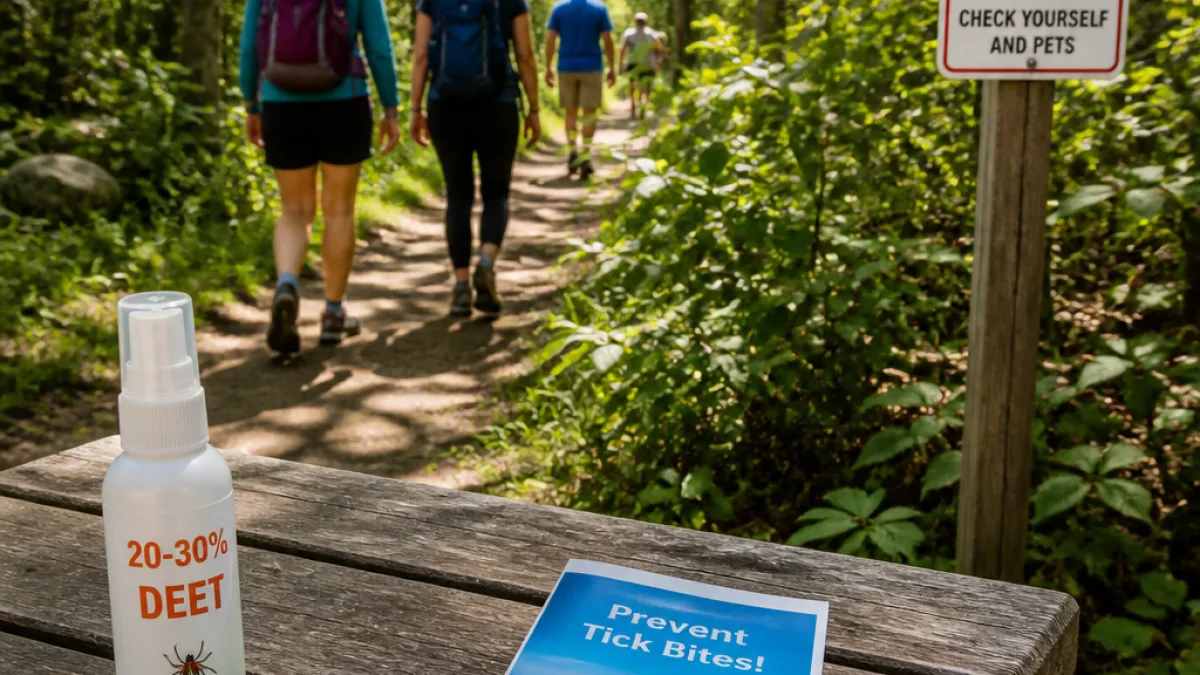
To help residents reduce their risk, the health department reiterated practical precautions:
- Avoid wooded and brushy areas with high grass when possible.
- Walk in the center of trails to minimize contact with vegetation.
- Wear long sleeves and light-colored clothing to make ticks easier to spot.
- Tuck pant legs into socks to limit skin exposure.
- Use EPA-approved insect repellent containing 20–30% DEET.
- Shower after outdoor activities and perform a full-body tick check, paying special attention to ears, belly button, behind the knees, between the legs, the waistline and hair.
- Check pets for ticks as well; animals can carry ticks into homes.
When a tick is found attached to the skin, officials advise removing it promptly and properly. The recommended method is to grasp the tick as close to the skin as possible with tweezers and pull straight up until it releases.
Quick reference: Powassan facts
| Item | Details |
|---|---|
| Recent Rhode Island cases | 2 in 2026 (including this Newport County case); 10 total since 2016 |
| U.S. trend (past decade) | More than 397 reported cases; 2025 had a record 76 cases |
| Common early symptoms | Fever, headache, vomiting, weakness |
| Severe illness | Meningoencephalitis with possible seizures, paralysis, altered mental status |
| Prevention | Tick avoidance, clothing barriers, DEET repellent, prompt tick checks |
What this means locally
The diagnosis highlights continued risk during the warmer months when outdoor activities increase. Newport County and other communities with wooded or brushy terrain should treat this report as a reminder to reinforce tick-safety practices for families, outdoor workers, hikers and pet owners.
Clinicians are advised to consider Powassan virus in patients presenting with compatible symptoms and a history of tick exposure. Because early symptoms are nonspecific, prompt testing and supportive care are important for patients who develop neurological signs.
For more information on tick prevention and guidance, the Rhode Island Department of Health directs residents to health.ri.gov/ticks.
Reporting by Priya Nair, State Correspondent.