
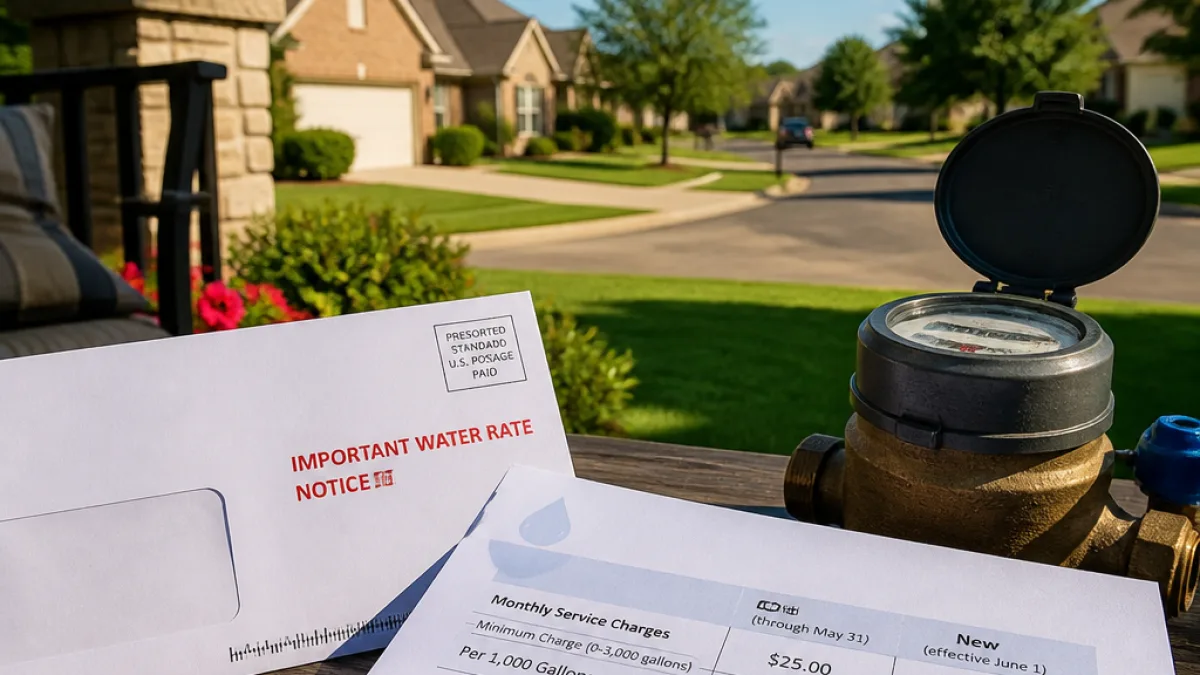
Customers of the Bethany Special Utility District in Johnson County will see higher water bills after the district's elected board approved a rate increase that takes effect with the Sept. 10, 2026 billing cycle, according to a notice sent to customers this summer.
What changed and when
The mailed notice, dated July 20 and reviewed by WE NEWS, said the increase followed “a rate study done by the Public Utilities Commission” and cited the rising cost of goods and services. The notice told customers the new rates would be reflected on their Sept. 10 bills.
| Charge | Previous | New |
|---|---|---|
| Monthly minimum service charge (per meter) | $43 | $55 |
| Residential per 1,000 gallons (single meter) | Varied | From $0.55 to $4.50 |
The notice specified that, depending on usage, a single-meter residential customer could see a per-1,000-gallon increase ranging from 55 cents to $4.50. The monthly minimum service charge will rise from $43 to $55 per meter.
Customers say they were blindsided
Several residents who spoke with WE NEWS said they learned of the change only after receiving the mailed notice and want to know what prompted the board’s decision and whether the public had opportunities to weigh in.
“What's the problems that you have today that's causing you to raise the rate that much? Or is it just because somebody said you could raise the rates and you did?”
The comment came from a resident who said higher bills are adding pressure to household budgets already stretched by rising costs for groceries, gas and other services.
Another neighbor questioned whether there had been public hearings before the board approved the rate hike. Both residents live in parts of Johnson County that do not receive city water and instead rely on the Bethany Special Utility District for service.
Regulator says board has authority
The Public Utility Commission of Texas (PUCT) responded to questions about the process, saying that, under state law, an SUD’s elected board is responsible for reviewing, adopting and approving rates charged to customers. The PUCT told WE NEWS it does not have rules requiring a special utility district to provide advance notice to customers that its board will consider a rate increase.
The PUCT also said it does not require a public hearing before a special utility district board considers or approves a rate change, though the notice reviewed by customers said the increase followed a rate study done by the commission.
What customers want to know
Customers are asking for clearer information about several items related to the increase:
- What specific factors in the PUCT rate study justified the size of the increase;
- Whether the Bethany SUD board held public meetings or hearings on the proposed change and when those meetings occurred;
- How the additional revenue will be used — for operations, infrastructure, debt service or other costs.
The district is governed by an elected board made up of Bethany SUD customers. The residents who contacted WE NEWS said they did not recall being informed in advance about a board vote on rates and that the mailed notice was their first formal communication about the change.
Practical steps for customers
Customers with questions about the hike should consider the following steps:
- Contact the Bethany Special Utility District directly to request documentation of the board vote and any meeting minutes or notices related to the rate change.
- Ask for the PUCT rate study referenced in the notice to understand the analysis used to justify the increase.
- Attend upcoming board meetings or request that the board hold a public hearing to discuss customer concerns and how additional revenue will be allocated.
WE NEWS has asked the Bethany Special Utility District for comment and for copies of any meetings or notices related to the rate change. The PUCT provided the agency statements about legal authority and notice requirements; the commission did not provide additional documents to WE NEWS beyond that guidance.
The rate increase highlights an ongoing tension in unincorporated areas that rely on special utility districts: those districts are locally governed but may follow state-regulated processes that customers do not always understand. Residents say they want more transparency about decisions that directly affect household budgets.
WE NEWS will update this story if and when the Bethany Special Utility District provides additional information or schedules a meeting to discuss the rate change.

















