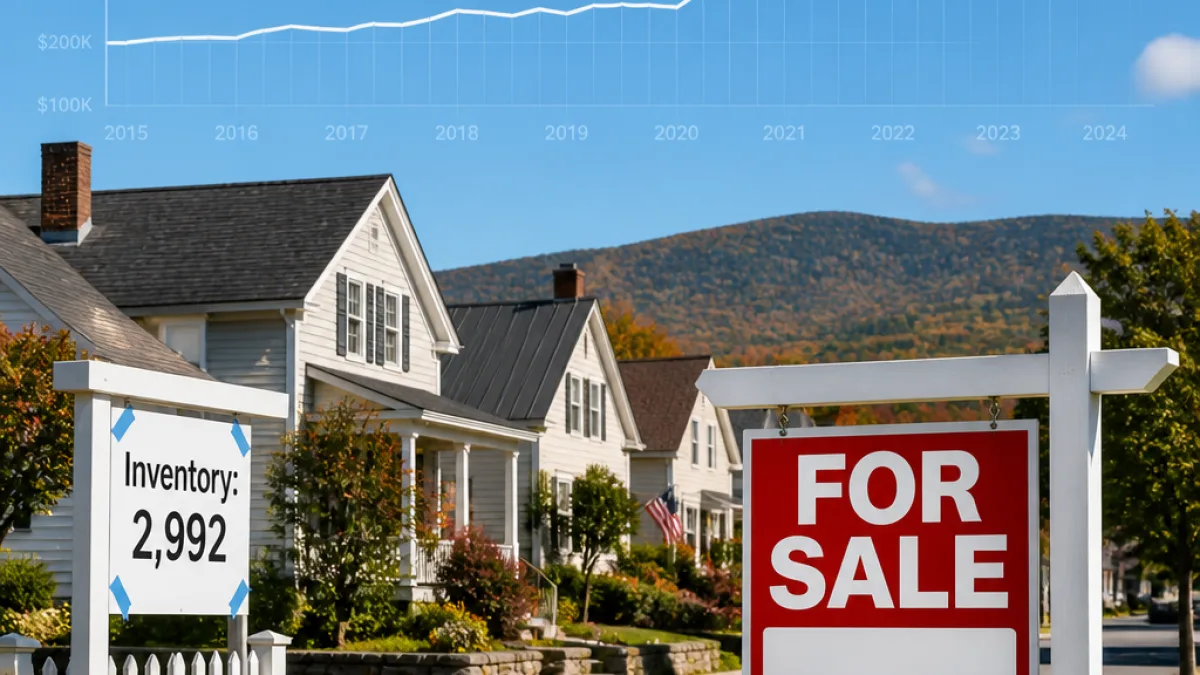
New Hampshire’s housing market hit a new milestone in July as the median price for a single-family home rose to $580,000, according to the New Hampshire Association of Realtors. The increase underscores continuing affordability challenges for residents across the state even as inventory shows tentative improvement.
Prices climb amid constrained supply
The $580,000 median marks a state record for single-family homes, though it remains well below prices in nearby parts of the Boston area, where comparable homes can exceed $1 million. The Realtors association tied the uptick to persistent supply constraints that have kept competition strong for available properties.
| Measure | July figure |
|---|---|
| Median single-family home price | $580,000 |
| Homes for sale (inventory) | 2,992 |
| Boston-area comparator | Over $1 million (single-family homes) |
Inventory rising but not balanced
Inventory in July reached 2,992 homes, the highest level since the COVID-19 pandemic, the association reported. Realtors described that as a positive sign, but not enough to restore what they regard as a balanced market.
- Median single-family price: $580,000
- July inventory: 2,992 homes
- Comparison: Boston-area single-family prices remain above $1 million in many markets
Lawmakers and industry consider next steps
Industry leaders told WE NEWS that the state Legislature made progress in 2026 on measures intended to boost housing supply. The Realtors association noted technical changes to a 2025 law that requires municipalities to permit multi-family housing in commercial zones as a meaningful step forward.
“Resolving the housing affordability crisis is going to take a multi-faceted approach,”
Bob Quinn, chief executive of the New Hampshire Association of Realtors, said there is no single solution to the affordability problem and that additional policy changes could be considered during the 2027 legislative session.
Among ideas Quinn highlighted as ripe for exploration are establishing state-level standards for minimum lot sizes to ease constraints on single-family construction and adopting a policy to allow manufactured housing by right. He noted the latter could gain traction in light of federal housing legislation enacted this year that contains provisions aimed at making manufactured housing more affordable.
What the numbers mean for Granite Staters
For buyers, the combination of higher median prices and relatively limited inventory translates to continued competition for desirable properties and pressure on household budgets. For sellers, the market remains favorable in many areas of the state, though regional variation exists and pockets of lower demand persist.
Local officials and housing advocates have long pointed to a shortage of buildable lots, zoning rules that limit density, and a lack of diverse housing types as drivers of the state’s constrained supply. The Realtors association’s proposals — from streamlined lot-size standards to broader acceptance of manufactured homes — aim to address multiple angles of the problem rather than rely on a single fix.
As lawmakers prepare for the 2027 session, the debate over how to increase housing options is likely to continue. Any state-level moves to standardize lot sizes or mandate broader permission for manufactured housing could draw both support and opposition from municipalities and residents concerned about development patterns, property values and local control.
For now, the July figures demonstrate a housing market that remains tight by historical standards even as inventory shows signs of recovery from the lows recorded during the pandemic era. The balance between price growth, supply gains and policy responses will be critical for how quickly affordability pressures ease across New Hampshire.