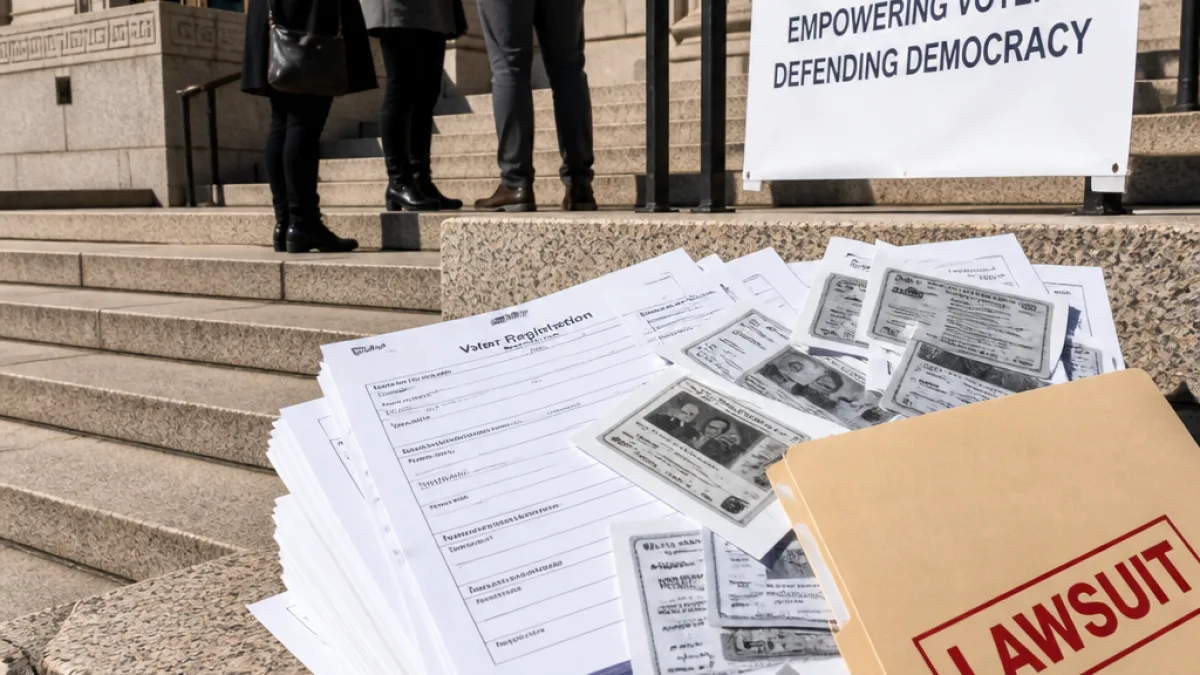
A nonprofit organization and a Sioux Falls voter asked a federal court Monday to block parts of South Dakota's new proof‑of‑citizenship voter registration rules, arguing the state's rollout has improperly disqualified eligible voters and left registrants without a meaningful way to correct problems.
What the law requires
Senate Bill 175, approved by the Legislature and signed by Gov. Larry Rhoden in March, requires people registering to vote in South Dakota to provide documentary proof of citizenship. Acceptable forms of proof listed in the law include a birth certificate, passport, driver's license, non‑driver identification card or tribal identification card, along with a catchall described as "any other type of acceptable documentary evidence of citizenship" under federal law.
The law also requires registrants to provide a physical South Dakota address that is not a mail‑forwarding service or post office box to be eligible to vote in state and local elections. That provision is intended to address situations such as full‑time recreational vehicle drivers who register vehicles and receive forwarded mail in the state but do not live there.
Federal‑only designations and the rollout
Under the new rules, people who do not supply the required documentation are still registered to vote but receive a "federal‑only" ballot, which contains only federal offices such as president and Congress and omits state and local offices.
An analysis by South Dakota Searchlight published in May found approximately 1,500 people in the state had been classified as federal‑only since the law took effect. The lawsuit filed Monday contends the state's implementation has led to disqualifications over minor errors and has not given registrants a realistic opportunity to fix application problems.
Relief sought in the lawsuit
The plaintiffs ask the court to order the state to change several aspects of how it handles proof‑of‑citizenship and address verification:
- Accept photocopies of driver's licenses, tribal identification and nondriver ID cards for voter registration;
- Rescind guidance that requires in‑person registration for people who seek to use those IDs as proof of citizenship;
- Ensure people designated as federal‑only are given accurate information and a meaningful opportunity to correct deficiencies in their registration.
The law currently allows photocopies for all documents except driver's licenses or state or tribal ID cards.
| Document | Photocopy Accepted (per law) |
|---|---|
| Birth certificate | Yes |
| Passport | Yes |
| Driver's license | No |
| Non‑driver ID card / tribal ID | No (as written) |
State rationale and implications
Supporters of the law have framed the requirements as measures to ensure elections are limited to citizens and to ensure registrants have a verifiable in‑state residence for state and local voting. The state’s address provision specifically targets situations where South Dakota may be used as a vehicle registration or mailing address without a corresponding physical residence for voting purposes.
Opponents and the plaintiffs say the practical effect has been to produce avoidable disenfranchisement. The lawsuit argues technical or minor errors in paperwork have led to federal‑only status and that the state has not provided sufficient processes to allow eligible voters to correct their registrations.
What happens next
The case is now pending in federal court. If a judge grants the plaintiffs' requested relief, state practices governing photocopies of ID, in‑person registration requirements tied to certain documents and notice or cure procedures for federal‑only registrants could change.
Until the court rules, the law remains in place as written and continues to shape how tens of thousands of South Dakotans interact with the voter registration system.
Election officials and advocacy groups around the state will be watching the litigation closely because its outcome could affect not only registration procedures but also broader questions about access to state and local elections.