
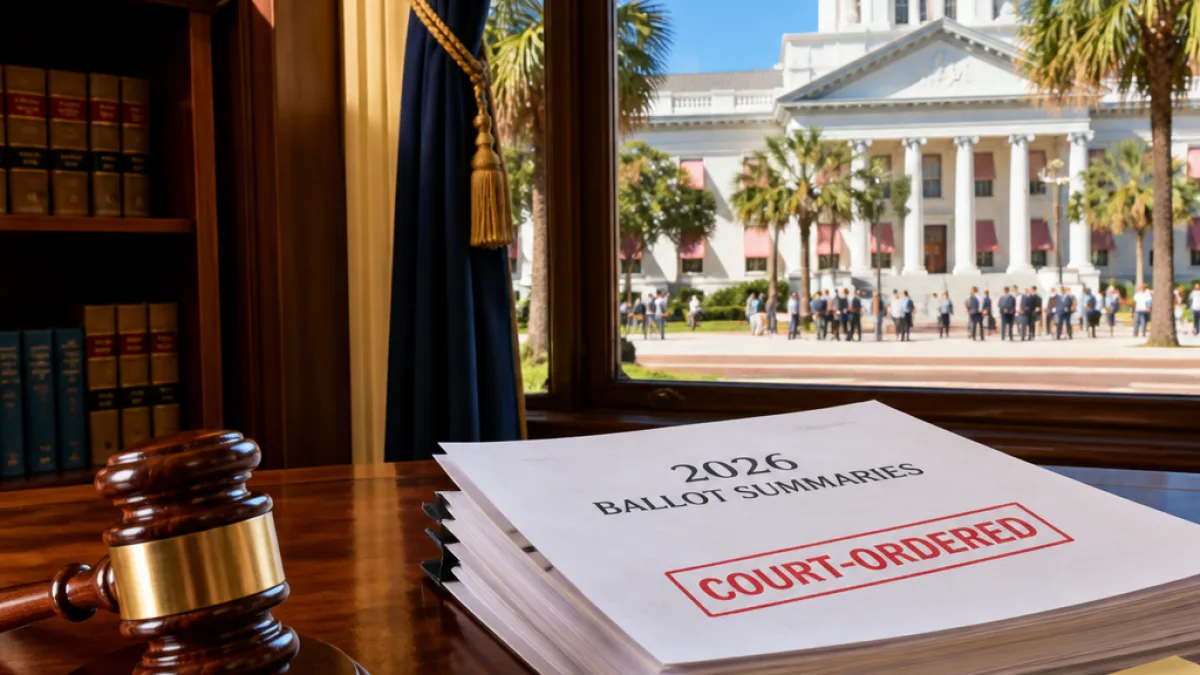
TALLAHASSEE — New ballot language has been released for a proposed constitutional amendment that would reshape property-tax rules across Florida after a judge ruled the original summary was misleading and required a rewrite.
What the revised summary says
Attorney General James Uthmeier circulated the revised text this week. The updated summary lays out several major changes that would take effect if voters approve the measure:
- Homestead exemption increases: an exemption of $150,000 in 2027 and $250,000 in 2028, with later adjustments tied to inflation.
- Expansion procedure: the Legislature would be required to establish a uniform process allowing counties and municipalities to raise the homestead exemption up to full assessed value; special districts could do the same subject to voter approval.
- Residency provision: people who are not Florida residents on Dec. 31, 2026 would get the current homestead exemption when they first qualify; the increased exemption would begin in their fifth year of exemption, subject to the U.S. Constitution.
- Nonhomestead cap lowered: the annual cap on assessment increases for nonhomestead property would fall from 10% to 5%.
- Use of property tax revenue: counties and municipalities would be required to use property taxes only for a defined list of purposes unless other expenditures were later approved by local officials or governing bodies.
| Year | Homestead Exemption |
|---|---|
| 2027 | $150,000 |
| 2028 | $250,000 |
Court ordered rewrite after judge's finding
The rewritten text follows a judicial finding that the attorney general’s original summary contained language the judge considered promotional rather than explanatory. The judge said the summary included "political taglines" and tasked the attorney general with producing neutral language focused on what the amendment actually would do.
"The purpose of the summary is to explain what the amendment does — not advocate for its adoption," the judge wrote.
Timing and legal limits
If voters approve the amendment, many provisions are slated to begin Jan. 1, 2027. The revised wording explicitly ties several elements to later legislative action — for example, directing the Legislature to set a uniform procedure for local governments to increase homestead exemptions.
The text also attempts to reconcile the measure with federal constitutional limits. It notes that for people who move to Florida after 2026, the larger exemption would only apply beginning in the fifth year of their exemption to the extent permitted by the U.S. Constitution.
Potential local impacts
The changes, as summarized, would have layered effects across the state:
- Homeowners who already have homestead exemptions could see larger taxable value exclusions once the higher exemptions take effect; details would depend on the implementing legislation.
- Property owners of nonhomestead parcels — such as commercial and second homes — could face smaller year-to-year assessment increases due to the lower cap, potentially reducing their property-tax growth.
- Counties and municipalities could face new restrictions on how they allocate property-tax revenue unless they expand allowable uses through local approvals or unless state law provides otherwise.
Local governments, school boards and special districts are likely to study the changes and estimate revenue impacts in the coming months as advocates and opponents prepare messaging for voters.
Next steps before the ballot
The revised language will appear on material provided to voters ahead of the election if the measure qualifies for the ballot and remains challenged. The judge’s decision to order a rewrite reflects a broader legal standard in Florida that ballot summaries must inform rather than persuade.
Voters and local officials should expect further litigation or commentary as the campaign unfolds and as state lawmakers consider statutory steps to implement parts of the amendment should it pass. Any legislative work will determine the precise mechanics local governments use to adjust exemptions and how the restrictions on tax revenue are enforced.
Ballot language and court rulings of this kind have influenced past statewide measures in Florida, and the technical wording voters read can shape turnout and public understanding. The measure is listed as Constitutional Amendment 3 — Increased Homestead Exemption in public materials released so far.
Further developments, including formal qualification for the ballot and any additional court action, will be followed and reported as they occur.

















