
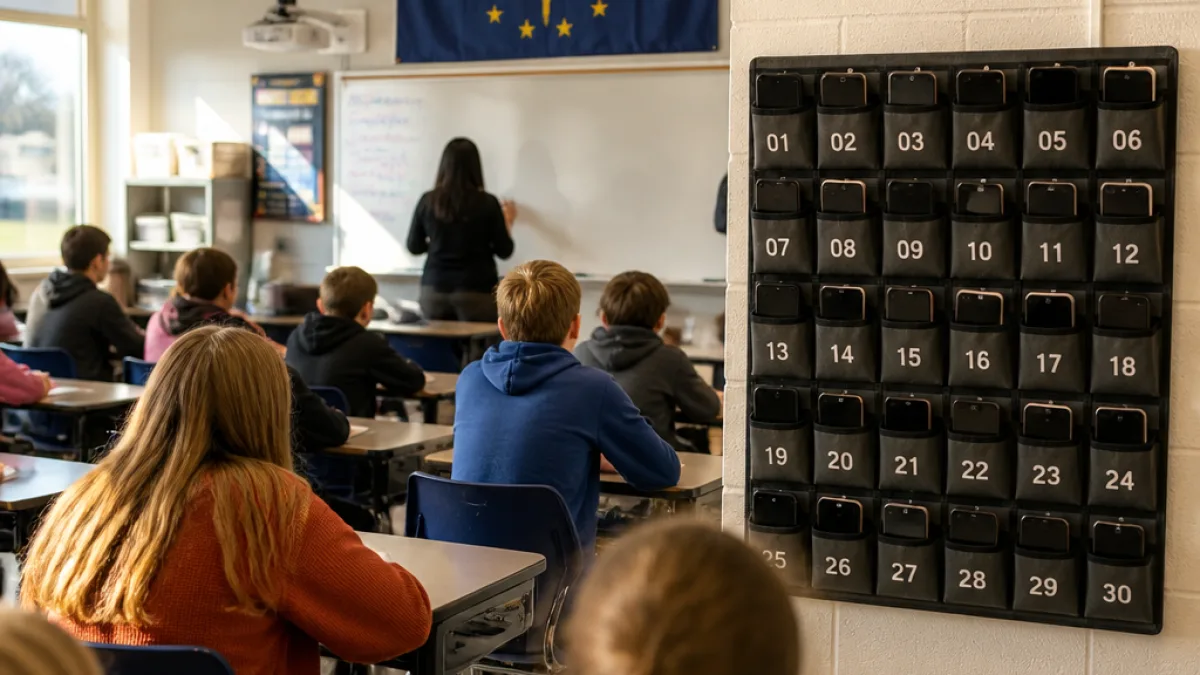
Indiana teachers and administrators report that a new statewide ban requiring students to keep personal devices powered off and inaccessible from the start of the school day until the final bell has made discipline clearer and more consistently enforced.
What the law requires
Senate Enrolled Act 78, which took effect July 1, expanded previous rules that limited phone use in classrooms to a full "bell-to-bell" prohibition across K-12 schools. The statute gives districts two basic options: ban personal devices outright for the school day, or require that phones and other devices remain powered off and stored in a place judged inaccessible until the end of the day. The law applies to both public and charter schools and includes exemptions for emergencies, medical needs and students with accommodations in Individualized Education Programs or 504 plans.
| Provision | Details |
|---|---|
| Effective date | July 1 |
| Applies to | Public and charter K-12 schools |
| Exceptions | Emergencies, medical needs, IEP/504 accommodations |
Teachers say enforcement is simpler
Andrew Biller, the student publications adviser at Anderson High School, told the Indiana Capital Chronicle that the change has encouraged teachers to follow through on consequences when students have phones out. Under previous policies described as "silent-and-away," students were often allowed to carry phones as long as they were not used in class, and some teachers hesitated to enforce rules because they expected continued violations.
“That has really, really helped enforce consequences across the board and get regular classroom teachers on board with say, ‘OK, I’m going to send this kid that has a cellphone out (to the dean) because I know that there’s going to be something done about it,’” Biller said.
Teachers said the law removed ambiguity about when and where devices could be used and that clarity has led to fewer distractions and more consistent administrative responses when rules are broken.
Districts adopt different approaches
How schools interpret what counts as "inaccessible" varies. In Fort Wayne Community Schools, officials piloted a bell-to-bell restriction two years ago and purchased magnetic-sealed pouches that allow students to lock phones, smartwatches and earbuds during the school day. Other districts may rely on lockers, classroom bins or administrative collection policies.
- Some districts require devices to remain powered off in student lockers.
- Others use lockable pouches or centralized collection boxes.
- Schools must accommodate students with documented medical or educational needs.
Classroom impact and student behavior
Teachers who spoke to the Capital Chronicle said the law has led to improved classroom focus and fewer interruptions. With clear rules aligned to state law, educators say they feel supported when removing a disruption from class and that students have begun to adapt to the new expectation as a routine part of the school day.
Supporters of the expanded rule argue it addresses what they call a learned behavior in which students repeatedly put devices away only to take them out again later. By making the prohibition apply to the entire day, proponents say the policy reduces opportunities for distraction and the administrative burden of repeated warnings.
Practical considerations for families and schools
While the law sets a statewide floor, local school boards and administrators retain authority to define procedures that meet the statute’s requirements. Families and students should check district- and school-level handbooks for specifics about storage options, disciplinary steps for violations and processes for requesting exemptions based on medical or special education needs.
For districts, implementation decisions include how to handle emergencies, where devices will be stored, how staff will monitor compliance and how to communicate changes to families. For students with IEPs or 504 plans, schools must ensure accommodations are honored under the new rule.
As districts continue to adopt or refine policies, administrators say they will monitor outcomes and may adjust procedures to balance safety, accessibility for legitimate needs and classroom management goals.
Trevor Lindqvist is the state correspondent for WE NEWS.















