
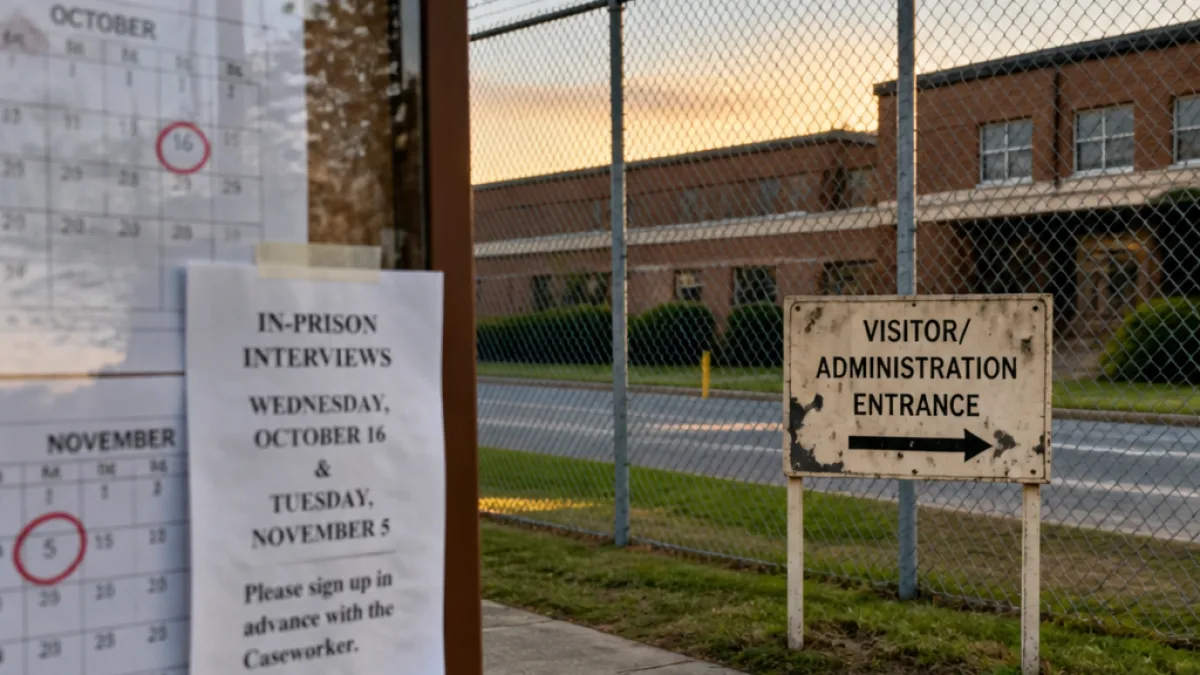
The Indiana Parole Board has scheduled two hearings in October to consider a clemency petition from Jeffrey Weisheit, who is set to be executed Nov. 5 after being convicted in the 2010 deaths of two children.
Hearing dates, locations and format
The board issued a formal notice after receiving Weisheit’s application for commutation. The schedule includes an in-prison interview and a separate day for public testimony in Indianapolis.
| Date | Event | Location | Time (local) |
|---|---|---|---|
| Oct. 16 | Prison hearing with inmate | Indiana State Prison, Michigan City | 11:30 a.m. Eastern |
| Oct. 19 | Public testimony (support/opposition) | Indiana Government Center, Indianapolis (Conf. Rooms 1 & 2) | 9 a.m.–11 a.m. (support); 1 p.m.–3 p.m. (opposition) |
The prison interview gives Weisheit an opportunity to address parole board members directly and answer their questions as they weigh whether to recommend a reduced sentence. The public hearing in Indianapolis will allow supporters and opponents to present statements in separate sessions: supporters in the morning and those opposing clemency in the afternoon.
What Weisheit’s petition says
In the clemency application filed Sept. 15, Weisheit contends that key evidence relevant to punishment was not fully presented during his earlier proceedings. The filing argues that lifelong mental impairments, congenital dysfunctions and multiple brain traumas he suffered beginning in childhood were not adequately considered as mitigating factors.
"Mr. Weisheit's lifelong mental impairments including congenital dysfunctions and the effect of multiple brain traumas suffered throughout his life, beginning early in his childhood, and their mitigating effect on the crime were never adequately presented to the courts,"
The petition also asserts that evidence of childhood psychological trauma was not presented and that the COVID-19 pandemic hindered investigation and presentation of relevant evidence in federal court.
Case background and procedural posture
Weisheit was convicted in 2013 of killing 8-year-old Alyssa and 5-year-old Caleb Lynch in a fire at their Evansville home. He was also convicted of arson. The Indiana Supreme Court set his execution date on Aug. 28; state officials have scheduled the execution to be carried out by lethal injection before sunrise at the Indiana State Prison in Michigan City.
If the parole board recommends commutation, that recommendation will be forwarded to Gov. Mike Braun, who has the final authority to grant or deny clemency. The parole board’s recommendation is advisory, but it traditionally factors heavily in the governor’s decision.
What to expect at the public hearings
Officials have outlined the structure of the Oct. 19 public session so that stakeholders can plan to participate. Those planning to speak should note the separate time blocks for supporters and opponents.
- Supporters: testimony scheduled 9 a.m.–11 a.m.
- Opponents: testimony scheduled 1 p.m.–3 p.m.
- Location: Indiana Government Center conference rooms 1 and 2 in Indianapolis
The hearings will inform the parole board’s formal recommendation to the governor. State law gives the governor authority to commute a death sentence to a lesser punishment, including life imprisonment.
Local impact and broader questions
The case draws renewed attention to the intersection of criminal justice, capital punishment and claims of unpresented mitigating evidence, including mental health and childhood trauma. The scheduled hearings will be closely watched by victims’ advocates, death-penalty opponents, legal observers and lawmakers tracking clemency policy.
Public participation is expected at the Indianapolis hearing, and the October schedule gives attorneys, family members and advocacy groups time to prepare statements and documentation for board members. The parole board’s recommendation and any subsequent action by the governor will determine whether Weisheit’s execution proceeds as scheduled on Nov. 5.
Reporting from the Indiana Department of Correction and the parole board provided the hearing dates and procedural details.
















