
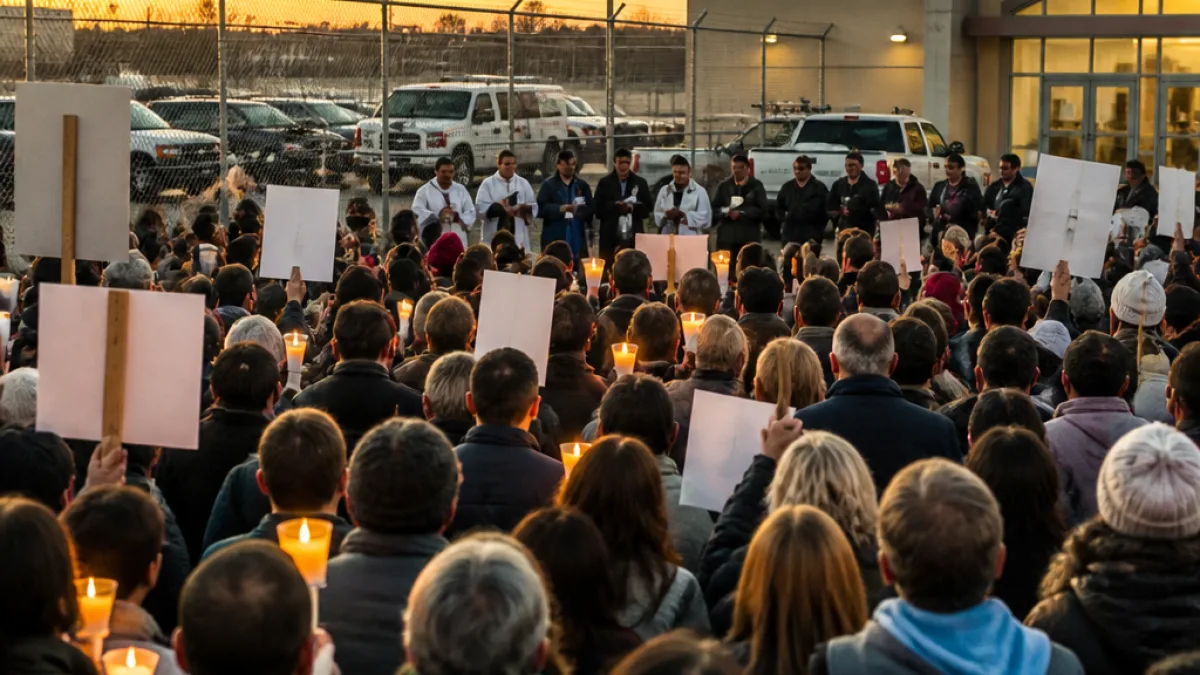
More than 600 people — including Catholic sisters, parishioners, immigration advocates and lawyers — assembled outside the U.S. Immigration and Customs Enforcement office in Blue Ash on Aug. 9 to support Haitian residents facing the loss of Temporary Protected Status and to press for permanent protections.
Why people rallied
The demonstration took place days after a federal judge in Washington, D.C., reversed an earlier decision that had blocked the Trump administration from ending TPS for Haitians. That reversal followed a U.S. Supreme Court ruling in June that limited judicial review of federal TPS designations, a legal change that the judge said removed the basis to keep the protections in place.
Organizers said they mobilized the vigil in part to respond to letters many recipients received instructing them to report to the ICE field office — a trip of nearly two hours for some families from communities such as Springfield, Ohio. The gatherings aimed to show solidarity with affected families, highlight the human toll of immigration enforcement, and call on lawmakers to create a path to permanent legal status for Haitians and other TPS holders.
Who attended and who organized it
The events drew a cross-section of local faith communities and advocacy groups. Ignite Peace, a Cincinnati nonprofit created by five communities of Catholic sisters, worked with the Miami Valley Immigration Coalition to coordinate the vigils. Participants included clergy and religious sisters, local parishioners, immigration attorneys and community activists.
Organizers described the demonstrations as both prayerful and political: a public expression of support for families who have lived and worked in the United States under TPS and as a call for legislative relief instead of deportation or forced return to a country recovering from repeated natural disasters and instability.
Scale and stakes
The judge’s ruling affects roughly 350,000 Haitians nationwide. Advocates estimate about 200,000 of those are employed in sectors including health care, food service, warehousing, retail and long-term caregiving. Local leaders warned that ending the protections could destabilize households and local workforces that rely on these employees.
| Figure | What it represents |
|---|---|
| 350,000 | Haitians potentially affected across the U.S. |
| 200,000 | Estimated TPS holders employed in key industries |
| Aug. 5, 2026 | Date the judge issued the reversal |
Local impact and community response
For many in the Miami Valley area, the decision created immediate uncertainty. Some recipients received administrative notices directing them to report to the ICE office in Blue Ash — a significant hardship for people who lack reliable transportation or who must arrange time off from work and childcare.
Faith leaders who attended said the vigils were intended to raise public awareness and press Ohio’s congressional delegation to act. Local immigration attorneys said they will continue to pursue legal avenues available to their clients, including claims alleging improper motives behind the termination of TPS.
- Support services: Local nonprofits and churches are coordinating legal clinics and assistance for people receiving ICE notices.
- Advocacy goals: Organizers are urging Congress to pass legislation granting permanent status to TPS holders.
- Practical challenges: Travel to the Blue Ash ICE office presents logistical and financial barriers for many families.
What’s next
While the judge’s order cleared the legal path for the federal government to terminate TPS for Haitians, attorneys are continuing to explore claims that the termination was influenced by unlawful considerations. On the policy side, advocates are pressing for a congressional solution that would provide a pathway to permanent residency for those who arrived under TPS and have built lives and livelihoods in the U.S.
Locally, groups such as Ignite Peace and the Miami Valley Immigration Coalition plan further public actions and legal support efforts. They say the goal is to keep affected families informed, reduce immediate removal risks where possible and build pressure for legislative relief.
The coming weeks are likely to bring more coordination between faith communities, legal advocates and impacted families as they respond to notices and seek counsel on next steps. For many, the rallies were the start of a sustained local campaign to protect neighbors now facing a precarious future.
Damon Carver, State Correspondent, WE NEWS