
COPLEY TOWNSHIP, Ohio — A change to Ohio tax law that took effect this year removed a financing tool many local governments used to capture rising property values, forcing Copley Township officials to rethink how they will pay for millions of dollars in fire equipment and operations.
What changed and why it matters locally
Before Jan. 1, 2026, municipalities and townships could place so-called replacement levies on the ballot. Those measures allowed local taxing authorities to reset an effective millage to an earlier, voter-approved rate so the jurisdiction could collect more as property values climbed. The state law that went into force for elections beginning in 2026 bars that approach, narrowing the options available to Copley Township trustees as they prepared for an autumn vote.
Officials in Copley concluded the loss of the replacement-levy tool would reduce the revenue they could reasonably seek while keeping existing levies in place. Township records show officials estimated a replacement levy under the prior rules would have yielded roughly $1.7 million more a year—about 2.1 mills in additional effective tax rate—than the path the trustees chose after the change.
What voters will see on the ballot
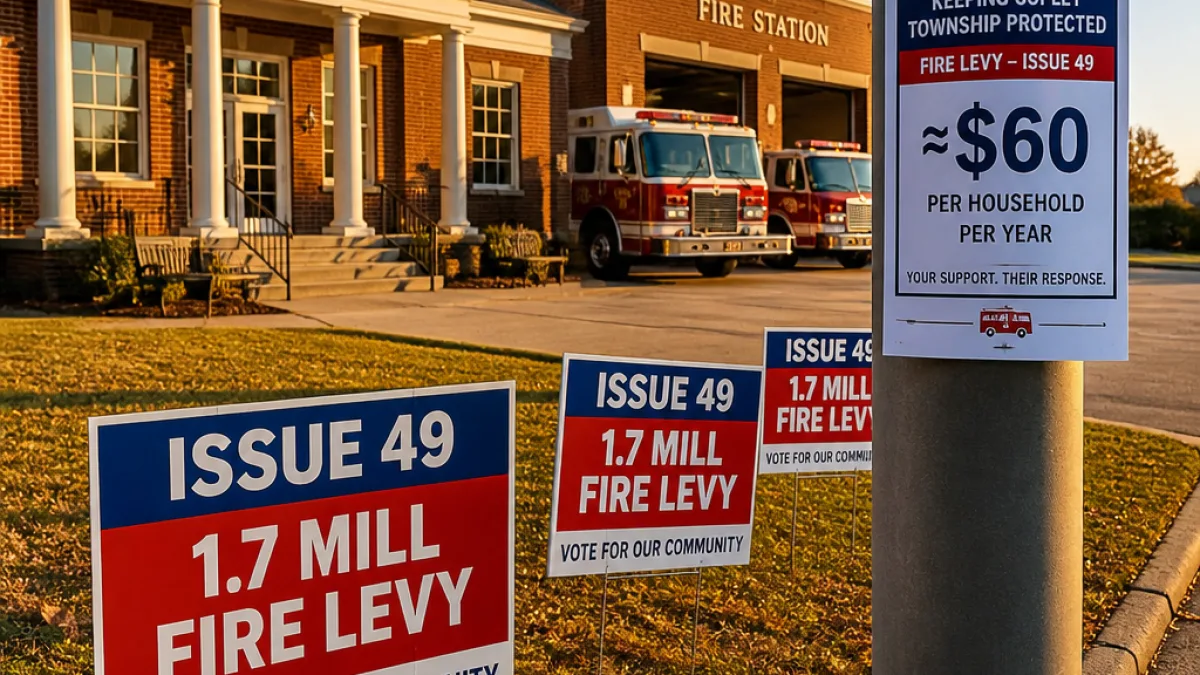
Instead of proposing to replace existing levies, trustees opted to ask voters Nov. 3 to approve an additional, limited-time levy. Ballot Issue 49 is a 1.7-mill fire levy that would be assessed for three years while the township retains its two continuing fire levies approved previously.
| Measure | Estimated annual revenue | Estimated household cost |
|---|---|---|
| Replacement levy (prior option) | $1.7 million (estimate) | Not specified |
| Issue 49 (1.7-mill, 3 years) | $1.3 million (county estimate) | About $60 per year |
The Summit County fiscal officer’s preliminary calculation indicates the proposed additional levy would produce more than $1.3 million annually. Township documents estimate the measure would cost a typical homeowner about $60 a year.
Local officials’ calculations and perspective
Township leaders have tried to balance maintaining fire service capacity with an awareness of what voters will accept. Copley’s fire operation is funded largely through two continuing levies approved in 2019 and 2020, which together carry a voted rate of 7.5 mills. Those continuing levies remain in place under the trustees’ plan.
"Replacing the current levies under the former law was estimated to generate about $1.7 million more annually," Township Administrator Greg Tracy told trustees, according to township minutes.
That estimate, discussed during trustee meetings earlier this year, was a central factor in the township’s deliberations. With the replacement option removed by the state, officials said a shorter, additional levy represented the most practical route to secure funding for near-term equipment and service needs.
Implications for other local governments
The prohibition on replacement levies affects a range of political subdivisions across Ohio, including townships, school districts and municipalities. Many jurisdictions that had relied on replacement measures to recover revenue lost to rising property values must now consider alternative approaches—such as limited-term supplemental levies, permanent new levies, or service cuts.
- Revenue trade-offs: Replacement levies historically let jurisdictions reset effective millage to capture growth in property values; without them, some localities will see lower revenue potential from renewal-style ballots.
- Voter decisions: Electors will increasingly confront choices between short-term additional levies and longer-term tax increases to sustain services.
- Budget planning: Officials may need to plan for more frequent ballot measures or adjust capital and equipment schedules.
For Copley residents, the Nov. 3 vote will determine whether the township secures the additional funding officials say is needed for fire services without altering the two earlier levies the community already approved.
The trustees have provided the township’s financial estimates and projections to county officials and discussed the matter in publicly posted meetings. Voters who want more detail can review the township minutes and the county fiscal officer’s estimates ahead of the election.
Reporting for WE NEWS. Damon Carver, state correspondent.