
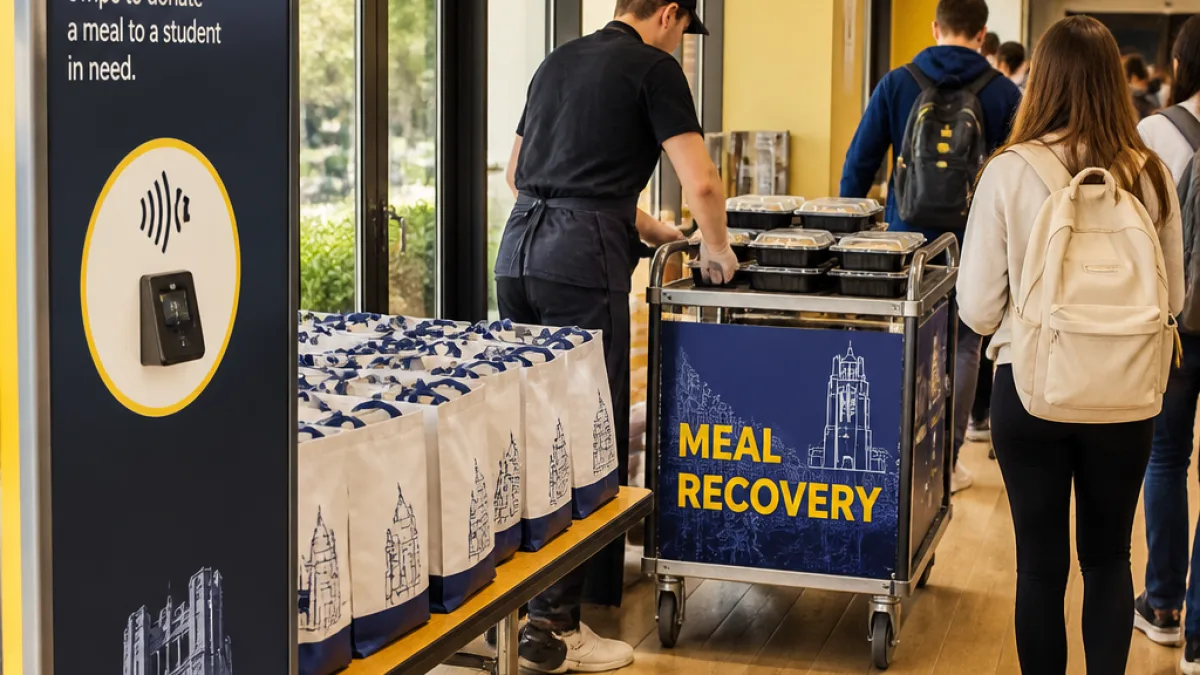
The University of Toledo is expanding campus supports this fall to address student food insecurity with three coordinated initiatives designed to reduce hunger and redirect surplus food to students in need.
Three-pronged approach aims to expand access
University officials said the programs — the Rockets Feeding Rockets Meal Swipe Donation Program, the return of Meal Recovery and distribution of Emergency Food Bags — will work together to reach students who are struggling to afford regular meals.
- Rockets Feeding Rockets Meal Swipe Donation Program: Students with meal plans can donate unused meal swipes to peers who are experiencing food insecurity at The Eatery.
- Meal Recovery: A partnership with Chartwells that redirects leftover catering orders to feed students while reducing food waste; notifications available through InvoNet.
- Emergency Food Bags: Ready-to-heat kits provided to campus partners and student support spaces, including Health Science Campus.
Those programs are being coordinated through the Center for Advocacy and Student Experience (CASE) and involve campus partners, auxiliary services and the university dining contractor, Chartwells, university officials said.
“I’m really excited and proud of the initiatives launching this fall to support our students’ basic needs,” said Danielle Lutman, associate director for the Center for Advocacy and Student Experience (CASE).
University leaders emphasized that the efforts aim both to provide immediate assistance and to demonstrate that the campus community recognizes and responds to student needs.
How students access help
Students who wish to donate meal swipes can begin doing so as the program launches this week, officials said. Students who need assistance should be connected to CASE through a Rocket Care Report, the university’s incident and support referral system.
Meal Recovery, which is returning to the Thompson Student Union, requires students to register on InvoNet to receive notifications when recovered meals are available.
| Program | Primary function | How to access |
|---|---|---|
| Rockets Feeding Rockets | Donated meal swipes for students in need | Donate via campus meal-plan system; request via Rocket Care Report |
| Meal Recovery | Redirect leftover catering to students | Register on InvoNet for availability alerts |
| Emergency Food Bags | Ready-to-heat food kits (~nine meals) | Distributed by campus partners and support spaces |
Aaron Skees, Chartwells director of marketing, said the dining contractor is supporting the programs.
“The meal swipe donation and food recovery programs provide Rockets in need with another critical opportunity for support,” Skees said.
Data and campus distribution
The university pointed to its internal data from the 2025-26 Rocket Care Reports to justify the expanded measures. That reporting showed Emergency Food Bags have been provided to campus partners who work directly with students experiencing food insecurity.
University materials note that an Emergency Food Bag contains about nine meals that require only water and a microwave to prepare. These bags have been placed in support areas across campus, including the Health Science Campus.
Campus leaders frame the push as both a safety net and a community signal: that students who struggle to get enough to eat have visible, practical options on campus. Officials also said the interventions are intended to reduce food waste by channeling surplus catering food to students rather than discarding it.
As the fall term begins, students and campus groups will be watching how quickly donated swipes and recovered meals move through the system and whether the Emergency Food Bags meet demand. The university did not provide figures for how many meal swipes have been donated or the number of Emergency Food Bags currently on hand.
For students seeking help or to learn how to donate, the university recommends contacting the Center for Advocacy and Student Experience through the Rocket Care Report process and watching InvoNet for Meal Recovery notifications.
The new measures add to broader efforts at colleges nationwide to address food insecurity, an issue that university officials say remains a pressing concern for some students balancing education and basic living costs.