
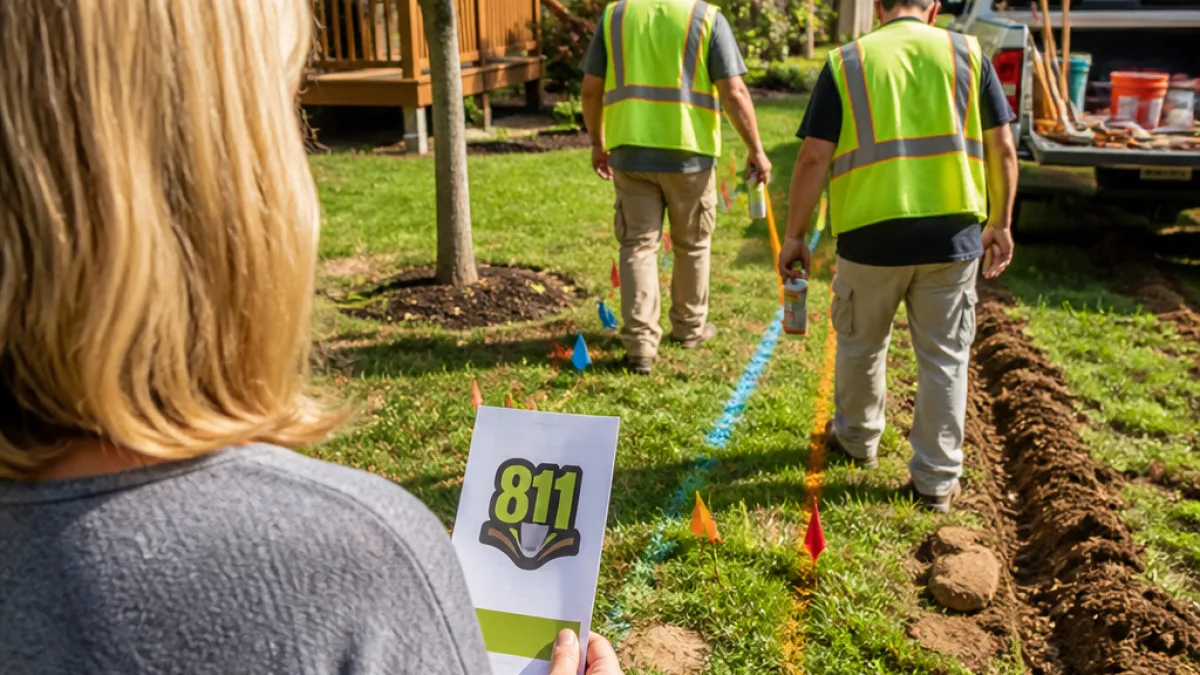
ATLANTA — As 811 Day (Aug. 11) nears, Georgia 811 is renewing its warning to homeowners, contractors and landowners across the state: request a locate ticket before you dig, every time, for every site.
One call triggers professional locates — not a permit
Megan Estes, director of corporate communications at Georgia 811, said common excuses — ranging from “I know where my utilities are” to “I’m not digging very deep” — can be dangerous and misleading. The locate process, she said, is not a one-time clearance for future work but a notification system that alerts utility operators to a planned excavation.
"These are some of the most common reasons people give for not contacting 811 before digging," Estes said. "The reality is that every digging project is different."
Under state law, anyone planning to excavate must contact Georgia 811 at least three business days before beginning work. After a locate request is filed, Georgia 811 notifies utility companies that may have underground facilities in the area. Those utilities then send technicians to mark the approximate location of their lines using paint, flags or both.
Why the ticket matters
Georgia 811 does not itself mark underground infrastructure. Its role is to notify affected utility companies, which are legally responsible for sending their own locators to mark facilities. That distinction matters because homeowners and contractors sometimes assume calling 811 places a ticket with a single agency that performs markings; instead, the utility companies carry out the field work.
Before breaking ground, people digging should confirm that all notified utilities have responded. Using the ticket number, customers can check responses online at Georgia811.com or through the Georgia 811 mobile app.
- Contact Georgia 811 at least three business days before digging.
- Ticket validity: one specific location, one type of work, for 30 days.
- Check ticket responses online or via the mobile app to verify markings.
The service is free. Georgia 811 emphasizes that taking a few minutes to request a locate ticket can prevent service outages, avoid costly repairs and reduce the risk of injury or death.
What the ticket covers — and doesn't
The ticket you submit is tied to precise parameters: the location you identify, the nature of the work planned and a 30-day window. If the dig site shifts or the scope of work changes, a new ticket must be submitted. This requirement applies to projects large and small — from planting a tree or installing a mailbox to building a fence or undertaking major construction.
To help readers understand the requirements at a glance, the basics are summarized below.
| Aspect | Requirement |
|---|---|
| Advance notice | At least three business days |
| Validity | One location, one type of work, 30 days |
| Who marks lines | Utility companies' locate technicians |
Estes stressed that being on a property when utilities were installed — or working on a farm — does not exempt one from requesting a locate. The underlying infrastructure, depth and routing can change or be buried in unexpected places, she said.
Georgia 811 offers multiple ways to submit a locate request. Homeowners and contractors can file tickets online at www.Georgia811.com or simply dial 811, the national Call Before You Dig number. After filing, users receive a ticket number they should keep on hand until the project is complete and markings are verified.
Local officials and utility operators say the simple step of contacting 811 has a track record of preventing damage to buried lines that supply electricity, natural gas, water, telecommunications and other essential services. The practice also reduces the chance that an excavation will cause an unplanned outage affecting neighbors or critical infrastructure.
As summer projects and back-to-school property work increase in the coming weeks, Georgia 811 is reminding residents that the process is quick, easy and free — and that a single missed ticket can have costly or dangerous consequences.


















