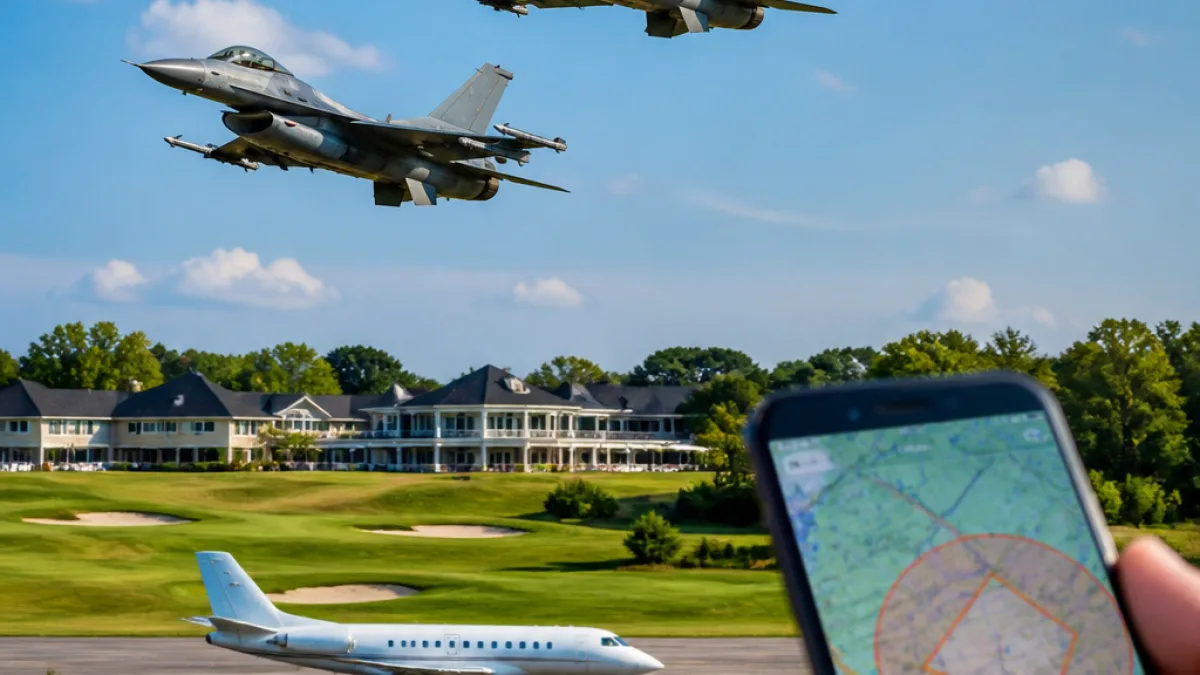
BEDMINSTER, N.J. — North American Aerospace Defense Command fighters intercepted at least two general aviation aircraft and monitored a third Sunday after they entered temporary flight-restricted airspace around President Donald Trump's golf club in Bedminster, officials said, an event that briefly delayed the president's departure to Washington.
What happened
NORAD said F-16s escorted two small aircraft out of the restricted area on Aug. 9, while a third aircraft "reestablished communications and became compliant before NORAD intervention was required," according to agency statements and accounts from pooled White House reporters. Video shared on social media showed what appeared to be an F-16 trailing a small Cessna.
The incident coincided with the president's weekend at his Bedminster golf club and the LIV Golf New York tournament taking place nearby. Fox News reported the third aircraft prompted an alert as President Trump prepared to board Air Force One, delaying the plane's departure by roughly 13 minutes.
"A number of Secret Service agents gathered on the runway just under the wing and were looking down the runway at something that appeared to be delaying departure," read a note from the out-of-town press pool at 5:55 p.m. EST. "Secret Service is now back on the plane and we are getting underway."
Authorities and responses
NORAD said it enforced multiple Federal Aviation Administration temporary flight restriction (TFR) areas that were in place for the president's presence. The agency confirmed the two aircraft were safely escorted out of the area.
The FAA establishes TFRs around certain VIPs and events to protect airspace for safety and security. NORAD had publicly warned of the TFRs for the New Jersey area ahead of the president's arrival and noted that U.S. Army ground-based defense assets could be deployed in support of enforcement.
Local context and implications
Bedminster and surrounding communities often see tightened airspace and heightened security when the president visits. Temporary flight restrictions typically prohibit general aviation from entering designated zones or require pilots to maintain radio contact and adhere to instructions from air-traffic control.
Incursions into TFR zones can result from pilot error, miscommunication, or technical issues. In this case, NORAD described the intrusions as general aviation aircraft rather than commercial flights or unmanned systems, and said no kinetic action was required. Still, the appearance of a military escort underscored the sensitivity of airspace around a presidential site.
- Two aircraft were escorted out of the TFR by F-16s.
- One aircraft regained communications and complied before intervention.
- The president's departure on Air Force One was delayed about 13 minutes, according to press pool reports.
Incident summary
| Aircraft | Action by NORAD | Outcome |
|---|---|---|
| General aviation #1 | Escorted by F-16 | Safely exited TFR |
| General aviation #2 | Escorted by F-16 | Safely exited TFR |
| General aviation #3 | Reestablished communications | Compliant before intervention |
Safety guidance for pilots and the public
Pilots operating in New Jersey airspace must check Notices to Air Missions (NOTAMs) for active TFRs and maintain communication with air-traffic control. TFRs can cover large areas and are enforced by both civilian and military agencies when a protected individual is traveling.
For residents and visitors, the visible presence of military aircraft conducting intercepts may be startling but is part of routine enforcement. Local authorities typically do not disclose real-time security details beyond confirmed outcomes to avoid compromising protective measures.
Broader significance
Intercepts like these highlight the layered approach to airspace security around presidential movements, combining FAA regulation, Secret Service protection, and NORAD's air defense capability. While the incidents did not result in a security breach or reported damage, they prompted a brief interruption in the president’s travel schedule and drew public attention through social media video and press pool notes.
NORAD and FAA statements remained the primary official sources; local officials in Bedminster did not provide immediate additional comment. The agencies have not indicated any follow-up enforcement actions or investigations beyond the immediate response.
Further updates will depend on any formal reports released by the FAA, NORAD or the Secret Service concerning pilot compliance or procedural findings related to the TFR violations.