
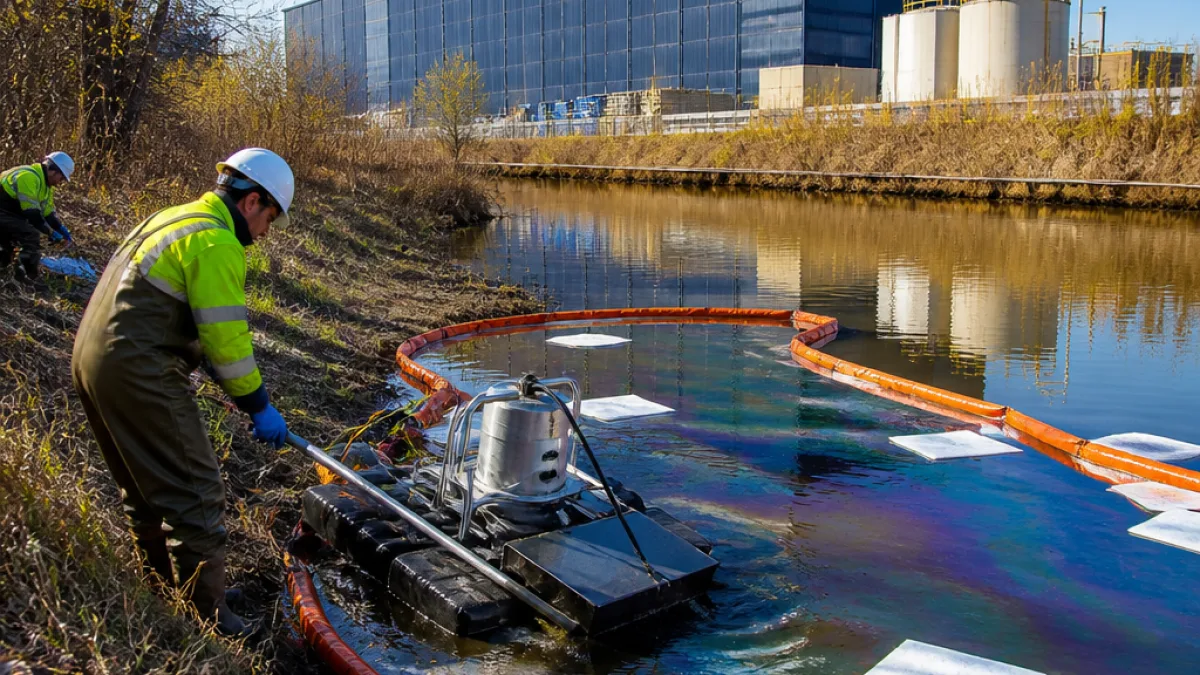
The cleanup of several thousand gallons of No. 2 diesel fuel that leaked into Anderson Creek, a tributary of the Hackensack River in Secaucus, continued into the week after crews worked around the clock to contain and recover fuel, state environmental officials said Sunday.
Source and response
State Department of Environmental Protection spokesperson Larry Hajna said the spill originated at a storage tank outside an Equinix data center the company refers to as NY2. The fuel stored at the site is used for heating and to power vehicles.
"Contractors are working to remove oil and water and it probably will be continuing into the week,"
Hajna added that, to his knowledge, "wildlife was not impacted." Equinix detected the leak Friday evening, halted the release and notified emergency responders, according to the company.
Equinix said it hired remediation firm Clean Harbors and contacted the Secaucus Fire Department, which in turn alerted the DEP and the Hudson Regional Health Commission. In a written statement, the company said it is working with agencies, local officials and community stakeholders to ensure a thorough cleanup and to determine the root cause of the leak.
Estimates, scope and local concern
The amount spilled has not been confirmed by state officials, but local environmental advocates visited the site and offered an early estimate. Hackensack Riverkeeper Bill Sheehan told reporters he believed about 5,500 gallons had been released based on his observations at the scene.
Debris booms and skimming equipment were deployed to limit downstream movement of the fuel. Contractors focused on separating oil and water and removing contaminated material from the creek and nearby containment areas.
- Leak detected Friday evening at Equinix NY2 storage tank
- Contractors and Clean Harbors performing remediation under state oversight
- Secaucus Fire Department, DEP and Hudson Regional Health Commission notified
Why a data center tank matters
Equinix operates multiple data centers in the New York/New Jersey region, including a facility in Secaucus it has run for more than two decades. The company said it operates 10 centers in the New York/New Jersey area. Fuel stored on-site commonly powers backup generators and supports building systems, particularly in facilities with high energy demands.
Data centers in New Jersey have seen increased scrutiny recently. In late August, Gov. Mikie Sherrill signed legislation requiring data center operators to report water and energy use to the state Board of Public Utilities twice a year for three years. The measure reflects growing concerns over the environmental footprint of large computing facilities, which can demand significant electricity and water resources.
Environmental and community implications
Anderson Creek feeds into the Hackensack River, a waterway that has been the focus of decades of restoration work. Any fuel spill raises concerns about impacts to aquatic life, water quality and recreation. State officials said they had no reports of affected wildlife as of Sunday, but monitoring and remediation were ongoing.
Residents and community groups often press for transparency and swift action when pollutants enter local waterways. Equinix’s statement said the company is committed to resolving the incident "quickly, transparently and responsibly" and that it is conducting a full investigation to prevent recurrence.
| Item | Detail |
|---|---|
| Estimated volume | ~5,500 gallons (local estimate) |
| Fuel type | No. 2 diesel |
| Response | Clean Harbors, DEP oversight, Secaucus Fire Dept., Hudson Regional Health Commission |
Next steps and oversight
State officials said contractors will continue removing oil and contaminated water into the week. The DEP will oversee remediation activities and the company has pledged a root-cause investigation. Any findings or violations identified by the DEP could lead to further enforcement action or additional cleanup requirements.
For residents who use local waterways for recreation or who draw water nearby, officials recommend following announcements from the DEP and local health authorities about any advisories. At this stage, agencies report they are coordinating the response and monitoring for public-health impacts.
The spill highlights growing tensions over industrial infrastructure sited near sensitive waterways and the increasing regulatory attention on data centers in New Jersey as demand for computing capacity expands.
Reporting for this story included company statements and information provided by the New Jersey Department of Environmental Protection and local environmental observers.

















