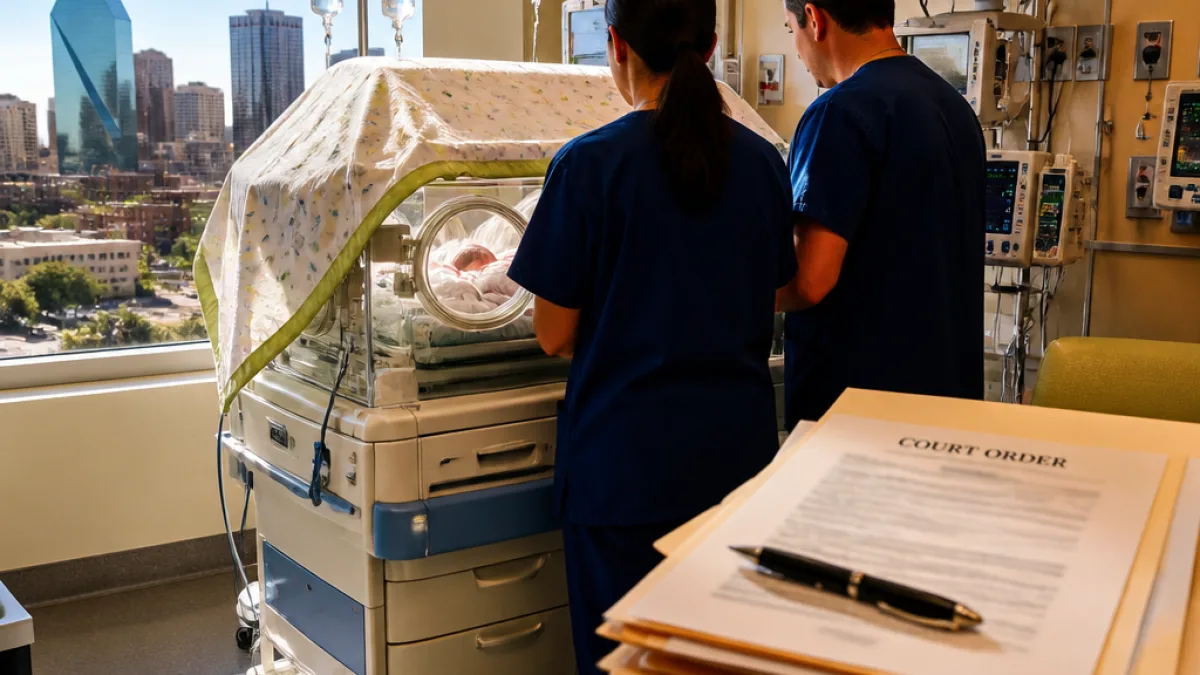
Dallas — A newborn delivered Wednesday by a California couple’s surrogate was receiving stabilizing medical care in a Texas hospital after a judge in Dallas ordered that the child be provided life-sustaining treatment, court filings and attorneys said. The decision comes amid a legal dispute that drew involvement from Texas Attorney General Ken Paxton and national attention from conservative groups.
Background of the dispute
The surrogate, McKenna West, had accused the California intended parents of wanting to end the pregnancy after the fetus was diagnosed with hypoplastic left heart syndrome, a congenital condition that severely affects the left side of the heart. The California couple, identified in court papers as Omar Ahmed and Nausheen Gilkar, have denied those claims in filings.
On Tuesday, a Dallas judge ordered that the newborn receive life-sustaining treatment. The ruling came after Paxton intervened in support of the surrogate, escalating what had already been a contentious and closely watched dispute.
Medical condition and immediate care
Physicians described the baby’s diagnosis — hypoplastic left heart syndrome, often shortened to HLHS — as a life-threatening defect in which the left side of the heart does not form properly, impeding normal blood flow. Without surgical intervention, infants with the condition can develop severe symptoms including breathing difficulties and low oxygen levels.
According to statements from attorneys involved, the newborn was receiving stabilizing care and was scheduled to undergo surgery in Texas. An attorney for West said she “has taken on great personal risk to herself,” praising her decision to continue the pregnancy.
“She has taken on great personal risk to herself,”
Attorneys for the intended parents issued a statement saying their clients were focused on ensuring the baby received necessary medical care and that the parents could spend time with their child. Their counsel also accused West and Paxton of turning the family’s situation into political theater.
“Our clients’ only focus at this time is ensuring that their baby receives the medical care that he vitally needs and that they, as his parents, are able to spend every precious moment they can with him,”
Legal and political implications
The case has become a flashpoint for broader debates over reproductive rights, surrogacy arrangements and the reach of state actors into family and medical decisions. Paxton’s intervention on behalf of the surrogate drew support from right-to-life groups and Republican officials, amplifying the dispute beyond the private parties involved.
Legal filings show competing narratives: West alleges the intended parents sought to terminate the pregnancy after the HLHS diagnosis; the intended parents deny that they planned to refuse necessary treatment for the child after birth.
What HLHS means and local context
Hypoplastic left heart syndrome is rare but severe. The Centers for Disease Control and Prevention estimates roughly 925 births in the United States annually involve HLHS. Treatment typically requires a series of complex surgeries that can extend over months and years; without intervention, the condition can be fatal within days or weeks.
| Item | Detail |
|---|---|
| Condition | Hypoplastic left heart syndrome (HLHS) |
| Estimated U.S. births/year | 925 |
| Immediate course | Stabilizing care and planned surgery in Texas hospital |
Voices and next steps
Lincoln Davis Wilson, attorney for West, framed the surrogate’s decision to carry the pregnancy as personally risky and morally significant. The intended parents’ attorney characterized public statements by West and Paxton as politicization of a private tragedy.
As of Wednesday, officials said the infant was under medical care and scheduled for surgery. The court order to provide life-sustaining treatment ensures the hospital can proceed with interventions necessary to stabilize the child pending further legal actions or medical updates.
- Case highlights tension between surrogate rights and intended parents’ decisions
- Texas AG’s involvement elevates the dispute into a political and legal test case
- Medical outcome depends on complex surgeries that are not cures but can be life-sustaining
The situation remains fluid. Court records, statements from counsel and hospital care plans will determine next steps for the newborn and for any ongoing litigation between the surrogate and the intended parents. Local officials and medical teams in Dallas will oversee the immediate care, while the wider legal and political debate continues to play out in public statements and filings.