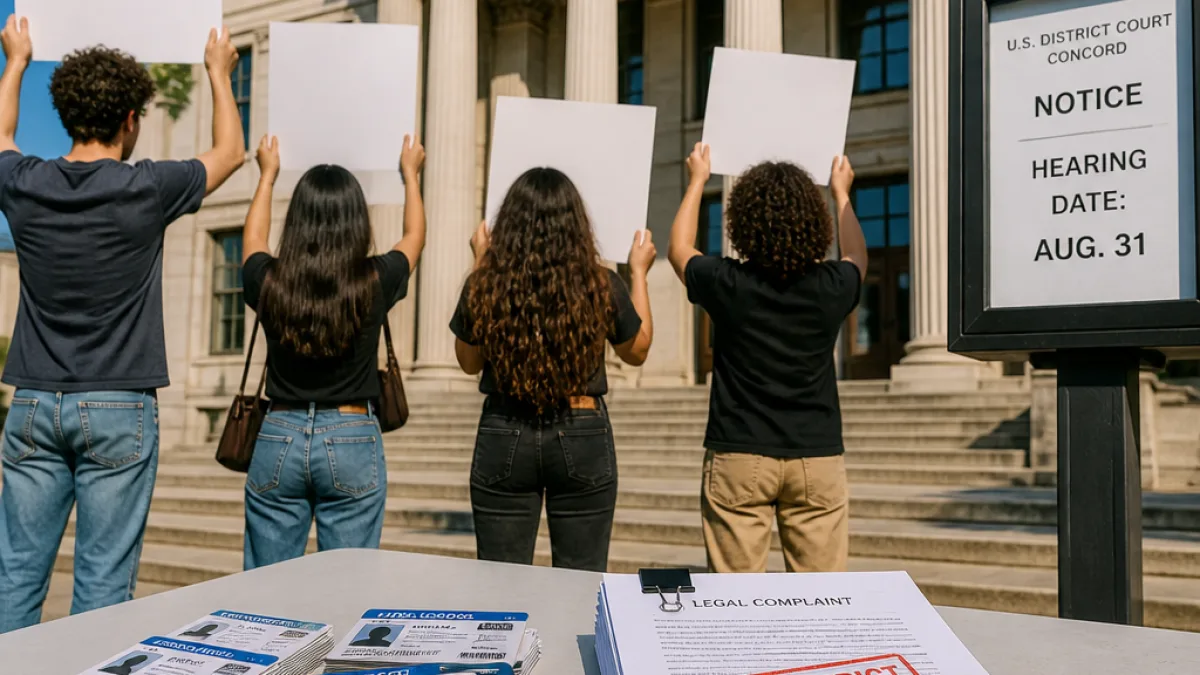
CONCORD — A Concord-based voting rights organization filed suit Tuesday in U.S. District Court seeking to halt what it describes as an unlawful restriction on student voting in New Hampshire. The Coalition for Open Democracy argues House Bill 323 — signed into law in June — and a subsequent directive from Secretary of State David Scanlan strip students of commonly used identification when they attempt to register, request absentee ballots or check in at polling locations.
What the lawsuit alleges
The Coalition’s complaint, filed in federal court, targets HB 323 and Scanlan’s April 23 directive, which the group says goes beyond what the legislature intended. According to legal counsel Ben Horton, the directive "unlawfully extends" the law by categorically barring student IDs — including high school and college-issued cards — as acceptable proof of identity or domicile.
“The laws have changed a lot, so if you voted in 2025 or 2024, this year will be different,” said Olivia Zink, executive director of the Concord-based nonprofit voting rights group the Coalition for Open Democracy. “They limited the amount of documents that can prove domicile, they’ve added requirements for absentee ballots. If you’re going to vote for the first time, remember ACID: Age, Citizenship, Identity, Domicile.”
Horton said the Coalition met with a judge the morning the suit was filed and has a motion hearing set for Aug. 31. The lawsuit asks the court to prevent Scanlan’s office from implementing policies that would remove student-issued identification from the list of acceptable documents used to demonstrate eligibility to vote.
Why students are at the center of the dispute
Horton told reporters there is a sizable share of young Granite Staters — especially those aged 18 to 24 — who do not possess driver’s licenses, the form of identification he says will become dominant under HB 323. While other federally recognized IDs such as passports or military identification remain valid, Horton and the Coalition say those are not viable options for many students.
- HB 323 was signed into law in June by Gov. Kelly Ayotte.
- Secretary of State David Scanlan issued a directive on April 23 barring student IDs from use in voter transactions.
- The Coalition’s motion hearing is scheduled for Aug. 31 in U.S. District Court.
A spokesperson for the Secretary of State’s office could not be reached for comment when the suit was filed.
Broader context and practical impact
Election advocates say changes to what documents can prove domicile and identity, and new absentee ballot rules enacted this year, will alter the voting process for people who participated in recent elections. The Coalition coordinates voter registration and outreach across New Hampshire and said its work is directly affected by the statute.
For students who live on campus or move between in-state addresses during the school year, commonly issued student IDs have long been used as part of the paperwork to confirm where someone lives and who they are. The lawsuit alleges removing those IDs will create barriers that could suppress participation among younger voters.
What to know if you plan to vote
Election officials and advocacy groups advise prospective voters to review updated requirements well before they cast ballots this year. While the litigation plays out, practical options include:
- Confirming acceptable documents with the local town or city clerk's office.
- Applying for a state driver’s license or non-driver ID if eligible.
- Using a passport or military ID where available.
The Coalition warned that relying on less common forms of identification could impose time and expense burdens on students and young adults who previously used school-issued IDs without issue.
Next steps
The case will return to federal court for the scheduled motion hearing on Aug. 31, where the Coalition will press for relief preventing enforcement of Scanlan’s directive as it relates to student IDs. Until then, uncertainty remains for student voters and the organizations that assist them with registration and turnout efforts.
The outcome could affect not only how college and high school students demonstrate eligibility to vote this year, but also how local elections are administered in the years to come if courts clarify whether the Secretary of State exceeded the law’s scope.