WENDOVER, Utah — Twenty years after setting a diesel land speed record on the Bonneville Salt Flats, retired Royal Air Force pilot Andy Green is back on Utah’s salt surface this week behind the wheel of a hydrogen-powered car, aiming to outpace his earlier mark and highlight hydrogen as an alternative fuel.
New car, new fuel, familiar landscape
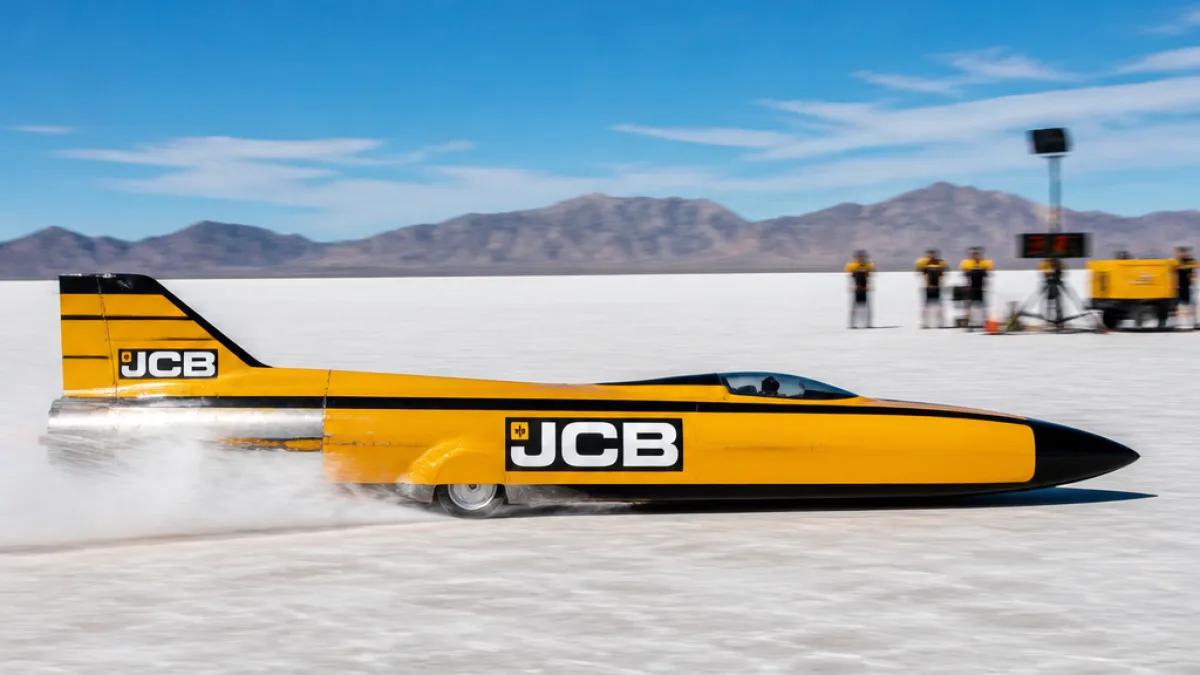
Green will pilot the 32-foot (9.75-meter) JCB Hydromax, a long, slim, bright-yellow vehicle developed by British construction-equipment manufacturer JCB. Rather than relying on jet propulsion or diesel, the Hydromax uses two hydrogen internal-combustion engines adapted from JCB’s heavy machinery. The pair produce a combined 1,600 horsepower by igniting pressurized hydrogen mixed with air.
The pilot and team have been practicing on the lunar-like salt surface in recent days. In practice runs last week, Green reached a top speed reported at 368.347 mph (592.797 kph). For any official record to stand, however, the run must be observed and ratified by the Fédération Internationale de l’Automobile (FIA), the sport’s global governing body.
Targets: diesel, hydrogen and electric benchmarks
Green’s 2006 diesel-powered record — set on this same stretch of salt — stood at 350.092 mph (563.4 kph). The Hydromax project seeks to surpass that mark. Team organizers have also framed the effort as an opportunity to set recognized speed records for hydrogen internal-combustion engines and to challenge electric vehicle marks.
“What the peak speed is, I can’t say. We just don’t know. Part of the adventure here is we’re going to find out.”
In interviews, Green has emphasized the demonstration aspect of the attempt: showing hydrogen’s potential as a low-carbon energy option for transportation and industrial uses. He has described hydrogen as the “fuel of the future,” positioning the run partly as a technology showcase as well as a pure racing endeavour.
How the Hydromax is powered
The Hydromax’s propulsion is notable because it uses hydrogen in internal-combustion engines rather than fuel cells. The engines operate by compressing hydrogen gas with air and igniting the mixture — a more familiar architecture for mechanics used to conventional combustion engines, but adapted for the unique properties of hydrogen.
- Vehicle: JCB Hydromax, 32 feet long
- Powerplant: Two hydrogen internal-combustion engines, combined 1,600 hp
- Practice top speed: 368.347 mph (592.797 kph)
- Official targets: Beat 350.092 mph diesel record; set hydrogen-ICE record
Context: land speed marks and what’s required
Land speed records require measured runs conducted under strict rules and witnessed by the FIA. Typically, a record attempt consists of two runs in opposite directions within a specified time window to offset wind and slope effects. Practice speeds do not count toward official records; the official attempt must meet timing, distance and observation standards.
| Record type | Speed | Holder / year |
|---|---|---|
| Outright land speed (jet-powered) | 763.035 mph (1,227.98 kph) | Andy Green, 1997 |
| Diesel-powered | 350.092 mph (563.4 kph) | Andy Green, 2006 |
| Electric vehicle | 341.3 mph (549.2 kph) | Current benchmark (FIA class) |
| Hydrogen internal-combustion | 185.5 mph (298.5 kph) | Current benchmark (FIA class) |
Local impact and the Bonneville setting
The Bonneville Salt Flats, west of Wendover, have long been a testing ground for land speed attempts because of their vast, flat expanse. Events draw teams, engineers and spectators from around the world, producing short-term economic activity in rural communities nearby. Safety protocols, environmental considerations and logistics — including support vehicles, timing equipment and marshals — are all part of a coordinated effort to conduct high-speed trials on the fragile salt crust.
Organizers say the Hydromax attempt aims both to set records and to spur discussion about hydrogen’s role in future transportation solutions. Whether the run will alter the broader energy conversation depends on how the experiment is framed, measured and publicized. For now, the focus at Bonneville is technical: can a hydrogen internal-combustion machine surpass the speeds Green once achieved with diesel, and how will the FIA record the result?
Attempts are scheduled to take place under FIA supervision. The outcome will determine whether JCB and Green add another certified entry to the books at one of the most storied venues in American motorsport.
Spencer Holloway is the state correspondent covering Utah for WE NEWS.