
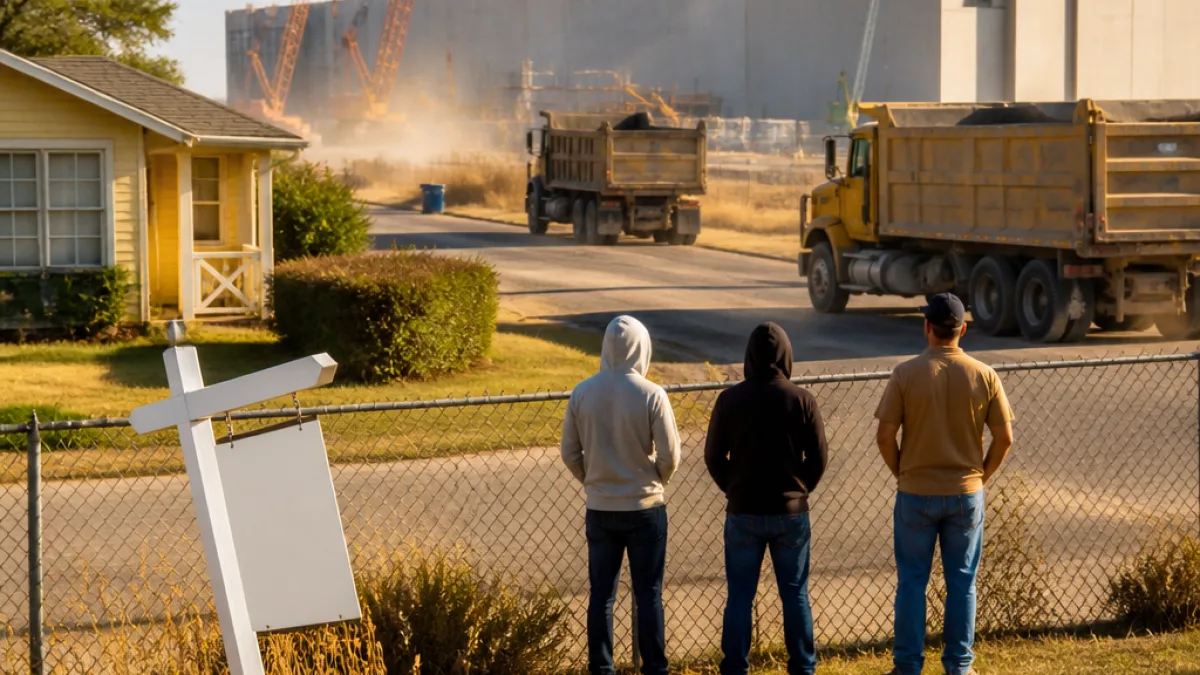
ABILENE — As construction rose on one of the largest data center campuses in the country, some local residents say the project has brought disruption, not prosperity, to neighborhoods surrounding the site.
Residents report strains on roads, air, water and housing
Lexi Smith and her husband moved their family just outside Abilene with a multigenerational plan: buy land large enough to build multiple homes so their children could grow up next door to grandparents. Since construction started on the Stargate Project in 2024, that plan has unraveled, she said.
Smith and other neighbors describe a mix of problems they attribute to the construction of the data center campus: increased traffic, damaged local roads, worsened air and water quality and declining residential value for properties close to the site. The Stargate Project has been described by officials as part of a wave of data center investment expected to boost local economies; critics in Abilene say those benefits have not materialized for nearby homeowners.
"We got taken, we got robbed," Smith said. "Because when you see what kind of money they're throwing into it, you're like, 'Holy cow.'"
Smith said her family’s house now lacks residential value and would be effectively commercial if sold. "[Our] house has no more residential value. If we were ever able to sell, it would be purely commercial," she said. Other residents and business owners echoed concerns about damaged streets and a diminished quality of life during and after heavy construction.
Big investment, limited local benefits reported
The Stargate Project is linked with major industry investment plans; one company associated with the project, OpenAI, has announced intentions to invest $500 billion in AI infrastructure over the next four years. State and local officials have promoted data center campuses as economic drivers that create jobs, broaden tax bases and revitalize downtowns in some Texas communities. In Abilene, however, residents and some local business owners say those promised benefits have yet to reach neighborhoods adjacent to large-scale construction.
- Traffic: Residents report increased construction vehicle traffic affecting commute times and safety.
- Infrastructure: Locals say heavy equipment has damaged roads built for rural traffic volumes.
- Environment: Neighbors described concerns about air and water quality tied to prolonged construction activity.
- Property values: Some homeowners say proximity to the site has reduced their properties’ residential marketability.
Local perspective amid statewide data center growth
Data center campuses have been developing across Texas, with proponents arguing they can revitalize economies in some areas. Officials in other parts of the state, such as the Austin area, have pointed to data centers as sources of jobs and tax revenue. But citywide or neighborhood-level outcomes vary, and in Abilene the most visible effects for some residents have been the negative impacts tied to construction and the loss of residential value for nearby parcels.
| Issue | Resident reports |
|---|---|
| Traffic | Marked increase during construction; safety concerns |
| Roads | Damage attributed to heavy construction vehicles |
| Air and water quality | Residents report declines; concerns remain about long-term effects |
| Property value | Some homeowners say properties near the site have lost residential appeal |
Local officials and developers have argued that data centers can expand municipal tax bases and drive ancillary economic activity. Still, the Smiths and others say the day-to-day impacts on their lives have outweighed any diffuse future benefits they might expect. As the Stargate Project advances, questions about mitigation, compensation and long-term community benefit remain central to debates over how Abilene will manage large-scale technology investments.
Residents seeking redress or clearer commitments from developers and city leaders say they are watching for concrete measures — such as infrastructure repairs, environmental monitoring and housing protections — that would address immediate harms and ensure neighborhood resilience as the project proceeds.
City and company officials were not quoted in these reports; follow-up with local authorities and the project’s developers will be necessary to document responses to the concerns raised by neighbors.















