
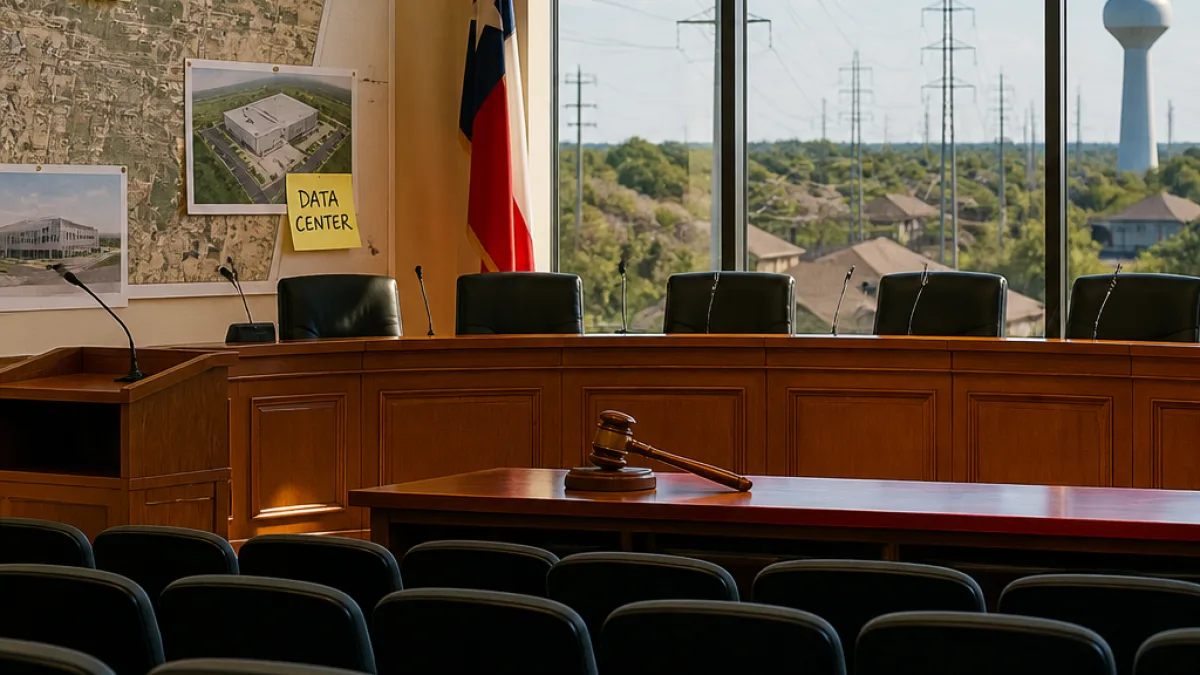
Three members of the San Antonio City Council have formally asked the city to consider a temporary moratorium on new data center construction, citing concerns about water consumption, electricity demand and impacts on nearby neighborhoods.
Council request would halt permits, plans and site approvals
District 5 Councilwoman Teri Castillo, District 6 Councilman Ric Galvan and District 8 Councilwoman Ivalis Meza Gonzalez signed a memo asking for a special City Council meeting by the end of August to consider a moratorium, according to reporting from the San Antonio Current.
The memo seeks a pause that would cover several phases of the planning and permitting process, including concept-plan applications, site-development-plan applications and permits tied to new data center projects. The proposed pause would also stop site permits for developments categorized as "office data processing and management."
- Applications targeted: concept plans and site-development plans
- Permits targeted: construction and site permits for data centers and related office data processing uses
- Requested timeline: special council meeting by the end of August to consider a moratorium
Why council members want a pause
Supporters of the moratorium argue it would provide time for city officials to study the consequences of rapid data center growth on land use, municipal utilities and neighborhood quality of life. Data centers are intensive users of electricity and water, and some council members and community advocates say the pace of approvals has outpaced local planning and infrastructure assessments.
"A temporary pause would give officials time to study possible effects on land use, utilities, and nearby residents."
Proponents say a pause is not intended to halt all industry activity permanently but to allow the city to evaluate whether current zoning, permitting and utility oversight sufficiently protect residents and system reliability.
State-level moves reflect broader scrutiny
The local action comes amid heightened scrutiny of data center expansion across Texas. Gov. Greg Abbott has already paused approval of new data centers at the state level and ordered the Public Utility Commission and ERCOT to review every center still waiting to connect to the grid. Democratic state Rep. Gina Hinojosa has also called for a freeze on new approvals until the Legislature addresses the issue in a special session, underscoring that the debate has moved beyond a local zoning dispute.
Industry representatives and developers counter that data centers underpin essential digital services used by millions, including cloud computing, financial services and artificial intelligence tools. They warn that halting approvals could slow investment and the digital infrastructure that modern services rely on.
Local consequences and next steps
If the City Council agrees to take up the request, a temporary moratorium would grant officials a finite window to commission studies, update land-use guidance or amend permitting thresholds. The action would also provide a clearer public forum for neighbors, utilities and developers to present data and concerns.
City residents could see a range of outcomes depending on the council’s follow-up, from modest changes to permitting standards to stricter utility and environmental conditions on future projects. The moratorium, if imposed, would be a stopgap measure allowing time for policymakers to weigh trade-offs between economic development and resource stewardship.
| Council member | District | Action requested |
|---|---|---|
| Teri Castillo | 5 | Special meeting to consider moratorium |
| Ric Galvan | 6 | Special meeting to consider moratorium |
| Ivalis Meza Gonzalez | 8 | Special meeting to consider moratorium |
As San Antonio officials weigh the request, the broader state-level reviews and temporary halts ordered by state leaders add urgency to local deliberations. Residents and stakeholders are likely to watch to see whether the city will follow the governor’s lead on pausing approvals, or carve a different path that balances growth with utility capacity and neighborhood impacts.

















