
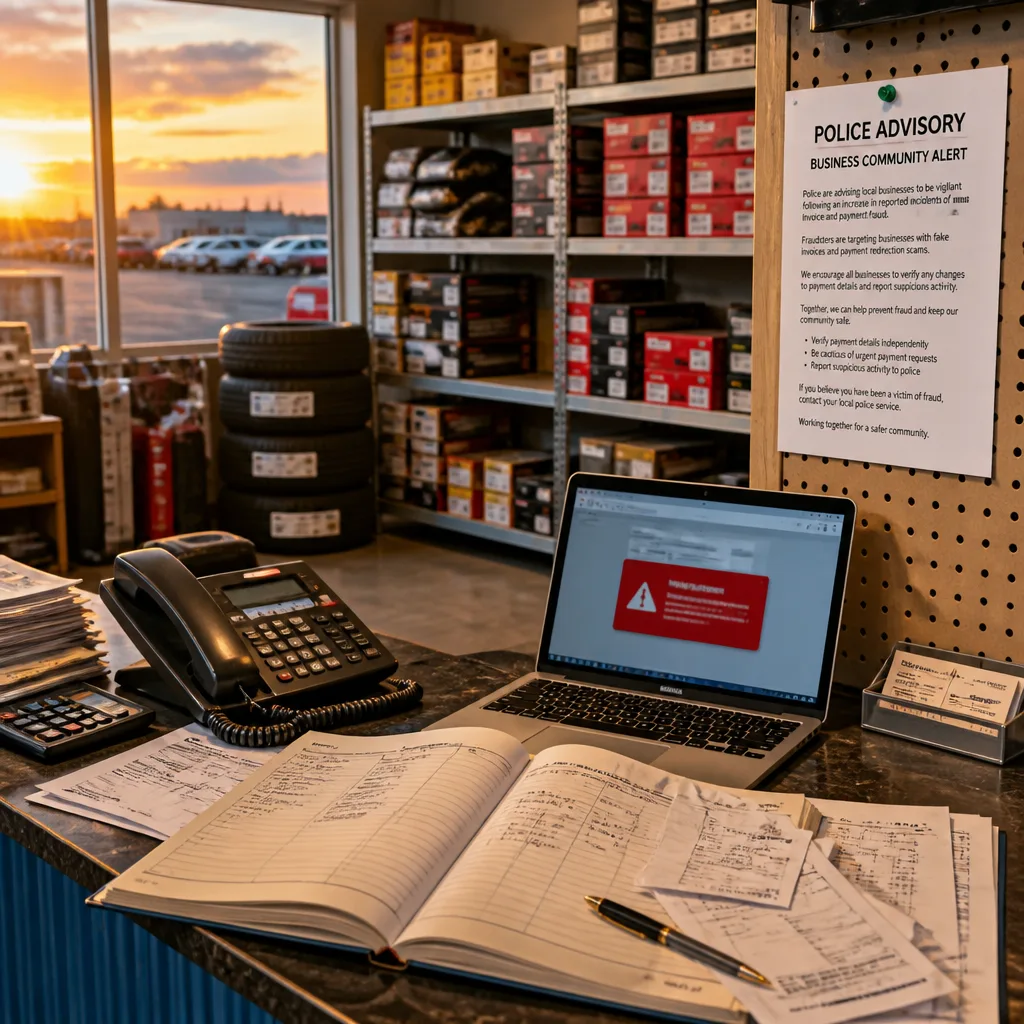
Businesses supplying the transport sector across Saskatchewan have been hit by a large‑scale credit‑card fraud that investigators say has already led to roughly US$500,000 worth of stolen products and prompted a provincial police warning.
How the scam operates
According to the Royal Canadian Mounted Police (RCMP), fraudsters have been placing orders for items such as tyres, oil and mechanical tools over the phone, using what appear to be legitimate card details and purchaser identities. Within days the purchases are disputed, leaving the supplier out of pocket for goods already supplied.
Leanne Tuntland‑Wiebe, owner and manager of Great West Auto Electric in Assiniboia, told Global News her store lost around US$20,000 earlier this year after a scammer made three separate purchases of power tools using fraudulent credit cards. She said the purchaser supplied a business name, a personal name, an email address and a phone number that all appeared authentic, which reassured staff at the time.
“He gave us a business name, gave us his personal name, gave us an email address, gave us a phone number, which sounded legit, so my guys didn’t think that much about it.”
Scale and investigative response
RCMP Sgt. William Groenen told Global News the operation appears to be widespread across western Canada and that investigators began examinations in March. He said the offending purchases can look legitimate at the point of sale and are often disputed shortly thereafter, putting the financial loss onto the supplier.
“It appears to be legitimate and like it’s an approved purchase, and in some time within a day or two, the purchase is being disputed, and then the businesses are out the money that’s associated with it.”
Sgt Groenen said the anonymous and dispersed nature of the purchases complicates investigations. He described these digital offences as increasing in frequency and noted they are "long, drawn‑out investigations" that demand significant resources, though police remain committed to co‑ordinating responses.
Geography and businesses affected
Businesses from several communities across Saskatchewan have reported being targeted or defrauded. The RCMP listed the following locations to Global News:
- Assiniboia
- Battleford
- Weyburn
- Kindersley
- Hudson Bay
- Moosomin
Police say they are aware of similar activity occurring in other western provinces as well.
| Data point | Value |
|---|---|
| Reported total value of stolen products (Saskatchewan) | US$500,000 |
| Loss reported by one business (Great West Auto Electric) | US$20,000 |
| Investigations started | March |
Consequences for firms and the wider market
The immediate impact is clear for small and medium suppliers: cashflow and inventory losses when goods leave premises but payment is later reversed. For businesses operating on tight margins, a single fraud loss of the size reported by Great West Auto Electric can affect payroll, supplier payments and short‑term viability. Where losses accumulate across a sector, firms may change sales practices — for example, tightening checks on phone or card transactions — which can raise administrative costs and delay fulfilment.
Police warn these cases require co‑ordination and resources to trace, and the RCMP’s account that the scams are "long, drawn‑out investigations" signals a protracted period of uncertainty for affected firms. The cross‑jurisdictional nature of the activity — spanning multiple communities and provinces — further complicates recovery of funds and prosecution.
What remains unclear
Authorities have not yet disclosed how many individual businesses in total have been targeted beyond descriptions of "more than a dozen" or an aggregate dollar value. It is also not public whether any successful prosecutions or recoveries have been achieved so far. Investigators are continuing inquiries.
For suppliers to transport and automotive sectors, the episode is a reminder that digital‑enabled fraud can quickly become a material business risk. The RCMP statement and local business losses underline the need for vigilance, but also the reality that verifying purchasers in a way that balances sales and risk is a fraught task for firms that rely on rapid turnover and narrow margins.