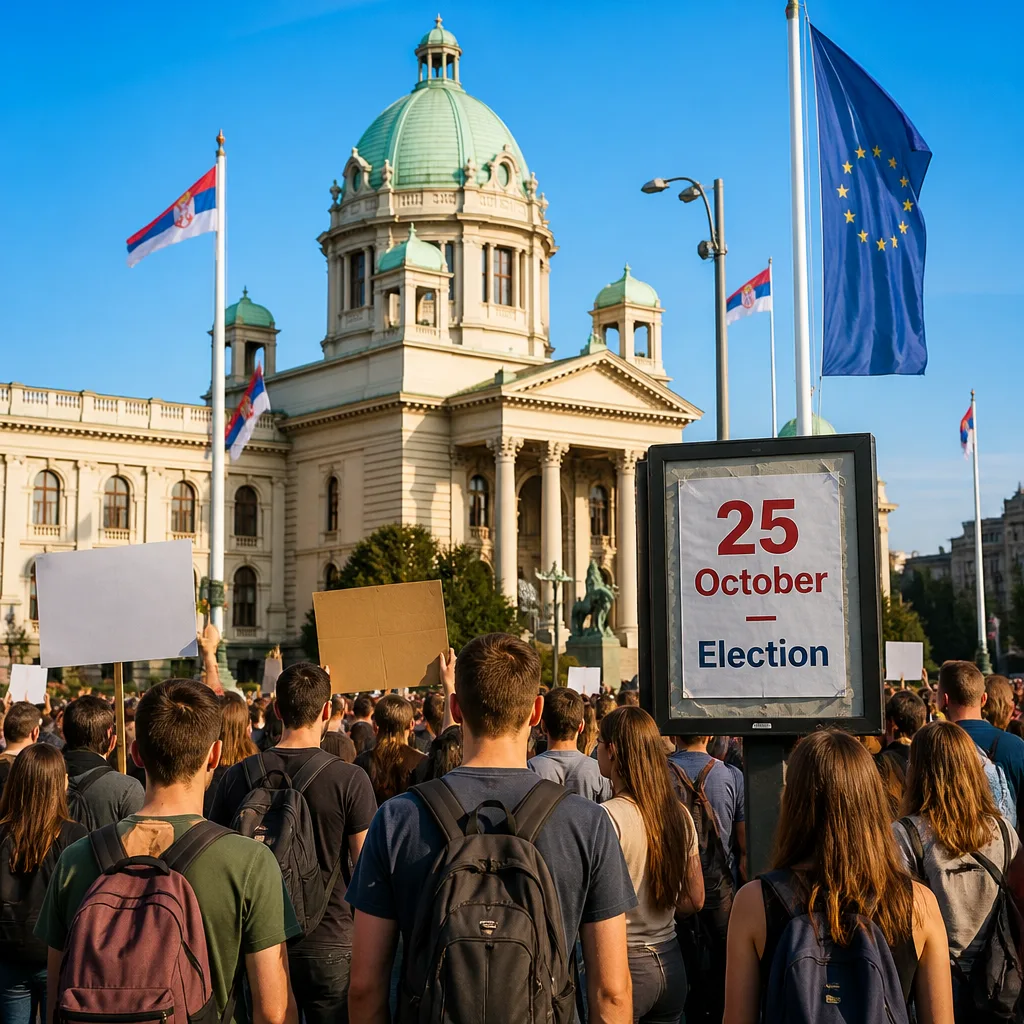
Belgrade — Serbian President Aleksandar Vučić has dissolved the National Assembly and announced snap parliamentary elections for 25 October, saying the step is required to address mounting political tensions and divisions.
Vučić told the nation that delaying elections would endanger democratic survival in Serbia and that the ballot was necessary to produce clear results about the country’s direction. The announcement comes almost two years after the Novi Sad canopy collapse, which set off prolonged, student-led protests across the country.
“We need election results that will clearly determine and show where Serbia is headed,”
How the vote is being organised
The ruling conservative Serbian Progressive Party (SNS) has decided to contest the election under a new umbrella, the United Serbia banner, and has named Mr Vučić as its candidate for prime minister. Under the Serbian Constitution, Vučić is required to resign the presidency before taking the prime minister’s office; he has said he intends to do so this month.
When he steps down, National Assembly Speaker and former prime minister Ana Brnabić, also of the SNS, will assume the role of acting president. She will then be obliged to call a presidential election within three months, meaning Serbia could face a second national vote soon after the parliamentary contest.
Opposition and protest movement
The SNS’s most visible challenger is the Student List, a slate formed by the movement that organised the sustained protests following the Novi Sad tragedy. The list had not been formally presented at the time of the announcement and its candidates remained unspecified. Most pro-European opposition parties have voiced support for the student movement, though only some have confirmed plans to stand in the election. Many right-wing parties are expected to run independently.
- Election date: 25 October
- Ruling ticket: SNS running as “United Serbia” with Vučić as candidate for prime minister
- Potential follow-up: Presidential election to be called within three months after Vučić’s expected resignation
Broader political context
The snap election arrives at a sensitive moment for Serbia’s relationship with the European Union. Brussels has recently renewed criticism of the glorification of convicted war criminal Ratko Mladić, adding to ongoing concerns about democratic backsliding, the rule of law and Belgrade’s refusal to align with EU sanctions on Russia. Vučić sought to balance those pressures in his address, asserting that Serbia had chosen a European path while preserving traditional friendships, national pride and dignity.
The timing and sequencing of the votes will be significant. If Vučić resigns the presidency as planned and the SNS wins the parliamentary poll, the subsequent presidential election could reshape Serbia’s political map within a narrow time frame. The emergence of a Student List backed by protest networks marks an unusual and potentially disruptive challenge to the established party system.
| Event | Date / Window |
|---|---|
| Parliament dissolved | Announcement (September) |
| Parliamentary election | 25 October |
| Presidential election (if Vučić resigns) | Within three months of acting president taking over |
Analysts and Brussels officials will watch the campaign closely for signs of how political divides are manifesting at the ballot box, and for any further evidence of the trends that have generated concern about Serbia’s democratic institutions. The participation and performance of the Student List, and the stance of pro-European opposition parties, will be key determinants of how competitive the contest becomes.
For now, the calendar is set and the next national vote is fixed. The sequence of events that follows — Vučić’s resignation, the acting presidency of Ana Brnabić and a possible presidential contest — means Serbia may undergo rapid political change before the end of the year.