A visible sign of a deepening problem
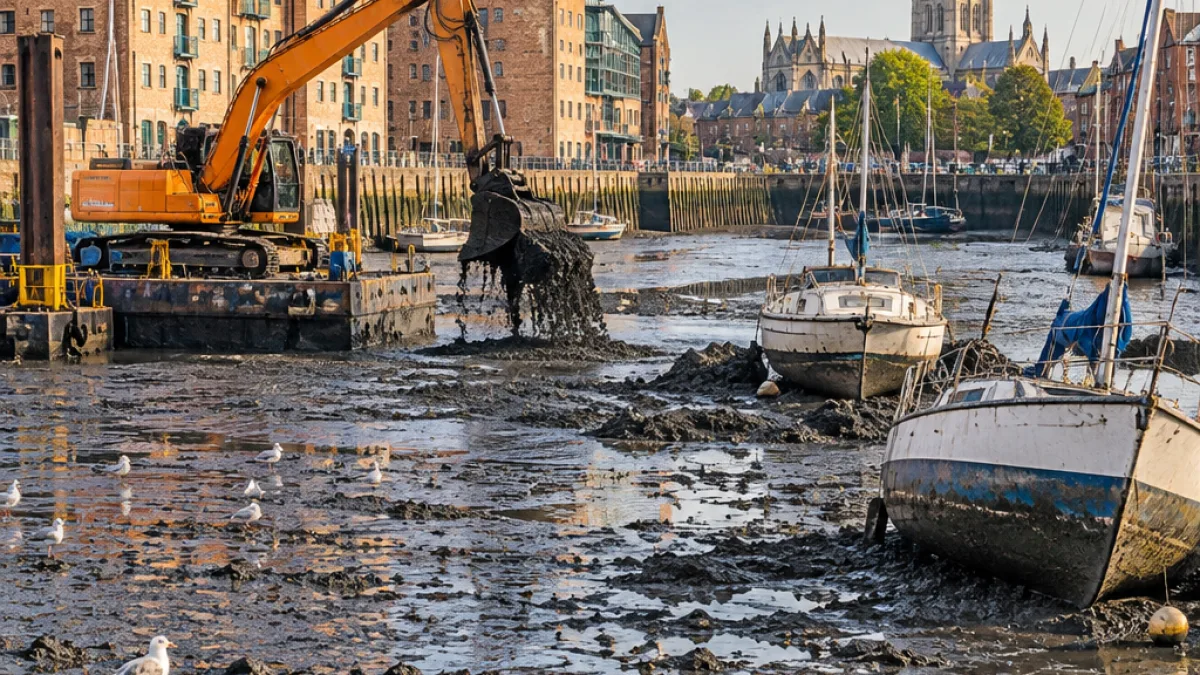
The condition of Gloucester Docks has become the subject of parliamentary concern after unusually heavy silt accumulation left boats surrounded by mud and allowed gulls to walk across parts of the Main Basin. A £4 million dredging programme has now begun, with the stated aim of bringing navigation depths back to a usable level.
The build-up has worsened over recent years, making it increasingly difficult for vessels to reach and move through the Docks. For a waterfront whose identity is closely tied to boats, canals and working water, the change is more than an unusual sight: it raises questions about how the area will be maintained in the years ahead.
Concern raised in the Commons
Gloucester MP Alex McIntyre brought the issue to the House of Commons this week. Speaking on 29 October, he referred to what he described as an unusual scene in the city’s historic waterfront, while warning that a single programme of work might not prevent the same difficulty returning.
“Now I’m not aware of any divine intervention but we have had a very dry summer and an unprecedented silt build up.”
The MP said the Canal and River Trust had begun the major intervention but questioned whether the underlying arrangement for managing water and silt would provide a lasting answer. He called for a debate on whether water companies should contribute more fairly to the upkeep of waterways affected by their operations.
Water transfers and the canal system
The principal source of the silt ingress identified in the report is water pumped from the River Severn into the Docks system to supply Bristol with around half of its drinking water. The Canal and River Trust has a long-term agreement with Bristol Water connected to that arrangement, although the terms are not considered favourable to the waterways charity.
That relationship is now an important part of the local discussion. The dredging work can remove material that has already settled, but the comments made in Parliament reflect concern about whether further dry summers could lead to another cycle of accumulation. The issue therefore combines the immediate needs of navigation with a longer-term debate about responsibility and funding.
What is known about the work
| Issue | Details |
|---|---|
| Current response | Dredging programme under way |
| Announced investment | £4 million |
| Areas named | Gloucester Docks and Gloucester and Sharpness Canal |
| Agreement milestone | Water supply contract due for renewal in 2028 |
The Canal and River Trust said the programme covers the Docks and the Gloucester and Sharpness Canal. It described the work as a response to significant sediment accumulation linked to recent drought conditions and said the purpose was to recover navigation depths.
A decision that reaches beyond the basin
Sir Alan Campbell, the Leader of the House of Commons, said he would ensure that the relevant minister heard the concerns raised, while noting that a debate might be needed. He also said discussions were continuing about dredging and the management of silt, with the current Bristol Water and Canal and River Trust water supply agreement expected to be renewed in 2028.
For people using the waterfront, the first test will be whether the work makes access more reliable for vessels. For the organisations responsible for the waterway, the larger question is how often such intervention may be required if dry conditions continue. The present scheme offers a substantial response to Gloucester’s immediate problem, but the parliamentary exchange shows that attention is already turning to what happens after the dredgers leave.
- Navigation: silt has made access to Gloucester Docks more difficult for vessels.
- Funding: the current dredging programme is valued at £4 million.
- Future responsibility: the water supply agreement is due to be renewed in 2028.