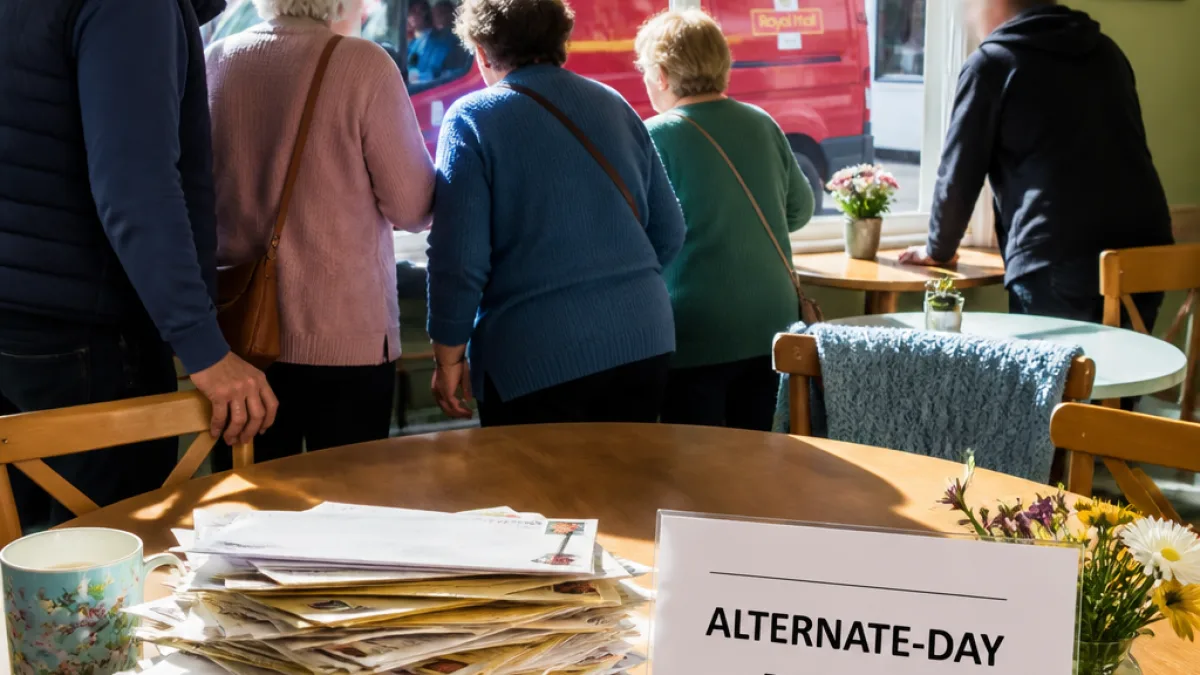
Royal Mail meeting in Gloucester as residents report missed appointments and months-long delays
Royal Mail representatives met customers in Gloucester this week after a sustained run of delays to second-class post prompted public concern. At a meeting held in The Friendship Cafe, managers apologised for what they described as a “totally unacceptable” service and outlined plans to change how deliveries operate from September.
Residents at the meeting said late letters have had serious consequences. Several people told officials they had missed medical appointments or failed to receive prescriptions on time because correspondence arrived weeks or even months late. The meeting was attended by local residents and Royal Mail figures including Nick Day and Alex Morrison, who took questions from those affected.
“Letters [are often] four or five months late including credit card bills, inland revenue or stuff not arriving,”
said local resident Bob Whittard, who lives in the GL4 area and described the service as “absolutely awful”. Another resident, Wendy Worth, said she missed a hospital appointment to have a stent fitted when the letter was delayed; she later discovered this only after being contacted by the NHS and felt forced to seek private treatment because of the delay.
What Royal Mail has proposed
At the meeting, Royal Mail managers acknowledged the problems and said they planned to alter the delivery pattern for second-class post to alternate days from next month. They signalled that this approach has already been trialled in other parts of Gloucestershire including Coleford and Tetbury.
Royal Mail personnel also committed to investigating ways to speed up delivery of time-sensitive medical correspondence, following concerns voiced by residents that delays were jeopardising treatment and prescriptions.
Local figures and operational pressures
Royal Mail estimated the backlog in local sorting offices could be as high as 25%, a figure which residents said helps explain the erratic timing of deliveries. The company said it has been recruiting locally, employing 20 people since January, but acknowledged staff turnover has been a problem, noting the service has also lost 20 people in the same period.
| Metric | Reported figure |
|---|---|
| Estimated backlog in sorting offices | 25% |
| Net hires since January | 20 employed / 20 lost |
At the meeting, managers said recruitment remains a priority as they attempt to stabilise the service. The coverage of staff turnover and backlog gives a sense of the operational pressures facing Royal Mail locally, though some residents remained doubtful that the changes proposed would restore reliable delivery quickly.
Concerns from residents and local consequences
People who depend on paper letters for important notices — including hospital appointments, prescriptions and financial correspondence — told the meeting they had suffered tangible harm. Examples raised by attendees included missed procedures and delayed access to necessary medication. For older residents and those without easy internet access, timely postal delivery remains essential.
- Medical appointments missed due to late letters.
- Prescriptions and time-sensitive notices arriving late or not at all.
- Loss of trust in the service among those affected, especially in some GL postcode areas.
Several people questioned whether changing second-class deliveries to alternate days would fix the underlying problems. Some asked for clearer guarantees on how medical and other urgent correspondence would be prioritised.
What happens next
Royal Mail said the new delivery pattern for second-class post will begin in September. Managers indicated they would continue to engage with customers to monitor progress and to look specifically at how time-critical medical letters can be expedited.
For now, residents have been left weighing the company’s assurances against months of frustration at a service they say has failed them at crucial moments. Local councillors and community groups will be watching to see whether the promised changes translate into swifter, more reliable deliveries.
The meeting highlighted the knock-on effect postal delays can have on health and household finances across Gloucester, underscoring how central a dependable local postal service remains to everyday life.