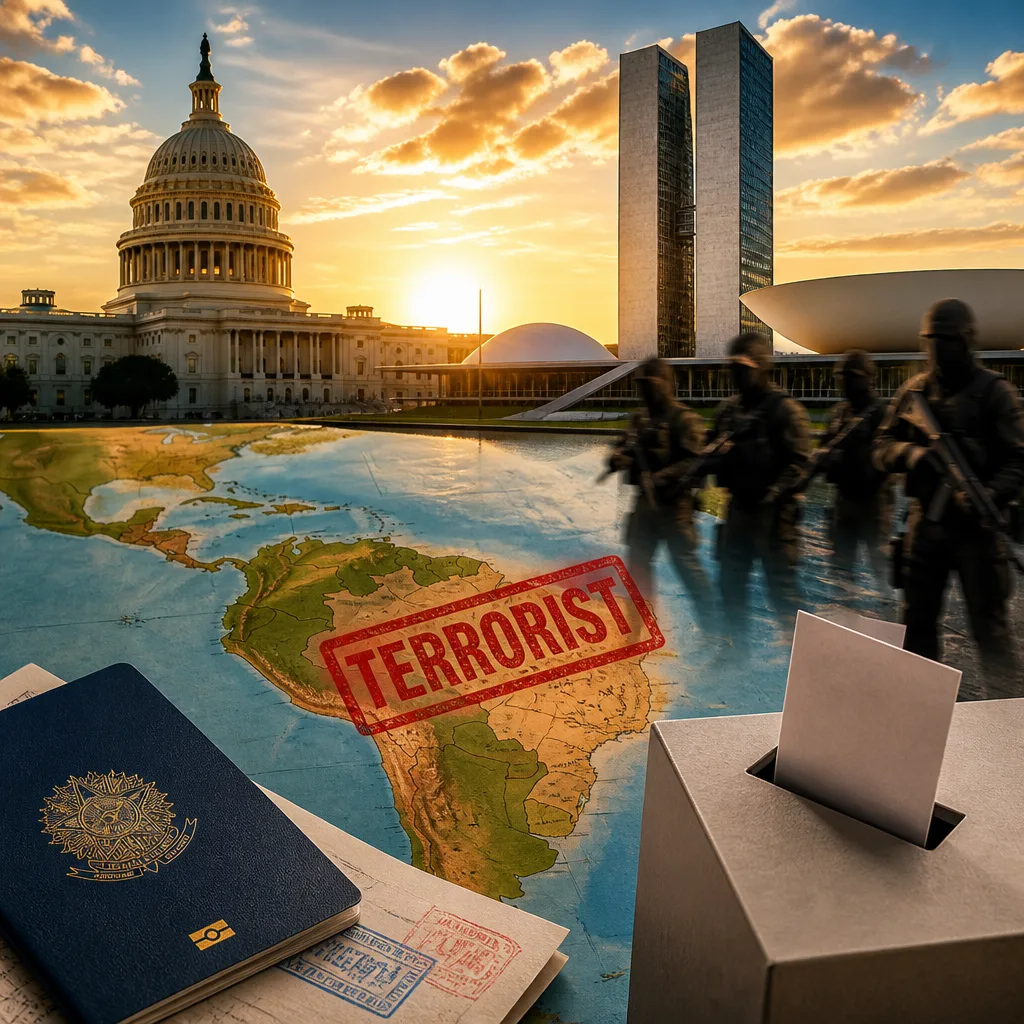
The United States has designated Brazil’s two largest criminal organisations, the Primeiro Comando da Capital (PCC) and the Comando Vermelho (CV), as “terrorist” groups. The decision, announced in 2026, has been presented by supporters as a response to an expanding transnational criminal threat. Critics say it tells a different story: one of politics, intervention and the stretching of a contested label.
Security problem or political tool?
The United States and elements of Brazil’s far right have described the classification as a necessary step to confront the transnational reach of organised criminal networks. The groups named are responsible for extensive violence and are among the most powerful criminal organisations in Latin America, according to the reporting.
But international commentators and analysts quoted in the source material argue that violence alone does not make an organisation terrorist. They note that terrorism is commonly understood to involve violence driven by political or ideological goals. In contrast, the PCC and CV are portrayed as principally motivated by criminal profit and power, using politics instrumentally rather than pursuing an ideological transformation of the state.
“The more broadly governments apply the terrorism label, the more it risks obscuring the nature of the security threat itself, while giving states greater scope to use such designations for political ends.”
The timing of the US action is a central point of contention. Both groups have been known to authorities in Brasilia and Washington for decades. The source notes the PCC has existed since the early 1990s and the CV is older still. That raises the question: why make the designation now?
Historical echoes and regional consequences
The reporting draws a line between the move and a longer pattern of US interventionist instincts in Latin America. It argues the decision resonates with past episodes of Washington’s involvement in the region — including the era of military rule in Brazil from 1964 to 1985 — and aligns with the priorities of Brazil’s political right.
There are practical consequences as well as symbolic ones. Applying a terrorism label can change how states act: it can expand legal tools, alter cooperation on law enforcement, and influence diplomatic posture. Critics warn that an overly wide use of the label may obscure whether the principal problem is criminality or insurgency, and give governments latitude to pursue political goals under a security rationale.
- Organisations designated: Primeiro Comando da Capital (PCC); Comando Vermelho (CV).
- Core contention: PCC and CV are violent and powerful, but primarily criminal rather than ideologically political.
- Key question: Why adopt the terrorism label now, rather than earlier?
| Group | Origin (as reported) |
|---|---|
| Primeiro Comando da Capital (PCC) | Since the early 1990s |
| Comando Vermelho (CV) | Older than the PCC |
The designation comes at a sensitive political moment in Brazil. The source suggests the move has been seized upon by domestic political forces and may be read as an external intervention that favours one side of a contentious national debate. That dynamic could shape campaigning, security policy and bilateral relations.
Policymakers and analysts now face several immediate questions. Will the designation materially disrupt the groups’ operations? How will Brazil’s government and opposition respond? And to what extent will other states adopt similar expansive definitions of terrorism for political ends?
For observers of Latin America and international security, the dispute highlights a broader tension: the line between crime and terror is not merely definitional. It carries legal, diplomatic and political weight. The choice to apply a terrorism label says as much about the label‑giver’s priorities as it does about the target.
As the debate unfolds, both the practical effects on criminal networks and the diplomatic fallout between Washington and Brasilia will be watched closely.