
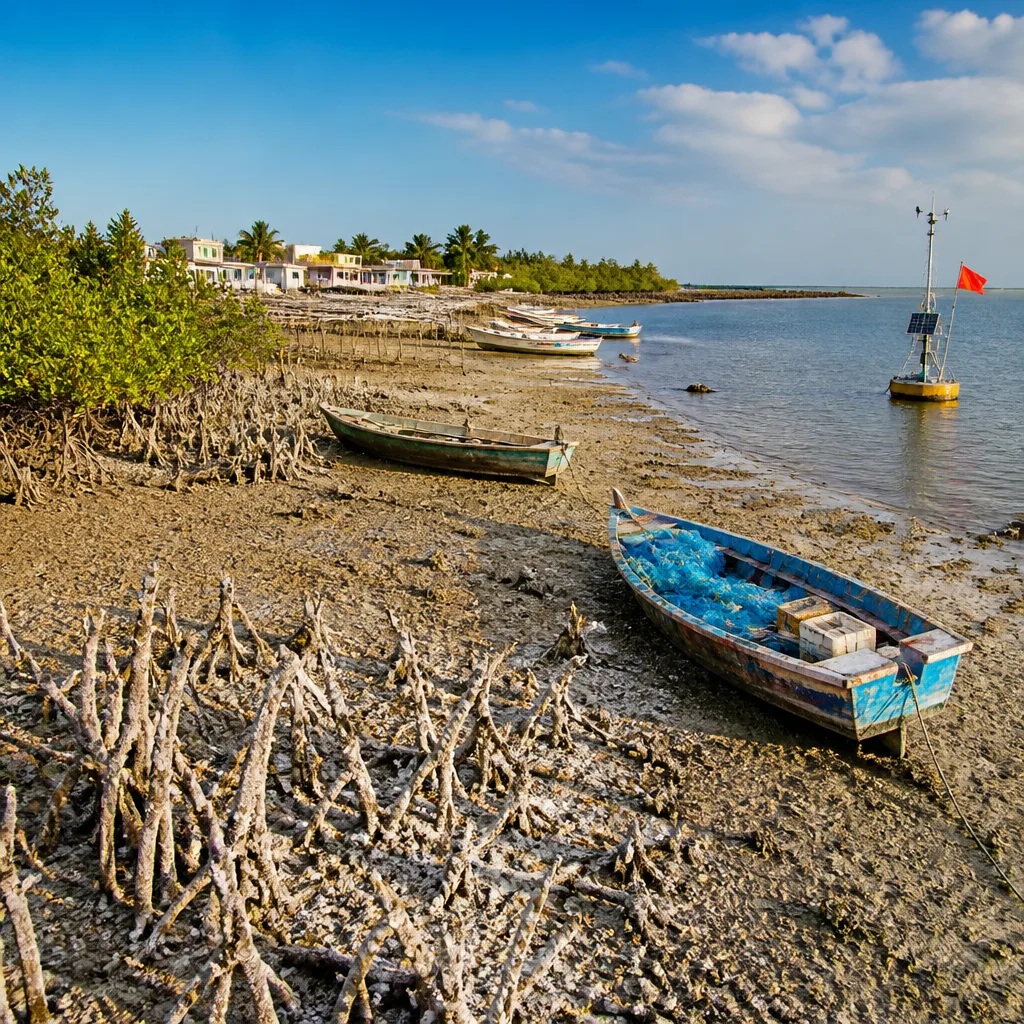
A strong El Niño is now underway and a positive Indian Ocean Dipole (IOD) is expected to develop, the United Nations Economic and Social Commission for Asia and the Pacific has warned, signalling amplified risks to mangrove ecosystems that protect shorelines, support fisheries and underpin coastal economies.
Immediate environmental threat, longer-term economic consequences
The UN briefing highlights that these two large-scale climate patterns influence ocean temperatures, rainfall and sea levels across the Indo‑Pacific. Their interaction can produce prolonged flooding, unusual heat and raised salinity in coastal wetlands — conditions that place severe stress on mangrove forests.
For economies, the risks are not abstract. Mangroves perform multiple economic functions: they shield coastlines from erosion and storm surges, sustain fish and shellfish populations that support commercial and subsistence fisheries, store significant amounts of carbon, and help secure livelihoods and food supplies for millions. The ESCAP paper stresses that Asia and the Pacific hold more than half of the world's mangrove area, so damage in this region can ripple across national economies and labour markets.
What the record shows
The briefing points to a concrete precedent. During the positive IOD in 2020–21 the Maldives suffered what the UN describes as “one of the most significant recorded mangrove dieback events” in its history: around one-quarter of mangrove-bearing islands reported impacts, with losses exceeding 40 per cent of mangrove cover in some locations.
| Indicator | Reported figure |
|---|---|
| Share of global mangroves in Asia & the Pacific | More than 50% |
| Maldives: islands affected in 2020–21 | ~25% |
| Maldives: localised mangrove loss | >40% |
Those figures are not solely ecological; they map onto people's incomes and food security. Where mangroves die back, fish nurseries shrink and coastal erosion accelerates, increasing costs for coastal protection, asset repair and disaster relief. For countries reliant on coastal tourism and small-scale fisheries, such shocks can reduce incomes for thousands and raise pressure on public finances.
Policy response and monitoring gaps
The UN document urges improved monitoring and early warning systems to detect changes in sea level, salinity and ecosystem health so governments and communities can act before impacts become irreversible. Early detection could allow targeted interventions — from managed retreat and restoration to temporary harvesting bans — that limit job losses and protect critical economic assets.
- Strengthened sea‑level and salinity monitoring can give governments lead time to protect fisheries and coastal infrastructure.
- Restoration and protection of mangroves are cost‑effective compared with hard coastal defences, but require sustained funding and labour.
- Regional coordination is essential because El Niño and IOD impacts can synchronise damage across multiple countries.
Economists and policymakers should note the signal the UN is flagging: climate variability that intensifies ecosystem stress is also an economic shock multiplier. Recurrent dieback events will raise costs for coastal communities and national budgets, and could depress real wages in local economies where alternative employment is limited.
There is a fiscal dimension too. If mangroves lose their capacity to sequester carbon at present rates, countries may face complications in meeting nature‑based carbon accounting and offset commitments, with potential knock‑on effects for climate finance and the valuation of blue carbon projects.
The UN's message is straightforward: these climate drivers are predictable enough to merit investment in monitoring and preventative measures now. Absent that, the next strong El Niño or positive IOD could produce further episodic losses with clear human and economic costs — fewer fish, higher repair bills, and more precarious livelihoods for coastal workers.
For business commentators and ministers concerned with jobs and prices, the policy choice is framed by timing and scale: invest in ecosystems and early warning systems to reduce future fiscal and labour market disruption, or face recurring economic damage that will ultimately be costlier to repair.














