
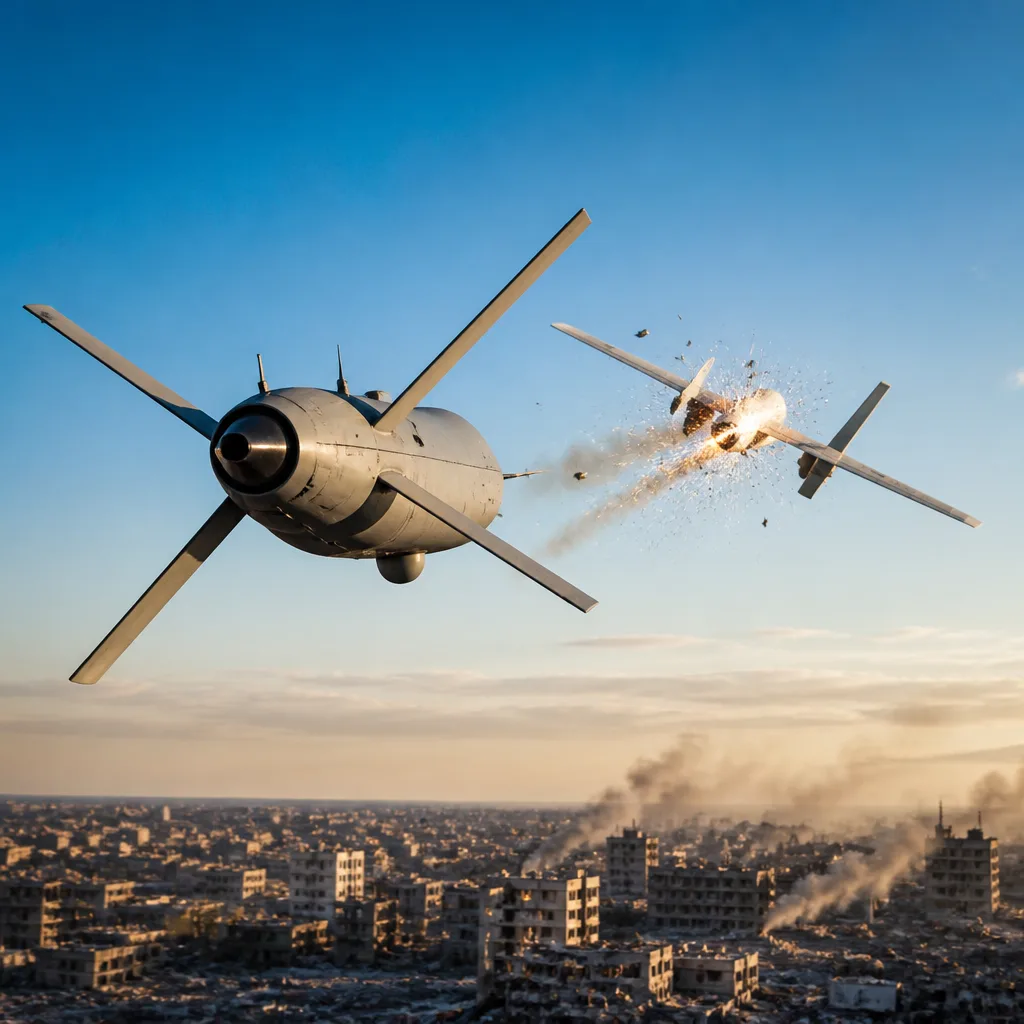
Ukraine has developed and deployed a new interceptor drone capable, it says, of bringing down Russia’s faster, jet‑powered Shahed attack drones, President Volodymyr Zelensky announced on Saturday.
President releases footage of in‑flight interception
Zelensky published video he described as showing the interceptor locking on to a Russian Shahed before exploding on impact. The Ukrainian leader credited the Security Service’s military counterintelligence with the breakthrough and said the system had already been used operationally to protect Ukrainian territory.
"There is a good result from the Security Service’s military counterintelligence in defending against jet-powered ‘shaheds’ ... A new interceptor drone has been developed and has already been successfully deployed."
The move addresses concerns Kyiv has previously raised about Moscow’s deployment of a new class of jet‑powered Shahed drones, which Ukrainian officials say can reach speeds of up to 600 kilometres per hour—about three times faster than the piston‑engine Shaheds used earlier in the war.
Ukrainian authorities reported that Russian forces launched missiles, KAB aerial bombs and a variety of drones in attacks on Kharkiv and surrounding areas. Regional officials said the strikes left five people dead and 15 injured, and hit Kharkiv plus 14 other settlements in the region.
- New capability: An interceptor drone has been developed and reportedly used successfully.
- Threat level: Russian jet‑powered Shaheds can travel at up to 600 km/h.
- Recent attacks: Strikes in Kharkiv region killed five and injured 15.
Operational and strategic implications
If the interceptor performs as described, it would mark a tactical adaptation to counter a faster class of loitering munitions that Kyiv has warned poses fresh challenges for air defences. The announcement indicates ongoing efforts by Ukrainian security services to field bespoke solutions rather than rely solely on conventional air‑defence systems.
International observers will watch closely for independent verification of the footage and for details about the interceptor’s range, sensors and guidance methods. Those technical specifics will determine whether the system is suited to contested airspace, short‑range defence of key infrastructure, or wider area protection.
The development also feeds into broader conversations about how Western military assistance and intelligence have been integrated into Ukraine’s domestic defence innovation, and whether such capabilities can be scaled or shared with partners facing similar threats.
Related NATO development
Separately, military chiefs from NATO’s 32 member states elected Germany’s chief of defence, General Carsten Breuer, as the next chair of the alliance’s Military Committee. He will succeed Italian Admiral Giuseppe Cavo Dragone and take up the role next summer. The committee is NATO’s senior military authority and the chair acts as the principal military adviser to the alliance’s political leadership.
| Item | Detail |
|---|---|
| Reported deaths | 5 |
| Reported injuries | 15 |
| Settlements struck in Kharkiv region | 15 (Kharkiv + 14 others) |
Ukraine’s claim, and the video footage, will add to assessments by Western capitals on the evolving battlefield, even as independent verification remains important. For a country still reliant on a mixture of donated Western systems and domestic innovation, each new defensive measure can change the calculus for both frontline units and strategic planners.
The immediate human cost of the strikes — civilian casualties and damage to communities in Kharkiv region — underscores why Ukraine is prioritising measures to counter increasingly varied and faster aerial threats.















