
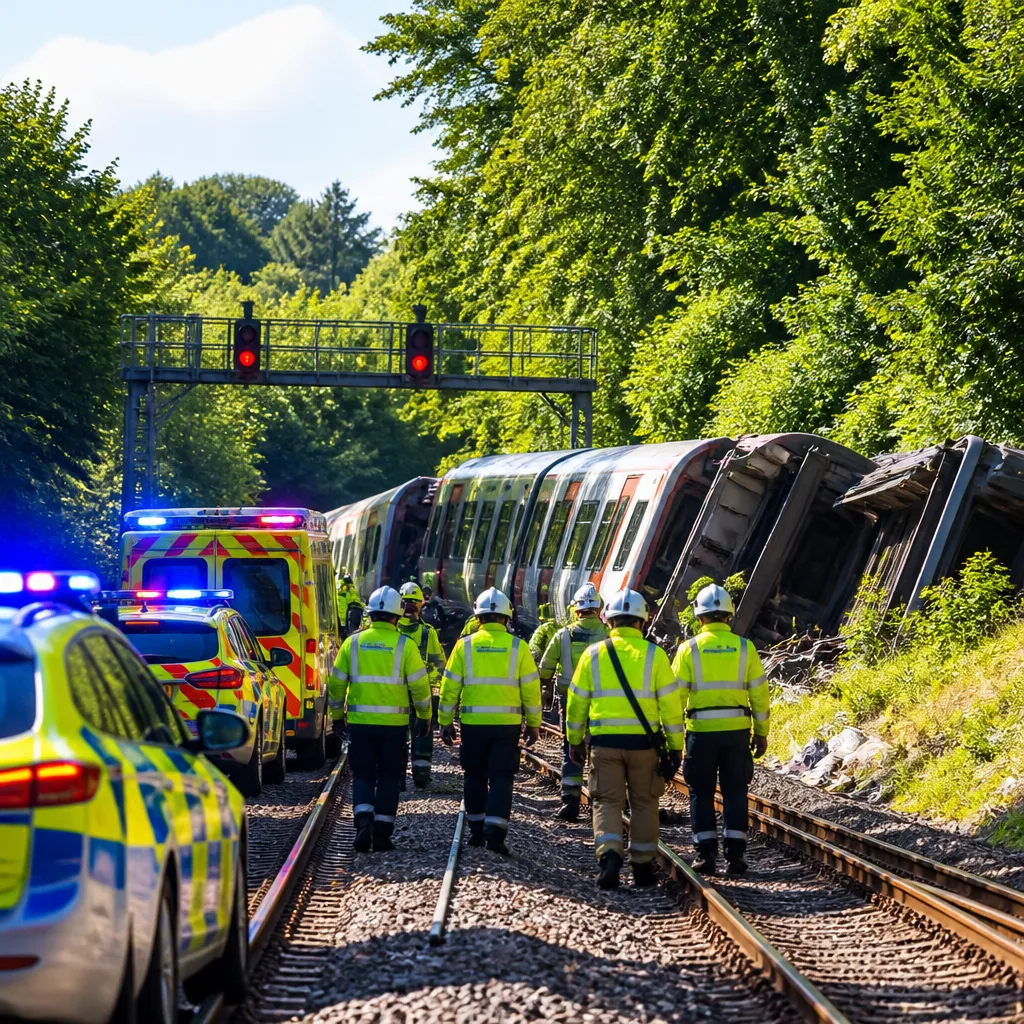
Two people have been reported with serious injuries after a passenger train derailed on the line between Haywards Heath and Lewes in East Sussex, prompting a significant emergency response and the declaration of a major incident.
British Transport Police said passengers were assessed and treated at the scene, with some taken to local hospitals. Police added that a further nine people sustained less serious injuries. Emergency teams worked to evacuate everyone on board and to secure the site, while the Rail Accident Investigation Branch (RAIB) has opened a formal inquiry into the cause of the derailment.
Scene, response and eyewitness accounts
Images from the scene showed several carriages on their sides and people standing on top of overturned rolling stock or gathered on neighbouring heathland alongside emergency personnel. An aerial photograph published by BBC News appeared to show three of the eight carriages lying on their side.
Assistant Chief Constable Ian Drummond-Smith, speaking on behalf of the force leading the response, said a major incident had been declared and that a “significant emergency service response” remained under way. He added that all passengers had been safely evacuated and that police were supporting the RAIB to determine what happened.
“We’ve declared a major incident and a significant emergency service response is ongoing at the scene, but all passengers on the train have now been safely evacuated from the service.”
An eyewitness, Rob Bradley, who was travelling with his six-year-old daughter Mabel, said they were in one of the carriages that remained upright. He described sensations consistent with derailment — the train accelerating, rocking and then “jumping vertically upwards” before emergency brakes brought the service to a halt. He reported seeing smoke and dust enter his carriage and the adjacent carriage lying on its side.
Immediate impact and disruption
The incident occurred shortly before 4pm on a Southern-operated service. Several rail routes were closed following the derailment, affecting passengers across the south-east as accident response teams and investigators worked on site.
- All passengers were evacuated from the train.
- Emergency services treated and triaged the injured at the scene, with some taken to hospitals.
- RAIB has begun a formal investigation to establish the cause of the derailment.
The nature and extent of the damage to track and rolling stock have not been disclosed; recovery and forensic examination typically require lines to remain closed for some time while investigators and engineers carry out inspections and evidence gathering.
| Item | Reported figures |
|---|---|
| Seriously injured | 2 |
| Less seriously injured | 9 |
| Carriages on their side (appeared) | 3 of 8 |
What happens next
The RAIB inquiry will examine the crash site, interview staff and passengers and review data from the train’s recording equipment. That investigation will determine the sequence of events and any contributing factors, such as track condition, signalling, engineering faults or human error. Police and emergency services will continue to manage the site while inquiries proceed.
Transport operators are likely to face prolonged disruption on affected routes while recovery and safety checks are completed. Passengers are advised to check with Southern and National Rail for updates and travel advice as services are revised or cancelled in the aftermath.
Further information will be released by emergency services and the RAIB as investigators establish the cause of the derailment and publish findings.















