
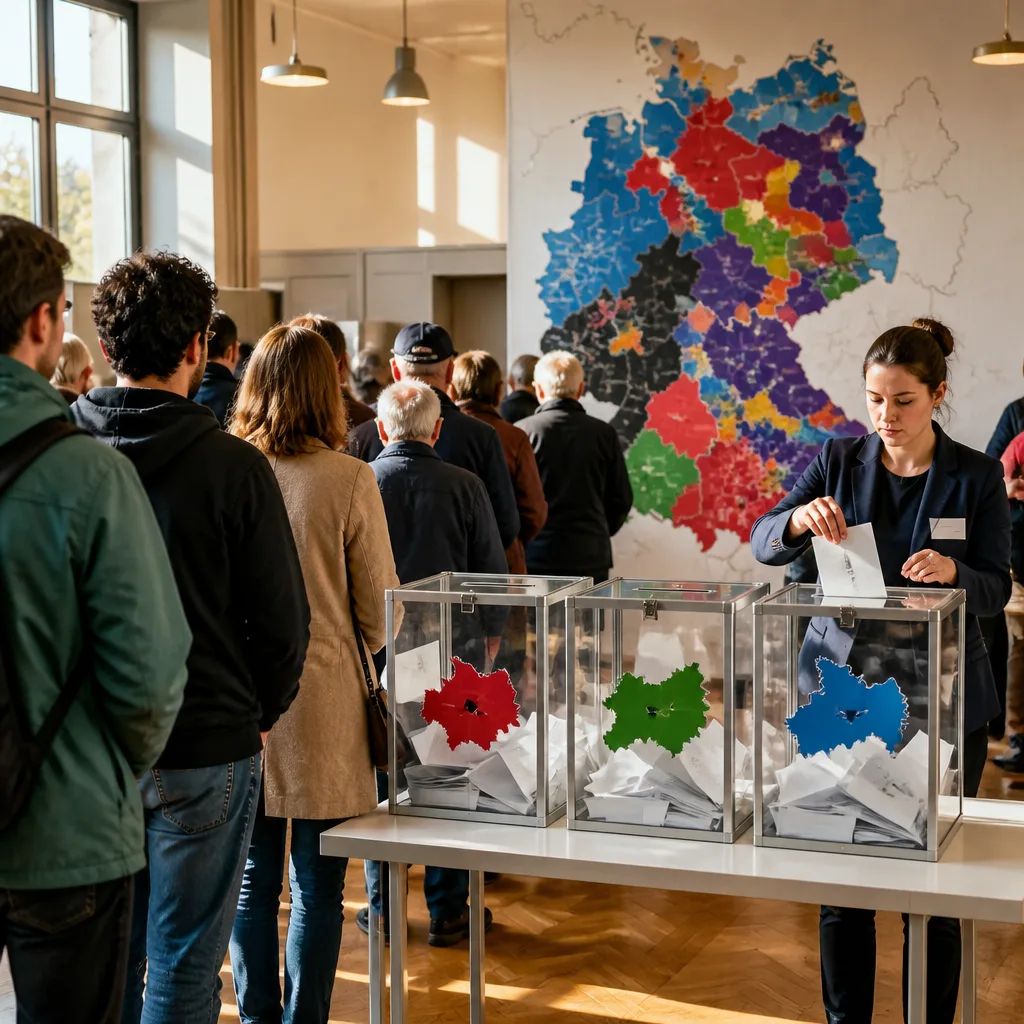
Voters in three recent German state elections have cast doubt on the stability of the country’s post‑war centrist political order, with historically high turnout producing dramatic and divergent outcomes that complicate governing at both state and federal level, according to a Brookings analysis published on 25 September 2026.
Unusually high engagement, unsettled politics
The contests, held on 6 and 20 September across the city‑state of Berlin and the eastern states of Saxony‑Anhalt and Mecklenburg‑Western Pomerania, drew levels of participation and international attention not normally seen at regional ballots, Brookings says.
Analysts argue the results reflected deep public frustration with national politics. In turn, the outcomes have produced “radical and potentially unworkable” political configurations in different states, the paper asserts, and may presage a new era of political polarisation, fragmentation and volatility in Germany.
Far‑right gains in the east
The most striking single figure reported in the analysis is the performance of the Alternative für Deutschland (AfD) in Saxony‑Anhalt, where the party won a commanding vote share of 43.8%. That victory is historically significant: it is the first state‑level win of this magnitude for the AfD, the Brookings piece says.
the party’s state chapter has been classified as “certified right‑wing extremist” by the state’s domestic intelligence service
Brookings notes the paradox that, despite the AfD’s electoral strength in Saxony‑Anhalt, it remains short of an outright majority and faces the practical barrier that other democratic parties have so far refused to form a government with it. That leaves the AfD’s path to power constrained by coalition arithmetic, even where it leads the vote.
Divergent outcomes across states
While the AfD captured large pluralities in parts of the east, the three ballots taken together produced a mix of outcomes that are difficult to reconcile into a single national story. Berlin, for example, presented different dynamics and priorities to the eastern states, underscoring the regional variation in German politics that the Brookings analysis emphasises.
The think‑tank warns these mixed results may have broader implications for the standing of the federal chancellor, noting that whether the autumn votes will end Chancellor Friedrich Merz’s political career remains an open question.
- High turnout elevated the stakes of votes that are usually low‑profile.
- AfD dominance in Saxony‑Anhalt produced both electoral firsts and practical governing problems.
- Fragmentation of results across the three states complicates national narratives and coalition options.
| State | Population (approx.) | Notable result |
|---|---|---|
| Berlin | 3.9 million | High turnout; divergent local dynamics |
| Saxony‑Anhalt | 2.1 million | AfD vote share 43.8% |
| Mecklenburg‑Western Pomerania | 1.6 million | High attention; far‑right advances reported |
What happens next
Brookings contends the combined effect of the three elections may be to end the era of consensus‑seeking centrism that characterised much of post‑war German politics. That does not mean an immediate wholesale realignment, but rather a more fractured parliamentary landscape in which coalition building becomes harder and policy drift more likely.
For now, the state‑level results create immediate practical questions about government formation and the willingness of mainstream parties to engage with or exclude the AfD. They also leave open a larger political question: whether federal leadership can respond in a way that restores centre‑ground cohesion, or whether the pattern of fragmentation will deepen in subsequent contests.
Brookings’s assessment is clear: the three votes together are a warning sign rather than a settled conclusion. They have shifted the terrain of German politics, and the coming weeks and months will determine whether those shifts are temporary turbulence or the start of a longer‑term realignment.












