
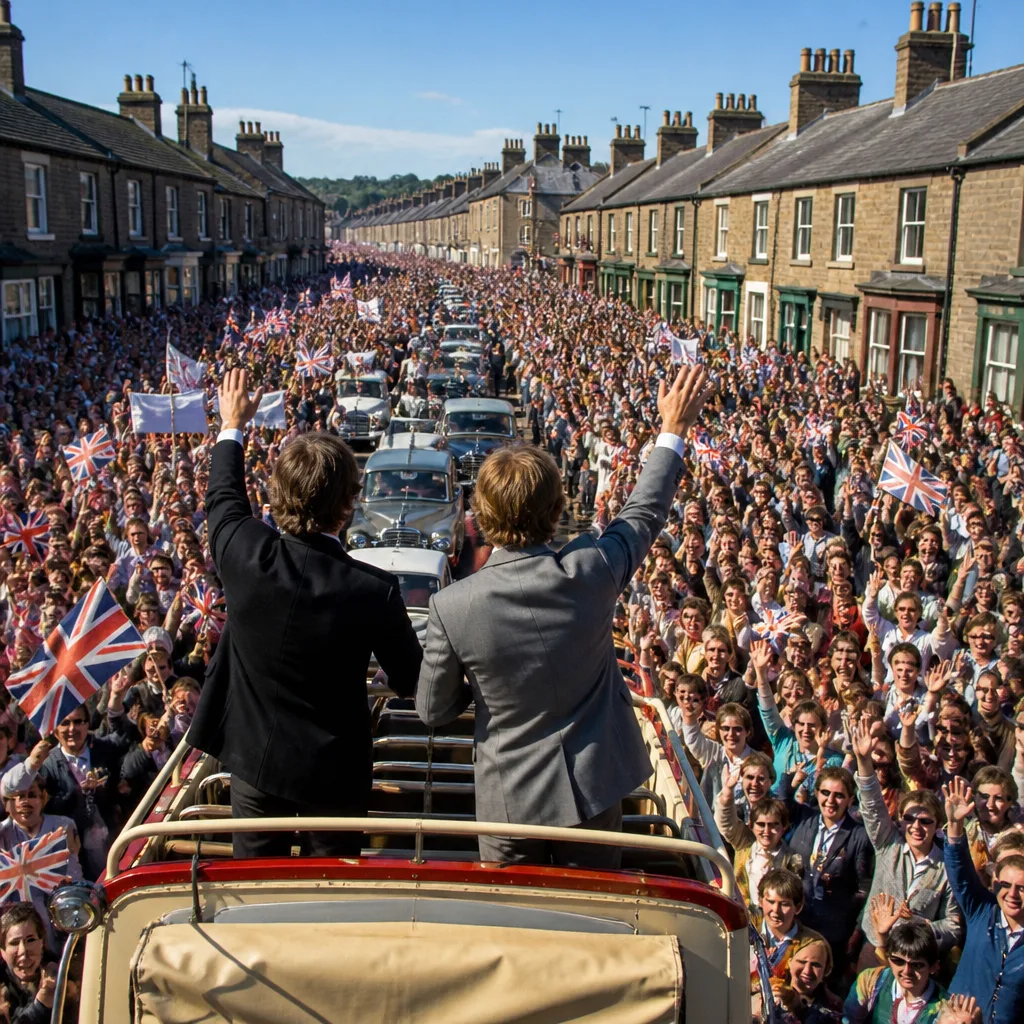
England’s 1966 World Cup victory remains one of the country’s most enduring sporting memories. Sixty years after the final under Wembley’s Twin Towers, attention has turned back to the two brothers from Ashington who were part of that winning side: Bobby and Jack Charlton. Their return to their Northumberland coal town days after the final received an emphatic local response and has been recalled this summer as the country marks the anniversary.
Homecoming and local acclaim
On 18 August 1966, the brothers were met by an enthusiastic reception in Ashington. Contemporary reports put the size of the crowd at around 15,000, a demonstration of the scale of celebration that followed the national triumph. The welcome reflected both the significance of the Wembley victory and the brothers’ roots in a town with deep footballing traditions.
From Ashington to Wembley and beyond
The World Cup final, contested on 30 July 1966 at Wembley, is famous for several dramatic moments: Geoff Hurst’s hat‑trick, the contentious second goal often called “the goal that never was”, a late equaliser for West Germany that forced extra time, and the sight of captain Bobby Moore lifting the Jules Rimet trophy. The match and its narratives have become woven into England’s sporting folklore.
“Some people are on the pitch... they think it’s all over”
Two of the England XI who secured that 4-2 victory hailed from the North East. Jack Charlton, described at the time as a tall, robust centre‑half, was 31 and then plying his trade with Leeds United. His younger brother Bobby, aged 28, played as a more attacking midfielder for Manchester United, combining technical poise with bursts of influence in big matches. The brothers had grown up supporting Newcastle United as boys, though neither would establish his senior career at that club.
Lives shaped by wider football history
Bobby Charlton’s career was shaped by events beyond the pitch as well as on it. He survived the 1958 Munich air disaster, an episode that had long-term consequences for Manchester United and figured significantly in the narrative of his life and career. The Charltons also came from a strong footballing family: their mother’s cousin was the well-known forward often referred to as ‘Wor Jackie’ Milburn, a prominent figure in Newcastle United’s history.
Jack Charlton later returned to the north-east in a managerial capacity; he spent a season in charge of Newcastle United in 1984–85, overseeing the club as they consolidated their position after promotion. In later years he said he continued to follow Newcastle’s results closely.
- 30 July 1966: World Cup final at Wembley (England 4–2 West Germany)
- 18 August 1966: Bobby and Jack Charlton welcomed in Ashington by around 15,000 people
- 1958: Bobby Charlton survived the Munich air disaster
- 1984–85: Jack Charlton managed Newcastle United for one season
| Brother | Role in 1966 England XI | Club at the time |
|---|---|---|
| Bobby Charlton | Attacking midfielder | Manchester United |
| Jack Charlton | Centre‑half | Leeds United |
Marking the 60th anniversary has prompted renewed reflection on how a single sporting triumph can anchor collective memory. The Ashington homecoming illustrates the way national events are refracted through local identities. For towns such as Ashington, the presence of two World Cup winners supplied a shared source of pride and a tangible link between working‑class communities and the highest levels of international sport.
Memories of that summer in 1966 are shaped equally by triumph and contested moments—the disputed goal and the tension of extra time—and by the personal stories that surround the players. The Charltons’ trajectory from a coal town to the centre of England’s most famous football match underscores the entwining of local roots and national fame.
As the country commemorates the victory six decades on, the images of a packed Ashington greeting its returning heroes remain a vivid reminder that sporting achievements are also social events: they consolidate civic narratives, create public rituals of celebration and sustain personal legacies across generations.









