Saudi Arabia, Türkiye and Pakistan have formalised a tripartite defence arrangement in Mecca that binds each state to regard an attack on any one of them as an attack on all three.
What was signed
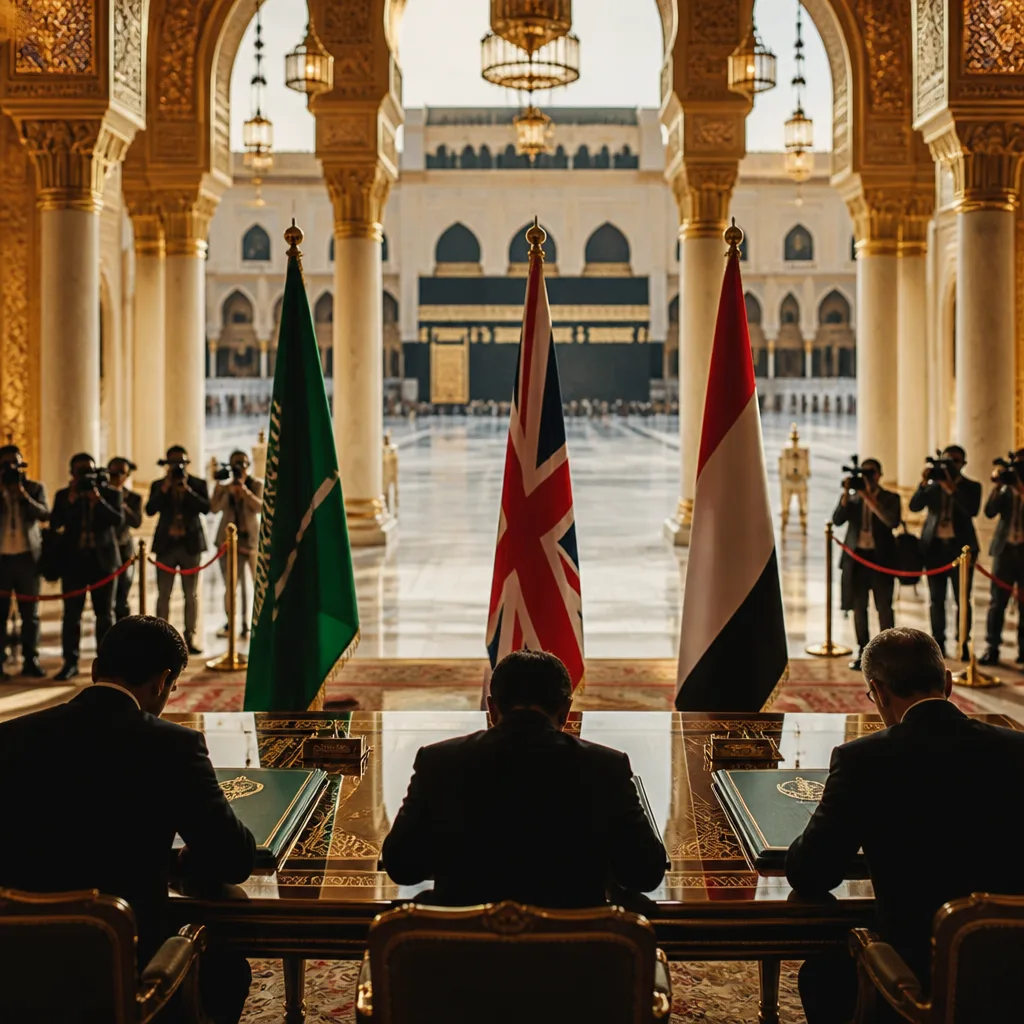
The agreement, described by officials as the Makkah Joint Defence Agreement, was unveiled after the leaders of the three countries — the crown prince of Saudi Arabia, the president of Türkiye and Pakistan’s prime minister — signed documents at al-Safa Palace. Photographs released by the parties showed the three men holding folders bearing the freshly signed text.
The pact expands a bilateral understanding between Saudi Arabia and Pakistan reached last year and brings Türkiye into a collective defence framework that its backers say is designed to strengthen deterrence.
Official lines and reassurance
Signatories were at pains to present the deal as defensive and non‑provocative. Pakistan’s prime minister characterised the arrangement as a “shield of peace” for the region, while Türkiye’s president insisted the pact was not aimed at any specific country and remained open to additional participants.
“[This pact] does not target any country,” the Turkish president said, adding it was “open to the participation of all brotherly countries seeking peace, prosperity and stability.”
Saudi officials likewise emphasised that the agreement posed no threat to regional security and would not be allowed to damage Riyadh’s ties with other partners, including the United States and neighbouring Gulf states.
Context and timing
The accord was concluded more than five months into a wider conflict between the United States, Israel and Iran that has generated missile and drone strikes against Gulf energy exporters and disrupted traffic through the Strait of Hormuz. The pact does not name a particular threat, but it arrives against that backdrop of heightened regional tensions.
Analysts say the value of such a pact may lie less in a fixed catalogue of obligations and more in signalling and deterrence. One security and foreign policy analyst quoted by the parties suggested the agreement’s primary effect is to introduce uncertainty for potential adversaries and to bolster collective deterrence rather than to replicate the formal, codified commitments typical of Western alliances.
Military dimensions and interoperability
Officials have framed the deal as practical as well as political. Türkiye’s modern defence industry and NATO-standard armed forces are now part of the arrangement alongside Saudi and Pakistani military capabilities. The accord therefore touches both defence procurement and interoperability, although the text made public does not specify operational arrangements or command structures.
Observers will now watch closely for follow‑up measures, including joint exercises, intelligence sharing and rules of engagement that would convert political pledges into operational realities.
- Participants: Saudi Arabia, Türkiye and Pakistan.
- Nature of commitment: An attack on one is treated as an attack on all.
- Stated purpose: Strengthen deterrence and provide a regional “shield of peace”, according to signatories.
Implications for regional order
While the pact has been presented as defensive, its formation is likely to affect regional calculations. It broadens a prior bilateral Saudi–Pakistani understanding and introduces a NATO‑trained military actor into closer security coordination with Riyadh and Islamabad. That could alter deterrence dynamics in the Gulf and beyond.
Allies and rivals will assess how the agreement intersects with existing security arrangements, including the United States’ relationships in the region. Saudi officials have been explicit that partnership with other states, including Washington, will continue.
The effectiveness of the pact will depend on the details that follow: the speed at which practical mechanisms are agreed, the degree of interoperability established, and whether the arrangement remains limited to deterrence or evolves into a more formalised security bloc.
| Country | Role emphasised |
|---|---|
| Saudi Arabia | Initiator and regional hub |
| Türkiye | Defence industry and NATO‑standard forces |
| Pakistan | Earlier bilateral partner with Saudi Arabia |
The pact marks a notable development in Middle Eastern and South Asian diplomacy. Whether it will prove primarily symbolic or become the basis for tangible collective action will depend on the next steps the three capitals take and how other regional and global powers respond.