
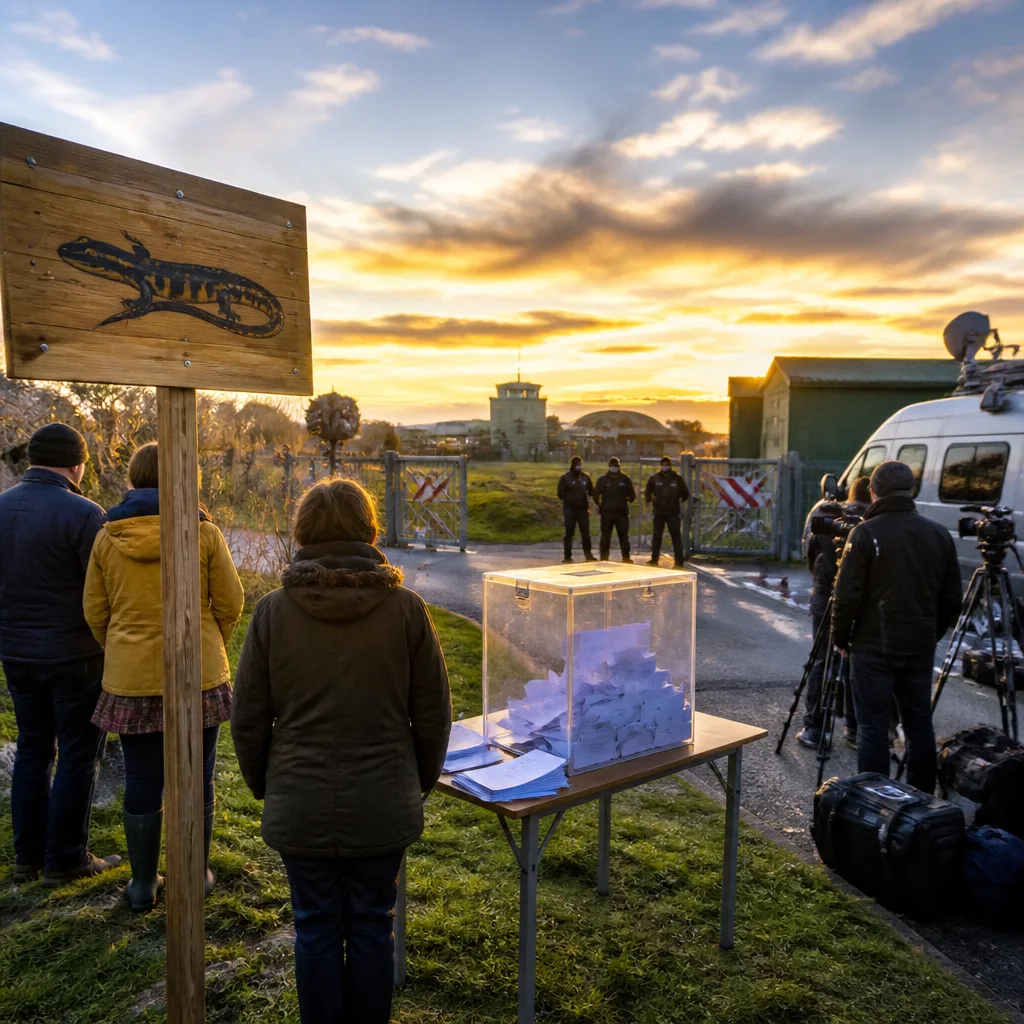
The Oxfordshire village of Piddington has announced it will pursue “self-determination” after a parish ballot on plans to convert a nearby former military base into housing for asylum seekers. The vote — described locally as a protest — has attracted international attention and raised fresh questions about how communities respond to national migration policies.
Local vote, national implications
On Wednesday parish councillors published the result of a symbolic ballot in which villagers voted to “secede from the UK and pursue self-determination” by a margin of 285 to 26. The ballot involved 358 villagers and came after proposals to open a centre for 1,250 asylum seekers on adjacent land.
| Ballot detail | Number |
|---|---|
| Total participants | 358 |
| Votes to secede | 285 |
| Votes against | 26 |
The choice of national symbol — the newt, an endangered amphibian — was announced on Thursday and was presented as a means to buttress opposition to the accommodation plans, with councillors hoping the animal’s protected status might influence decisions about local land use.
Outside figures and growing unease
The vote has not simply been a local curiosity. Journalists from Japan, Norway and Ireland were reported as arriving in the village, underlining the unusual optics of a small parish proclaiming a new principality. Visitors and some residents described a mix of festive eccentricity — bunting and placards — alongside serious concern about safety and rhetoric.
Adding to tensions, Daniel Thomas, known publicly as Danny Tommo, leader of the balaclava-wearing anti-migrant group Patriot Platform, arrived in the village offering the support of his masked followers should the asylum centre open. He was reported as saying they would rally "
to protect women and children" if required.
Not all residents welcomed the high-profile attention. One long-term resident, who has lived in Piddington for 20 years, said she had suffered "violent threats online from a lot of very toxic keyboard warriors. I’ve never encountered anything like this before." The account, broadcast on Newsnight, illustrates the personal toll the dispute is taking on individuals in the community.
- Symbolic vote: Parish ballot was framed as protest against asylum housing plans.
- External mobilisation: Arrival of an anti-migrant leader offering masked supporters.
- Media interest: International journalists visiting the village highlighted the story’s wider resonance.
Councillors have also been discussing other trappings of a self-styled principality, including commissioning a flag designed by local children and debating whether cricket or football should be the national sport — details that have contributed to a surreal, almost theatrical public image for what residents describe as a serious objection to central government decisions on asylum accommodation.
What this signifies
While the ballot carries no legal force, it is a sharp demonstration of local resistance to national policy on asylum seekers. The use of protected-species rhetoric and the involvement of high-profile activist groups signal a shift in how some communities are choosing to register dissent — blending symbolic acts, media-savvy stunts and, in some cases, the threat of direct mobilisation.
For policymakers, the episode underlines the need to manage infrastructure decisions affecting small communities with clear communication and careful local engagement. For national audiences, it is a reminder that migration policy debates play out not only in Westminster but on parish noticeboards and village greens, sometimes attracting actors and attention that escalate tensions beyond their origins.
The future of the planned asylum housing near Piddington remains unclear. What is already evident is that a local protest, amplified by symbolic gestures and outside agitators, can rapidly become a national story — testing the limits of tolerance, the responsibilities of public figures, and the capacity of small communities to absorb the pressures of contemporary political disputes.









