
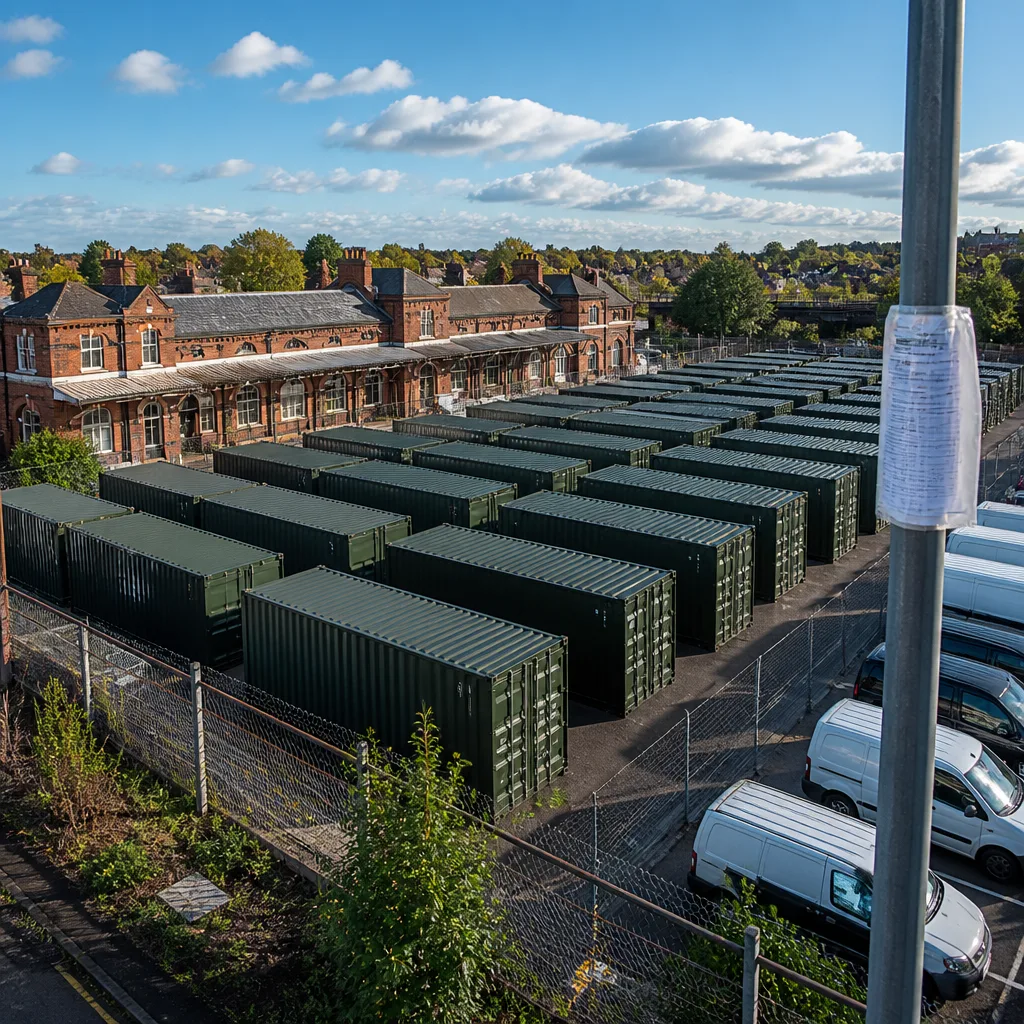
A self‑storage operation built from shipping containers on the former railway goods yard at Windhill, Shipley, has applied retrospectively for planning permission after operating without consent since it opened in September 2023.
The site comprises 60 containers, the applicant says they are fully let to businesses and individuals, and a retrospective application to retain the storage use was recently submitted to Bradford Council, with a decision expected in October.
What the application says
In the planning submission the operator argues the development makes efficient use of existing hardstanding and did not require significant building work. The application adds the Dock Lane access has functioned throughout the period of occupation "without giving rise to known highway safety concerns" and describes the business as having "established itself as a successful local storage provider" with all units occupied.
"The business has established itself as a successful local storage provider, with all 60 units currently occupied, demonstrating clear demand for this type of facility within the local area."
Heritage and local planning context
The containers sit adjacent to the former Windhill railway station, a Victorian building with a long transport history: freight services began on the line in May 1874 and the station opened to passengers in January 1875. Passenger services on the line ceased in 1931, though goods traffic continued until the 1960s.
The station itself was the subject of a separate planning approval in 2021 when a scheme to convert the Victorian building into flats was granted consent, although the building remains in commercial use.
Why this matters for business and local policy
There are a number of intersecting issues in play for councillors weighing the retrospective application:
- Brownfield use: The operator emphasises reuse of former goods yard hardstanding rather than greenfield development.
- Local demand and economy: Full occupancy is cited as proof of demand for storage space, which can be an indicator of pressure on housing, business storage needs or changing retail patterns.
- Heritage and conversion plans: The proximity to a Victorian station where residential conversion has already been approved raises questions about long‑term planning objectives for the site.
- Highway and amenity impact: The applicant contends access arrangements have not given rise to safety concerns; that assertion will be tested by council officers and any representations from neighbours or highways authorities.
Each of those factors ties back to jobs, prices and the local property market: if the council permits the storage use permanently, land that might otherwise have been redeveloped for housing or commercial premises will remain in low‑value storage use; if the council enforces removal, short‑term disruption and potential costs fall on the operator and occupiers.
Facts at a glance
| Fact | Detail |
|---|---|
| Number of containers | 60 |
| Opened | September 2023 |
| Decision expected | October |
| Station opened to freight | May 1874 |
| Station opened to passengers | January 1875 |
| Passenger services ceased | 1931 |
| Goods traffic continued until | 1960s |
| Station conversion approval | 2021 |
Local planning authorities must balance short‑term economic activity against strategic objectives for housing and heritage preservation. A retrospective application puts that tension into sharp relief: it seeks to regularise a use that has demonstrably met local demand, while potentially foreclosing alternative, higher‑value redevelopment that could deliver homes or jobs.
Councillors will also consider precedent. Granting permission could encourage similar unauthorised conversions of brownfield sites into containerized storage, shifting the local property market dynamics. Conversely, a refusal or enforcement could leave a fully occupied enterprise without a viable business, with consequences for small businesses and individuals who rely on affordable storage.
The council’s forthcoming decision will therefore be watched not just in Shipley but by planners and property owners elsewhere as a test of how local authorities steer the reuse of former industrial land in the face of changing demand.














