
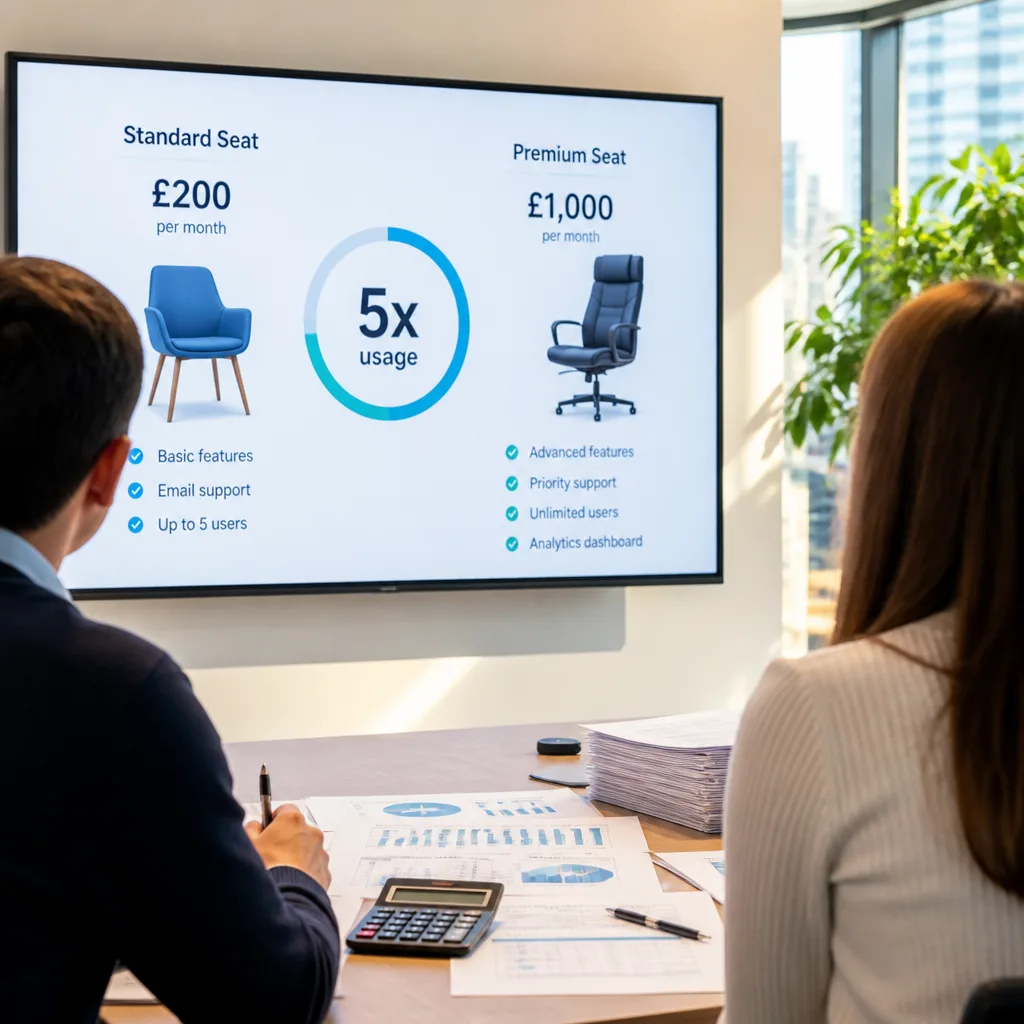
OpenAI has introduced a new Premium seat for its ChatGPT Business product, offering firms a higher‑usage tier designed for heavy users within the same workspace. The move, announced by the company, gives Premium seats five times the usage allowance of Standard seats and drops the five‑hour limit that applied to the lower tier.
What companies will pay and what they get
Under the revised pricing structure, the Premium seat is priced at USD $125 per user per month on a monthly plan, or USD $100 per user if billed annually. Standard seats remain available at USD $25 per user per month, or USD $20 on an annual commitment. Businesses can mix seat types in a single ChatGPT Business workspace, allowing organisations to allocate higher capacity to staff who need it while keeping lower‑cost seats for lighter users.
| Seat type | Monthly price | Annual price (per month equiv.) | Usage |
|---|---|---|---|
| Premium | USD $125 | USD $100 | 5× Standard; weekly reset; no five‑hour cap |
| Standard | USD $25 | USD $20 | Lower tier with previous five‑hour constraint |
Administration and operational controls
Workspace owners and administrators will be able to upgrade or reassign seat types, track usage across the organisation and set billing or spend limits from a central control point. OpenAI is also offering shared workspace credits that can be allocated to teams whose members exceed individual caps, with usage quotas resetting on a weekly basis under the Premium model.
- The new Premium option targets staff who rely heavily on generative AI for day‑to‑day tasks.
- Organisations can maintain a single business environment rather than splitting work across multiple accounts.
- OpenAI says the change addresses demand from customers requiring greater capacity within teams.
How firms are using ChatGPT — and why this matters for costs and jobs
OpenAI highlights a broad set of applications being used by teams, including inventory planning, marketing, business analysis, customer support and product development. For businesses, that breadth matters: increased AI reliance can reduce time spent on routine tasks, but it also shifts where labour is required and how salaries are justified.
Higher‑usage seats may concentrate power in the hands of data analysts, product developers and marketing staff who can extract more value from large prompts or longer code completions. That could increase their individual productivity — and, in time, place pressure on employers to reflect that productivity in remuneration or to reorganise roles so that heavy users handle more value‑generating work.
From a cost perspective, the Premium pricing is a clear recognition that companies are willing to pay substantially more to avoid administrative friction and keep work within one managed environment. But firms will need to weigh the direct subscription costs against the gains in time saved and potential reductions in external vendor spend.
Early adopter incentives and rollout
To encourage uptake, OpenAI is offering credits to early eligible customers: the first 10,000 qualifying ChatGPT Business customers can receive USD $100 in workspace credits — equivalent to 2,500 credits — for each Premium seat added, up to five seats. Some early sign‑ups may be given access ahead of a wider release.
The company says the new structure enables teams with differing usage patterns to stay under a single subscription instead of operating separate accounts, which it argues will reduce administrative friction and help keep corporate data within the same controlled environment.
Questions for corporate buyers
Companies considering Premium seats should assess three practical points before upgrading:
- Which roles genuinely require five‑times the capacity, and can usage be pooled through shared credits?
- How will additional spend be justified against measurable gains in productivity or reduced outsourcing?
- What governance will be put in place to monitor sensitive data and control escalating costs?
The introduction of Premium seats is a logical step as firms embed generative AI into core workflows. For UK businesses, the decision will be a calibration between higher licence fees and potentially significant time savings — a calculation that will affect near‑term budgets and, if widespread, could influence how jobs and pay are structured around AI‑enabled productivity.